Kersten Paula, Vandal Alain C, Elder Hinemoa, McPherson Kathryn M
School of Health Sciences, University of Brighton, Brighton, UK.
Department of Biostatistics and Epidemiology, AUT University, Auckland, New Zealand.
BMJ Open. 2018 Apr 21;8(4):e021551. doi: 10.1136/bmjopen-2018-021551.
This observational study examines the internal construct validity, internal consistency and cross-informant reliability of the Strengths and Difficulties Questionnaire (SDQ) in a New Zealand preschool population across four ethnicity strata (New Zealand European, Māori, Pasifika, Asian).
Rasch analysis was employed to examine internal validity on a subsample of 1000 children. Internal consistency (n=29 075) and cross-informant reliability (n=17 006) were examined using correlations, intraclass correlation coefficients and Cronbach's alpha on the sample available for such analyses.
Data were used from a national SDQ database provided by the funder, pertaining to New Zealand domiciled children aged 4 and 5 and scored by their parents and teachers.
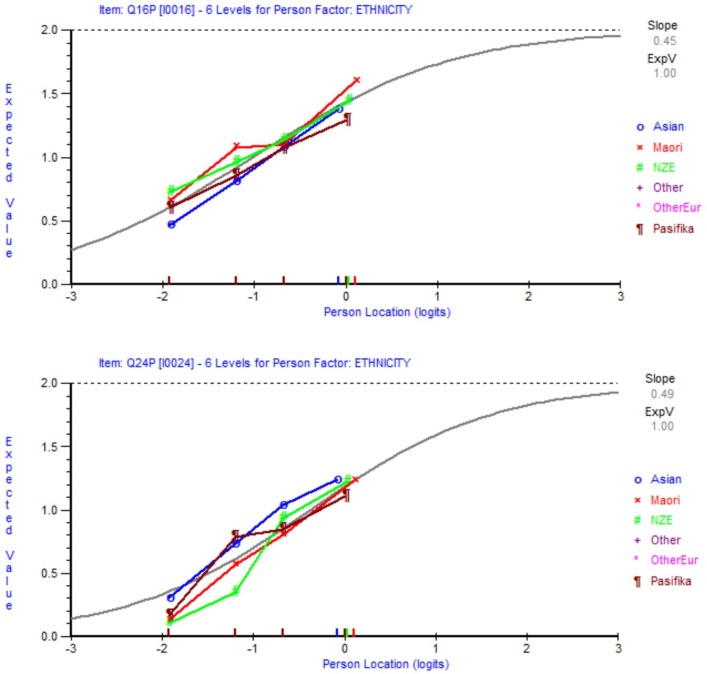
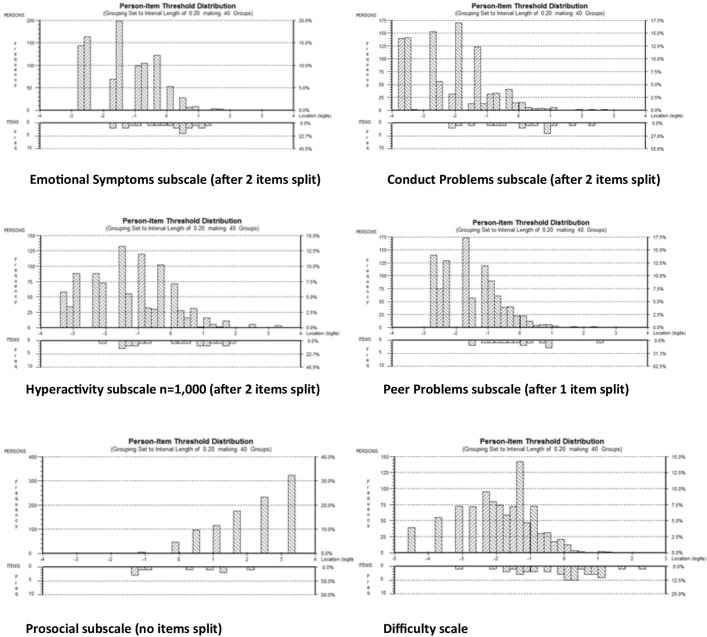
The five subscales do not fit the Rasch model (as indicated by the overall fit statistics), contain items that are biased (differential item functioning (DIF)) by key variables, suffer from a floor and ceiling effect and have unacceptable internal consistency. After dealing with DIF, the Total Difficulty scale does fit the Rasch model and has good internal consistency. Parent/teacher inter-rater reliability was unacceptably low for all subscales.
The five SDQ subscales are not valid and not suitable for use in their own right in New Zealand. We have provided a conversion table for the Total Difficulty scale, which takes account of bias by ethnic group. Clinicians should use this conversion table in order to reconcile DIF by culture in final scores. It is advisable to use both parents and teachers' feedback when considering children's needs for referral of further assessment. Future work should examine whether validity is impacted by different language versions used in the same country.
本观察性研究考察了优势与困难问卷(SDQ)在新西兰四个种族阶层(新西兰欧洲裔、毛利族、太平洋岛民、亚裔)的学龄前儿童群体中的内部结构效度、内部一致性和多源信息可靠性。
采用拉施分析对1000名儿童的子样本进行内部效度检验。使用相关性、组内相关系数和克朗巴哈系数对可用于此类分析的样本进行内部一致性(n = 29075)和多源信息可靠性(n = 17006)检验。
数据来自资助者提供的全国SDQ数据库,涉及居住在新西兰的4岁和5岁儿童,由其父母和教师评分。
五个分量表不符合拉施模型(由整体拟合统计量表明),包含受关键变量影响有偏差的项目(项目功能差异(DIF)),存在地板效应和天花板效应,且内部一致性不可接受。处理DIF后,总困难量表符合拉施模型且具有良好的内部一致性。所有分量表的家长/教师评分者间信度均低至不可接受。
SDQ的五个分量表无效,不适用于新西兰的儿童自评。我们提供了总困难量表的转换表,该表考虑了种族群体的偏差。临床医生应使用此转换表来协调最终分数中的文化差异。在考虑儿童是否需要转介进一步评估时,建议同时使用家长和教师的反馈。未来的工作应研究同一国家使用的不同语言版本是否会影响效度。