MRC Centre for Neuropsychiatric Genetics and Genomics, Division of Psychological Medicine & Clinical Neurosciences, Cardiff University School of Medicine, Cardiff, UK.
Population Health Sciences, University of Bristol, Bristol, UK.
J Child Psychol Psychiatry. 2018 Oct;59(10):1105-1113. doi: 10.1111/jcpp.12911. Epub 2018 Apr 23.
Adult ADHD has been assumed to be a continuation of childhood-onset ADHD. However, recent studies have identified individuals with ADHD in adulthood who have not had ADHD in childhood. Whether or not these individuals have a 'typical' neurodevelopmental profile is not clear.
We tested two explanations for the emergence of apparent late-onset ADHD symptomatology using the ALSPAC epidemiological cohort, by grouping individuals according to their scores on the Strengths and Difficulties Questionnaire (SDQ) hyperactivity subscale at ages 12 and 17 years. First, we tested whether some of those with apparent late-onset ADHD symptoms had been potentially misclassified on the basis of earlier SDQ hyperactivity scores (ages 7, 8 and 9 years) or of subthreshold symptoms at age 12 years. Second, we investigated the possibility that those with 'genuine' late-onset ADHD symptoms had a delayed manifestation of the same liability that underlies childhood-onset symptoms, by investigating whether they had a similar profile of neurodevelopmental impairments (in the domains of autistic symptomatology, language, reading, spelling, executive functioning and IQ) as those with typical childhood-onset ADHD.
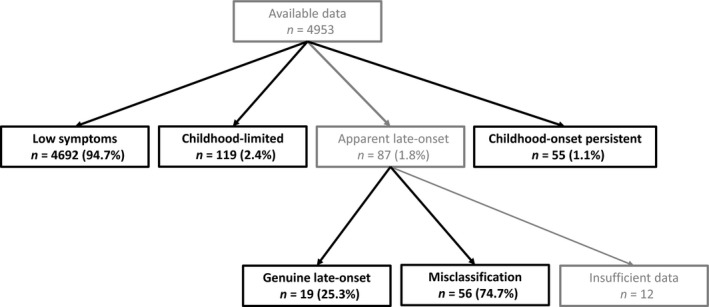
N = 56/75 (75%) of those with apparent late-onset ADHD had had high ADHD scores at least one point in childhood, suggesting that they may have been misclassified on the basis of their score at age 12 years. The remaining 19 individuals (25%) with genuine late-onset ADHD symptoms did not show a profile of neurodevelopmental impairment typically seen in ADHD, instead showing similar levels of autistic symptoms, language skills, executive functioning ability and IQ to those without ADHD symptoms. The only exceptions were that this group showed reading and spelling problems at age 9 years.
Our work suggests that this small number of individuals with genuine late-onset symptoms may not be most appropriately considered as having a typical neurodevelopmental disorder.
成人 ADHD 被认为是儿童期 ADHD 的延续。然而,最近的研究已经确定了一些成年 ADHD 患者在儿童期没有 ADHD。这些个体是否具有“典型”的神经发育特征尚不清楚。
我们使用 ALSPAC 流行病学队列,根据个体在 12 岁和 17 岁时的 SDQ 多动子量表得分,将个体分为两组,以此来检验两种解释,即出现明显的晚发性 ADHD 症状的原因。首先,我们测试了那些具有明显晚发性 ADHD 症状的个体是否基于早期 SDQ 多动得分(7、8 和 9 岁)或 12 岁时的亚阈值症状被错误分类。其次,我们通过调查那些具有“真正”晚发性 ADHD 症状的个体是否具有导致儿童期症状的同一易感性的延迟表现,来调查他们是否具有类似的神经发育障碍(在自闭症症状、语言、阅读、拼写、执行功能和 IQ 等领域)特征,以研究他们是否具有与典型儿童期 ADHD 相同的特征。
在具有明显晚发性 ADHD 的个体中,有 56/75(75%)的个体在儿童时期至少有一次 ADHD 高分,这表明他们可能基于 12 岁时的得分而被错误分类。剩下的 19 名(25%)具有真正晚发性 ADHD 症状的个体没有表现出通常在 ADHD 中看到的神经发育障碍特征,而是与没有 ADHD 症状的个体表现出相似的自闭症症状、语言技能、执行功能能力和 IQ。唯一的例外是他们在 9 岁时表现出阅读和拼写问题。
我们的工作表明,这些极少数具有真正晚发性症状的个体可能不太适合被认为具有典型的神经发育障碍。