Department of Respiratory Medicine, The Second Hospital, Dalian Medical University, Dalian, China.
Department of Radiotherapy, The Second Hospital, Dalian Medical University, Dalian, China.
Sci Rep. 2018 Apr 23;8(1):6394. doi: 10.1038/s41598-018-24748-7.
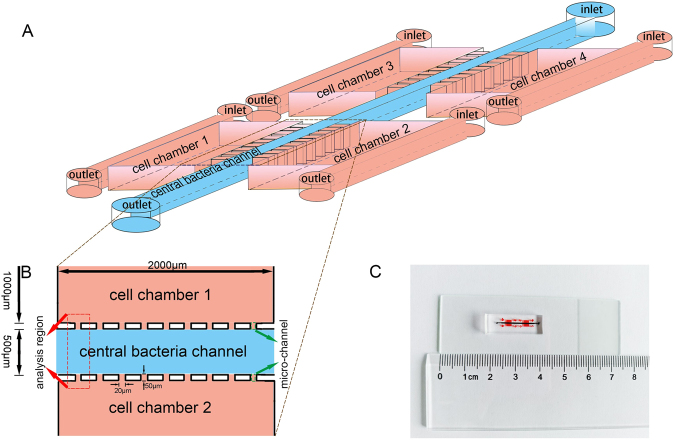
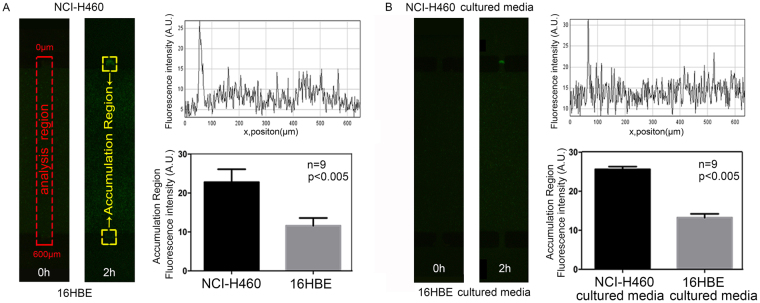
Bacterial cancer targeting may become an efficacious cancer therapy, but the mechanisms underlying bacterial specificity for cancer cells need to be explored prior to adopting it as a new clinical application. To characterize the mechanism of bacterial chemotactic preference towards cancer cells, we developed a microfluidic device for in vitro study. The device consists of a cell culture chamber on both sides of a central bacteria channel, with micro-channels used as barriers between them. The device, when used as model for lung cancer, was able to provide simultaneous three-dimensional co-culture of multiple cell lines in separate culture chambers, and when used as model for bacterial chemotaxis, established constant concentration gradients of biochemical compounds in a central channel by diffusion through micro-channels. Fluorescence intensity of green fluorescence protein (GFP)-encoding bacteria was used to measure bacterial taxis behavior due to established chemotactic gradients. Using this platform, we found that Escherichia coli (E. coli) clearly illustrated the preference for lung cancer cells (NCI-H460) which was attributed to biochemical factors secreted by carcinoma cells. Furthermore, by secretome analysis and validation experiments, clusterin (CLU) was found as a key regulator for the chemotaxis of E. coli in targeting lung cancer.
细菌靶向癌症可能成为一种有效的癌症治疗方法,但在将其作为一种新的临床应用之前,需要探索细菌对癌细胞特异性的机制。为了研究细菌对癌细胞趋化性的机制,我们开发了一种用于体外研究的微流控装置。该装置由中央细菌通道两侧的细胞培养室组成,微通道用作它们之间的屏障。当该装置作为肺癌模型使用时,能够在单独的培养室内同时对多种细胞系进行三维共培养,而当作为细菌趋化性模型使用时,通过微通道扩散在中央通道内建立生化化合物的恒定浓度梯度。绿色荧光蛋白 (GFP) 编码细菌的荧光强度用于测量由于建立的趋化梯度而产生的细菌趋性行为。使用该平台,我们发现大肠杆菌 (E. coli) 明显表现出对肺癌细胞 (NCI-H460) 的偏好,这归因于癌细胞分泌的生化因素。此外,通过分泌组分析和验证实验,发现簇蛋白 (CLU) 是大肠杆菌靶向肺癌趋化的关键调节剂。