The Johns Hopkins University, School of Nursing, Baltimore, Maryland, United States of America.
Center for Cardiovascular and Chronic Care, The Johns Hopkins University, Baltimore, Maryland, United States of America.
PLoS One. 2018 Apr 24;13(4):e0194928. doi: 10.1371/journal.pone.0194928. eCollection 2018.
Community health worker (CHW) interventions are a successful strategy to promote health among HIV-negative and persons living with HIV (PLWH). Psychosocial factors are critical dimensions of HIV/AIDS care contributing to prognosis of the disease, yet it is unclear how CHW interventions improve psychosocial outcomes in PLWH. The purpose of this study was to critically appraise the types, scope, and nature of CHW interventions designed to address psychosocial outcomes in PLWH.
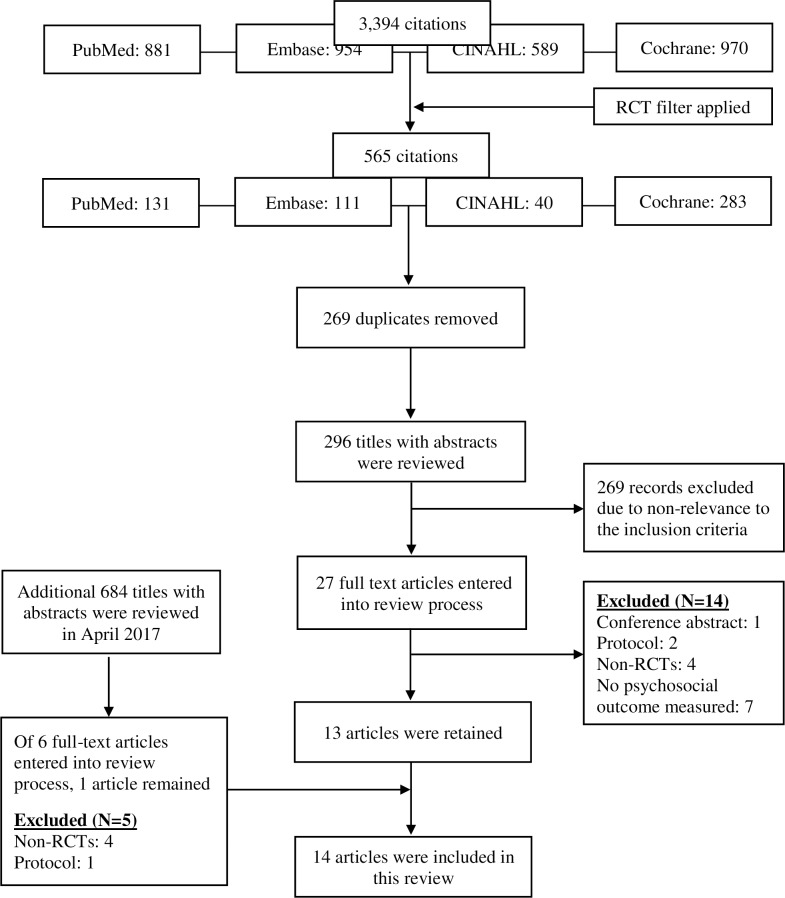
We performed database searches-PubMed, EMBASE, CINAHL, and Cochrane-to identify randomized controlled trials published in English before April 2017. Fourteen articles met the eligibility criteria.
Half of the studies were conducted in the United States. Social cognitive theory was used more than once in nine theory-guided studies. CHW interventions were largely focused on reducing depression (n = 6) or stigma related to HIV (n = 4), or promoting quality of life (n = 4), social support (n = 4), and self-efficacy (n = 4). Didactic methods and role-playing were used to train CHWs. CHWs played multiple roles in delivering intervention, including a counselor and a supporter (n = 10), educator (n = 5), or a navigator (n = 3). CHW intervention fidelity was assessed in 4 studies. Five studies found positive changes in six psychosocial outcomes including quality of life (2 of 4) and self-efficacy (2 of 4). CHW interventions had no effect on social support in 2 of 4 studies, and stigma in 3 of 4 studies. None of the CHW interventions were successful in reducing depressive symptoms among PLWH.
Evidence partially supported the use of CHWs in promoting psychosocial outcomes in PLWH. Future CHW intervention should be expanded in scope to address key psychosocial determinants of HIV/AIDS outcomes such as health literacy. Further, fidelity measures should be incorporated into intervention delivery.
社区卫生工作者(CHW)干预措施是促进 HIV 阴性和 HIV 感染者(PLWH)健康的成功策略。社会心理因素是 HIV/AIDS 护理的关键维度,有助于预测疾病的预后,但尚不清楚 CHW 干预措施如何改善 PLWH 的社会心理结局。本研究的目的是批判性地评估旨在解决 PLWH 社会心理结局的 CHW 干预措施的类型、范围和性质。
我们对 PubMed、EMBASE、CINAHL 和 Cochrane 数据库进行了检索,以确定 2017 年 4 月前发表的英文随机对照试验。有 14 篇文章符合入选标准。
一半的研究在美国进行。有 9 项基于理论的研究不止一次使用社会认知理论。CHW 干预措施主要集中在降低抑郁(n = 6)或与 HIV 相关的耻辱感(n = 4),或提高生活质量(n = 4)、社会支持(n = 4)和自我效能感(n = 4)。使用说教方法和角色扮演来培训 CHW。CHW 在提供干预措施方面扮演了多种角色,包括顾问和支持者(n = 10)、教育者(n = 5)或导航员(n = 3)。有 4 项研究评估了 CHW 干预的一致性。有 5 项研究发现 6 项社会心理结局(包括生活质量[4 项中的 2 项]和自我效能感[4 项中的 2 项])发生了积极变化。有 2 项研究中 CHW 干预对社会支持没有影响,4 项研究中对耻辱感没有影响。CHW 干预措施均未成功降低 PLWH 的抑郁症状。
部分证据支持在 PLWH 中使用 CHW 来促进社会心理结局。未来的 CHW 干预措施应扩大范围,以解决影响 HIV/AIDS 结局的关键社会心理决定因素,如健康素养。此外,应将一致性措施纳入干预措施的实施中。