Department of Gastrointestinal Surgery, Zhongshan Hospital of Xiamen University, Xiamen, Fujian, China.
Institute of Gastrointestinal Oncology, Medical College of Xiamen University, Xiamen, Fujian, China.
Mol Cancer. 2018 Apr 24;17(1):84. doi: 10.1186/s12943-018-0834-9.
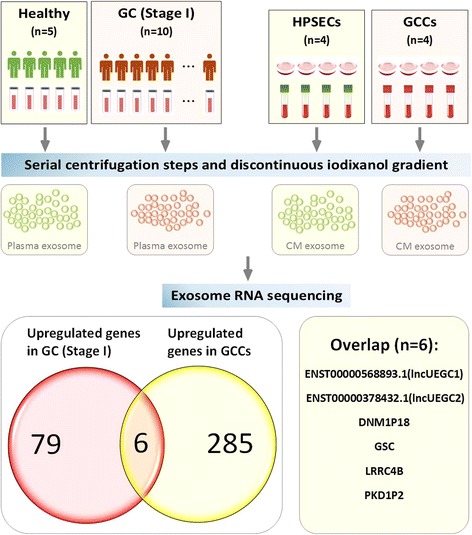
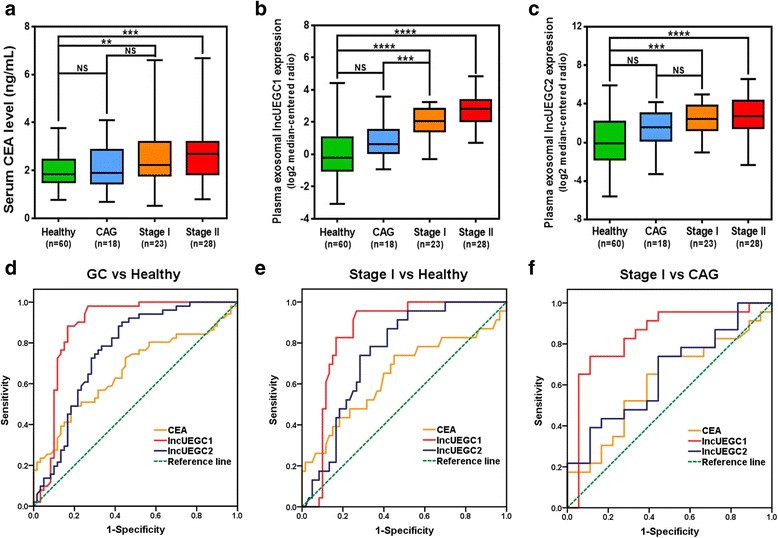
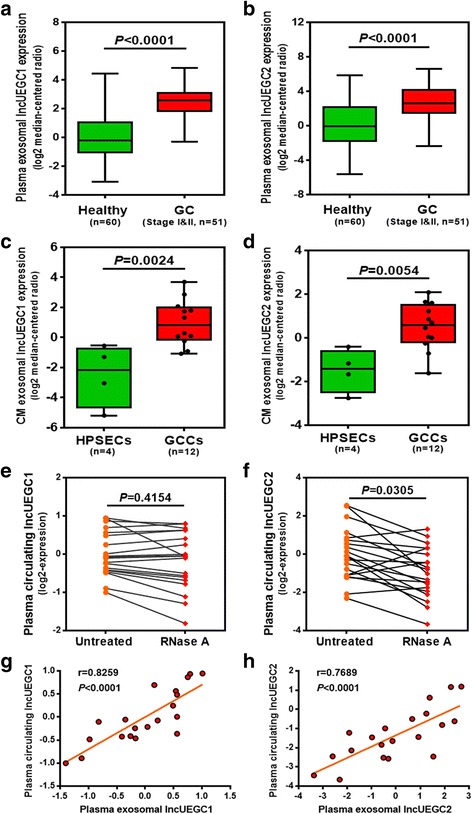
Conventional tumor markers for non-invasive diagnosis of gastric cancer (GC) exhibit insufficient sensitivity and specificity to facilitate detection of early gastric cancer (EGC). We aimed to identify EGC-specific exosomal lncRNA biomarkers that are highly sensitive and stable for the non-invasive diagnosis of EGC. Hence, in the present study, exosomes from the plasma of five healthy individuals and ten stage I GC patients and from culture media of four human primary stomach epithelial cells and four gastric cancer cells (GCCs) were isolated. Exosomal RNA profiling was performed using RNA sequencing to identify EGC-specific exosomal lncRNAs. A total of 79 and 285 exosomal RNAs were expressed at significantly higher levels in stage I GC patients and GCCs, respectively, than that in normal controls. Through combinational analysis of the RNA sequencing results, we found two EGC-specific exosomal lncRNAs, lncUEGC1 and lncUEGC2, which were further confirmed to be remarkably up-regulated in exosomes derived from EGC patients and GCCs. Furthermore, stability testing demonstrates that almost all the plasma lncUEGC1 was encapsulated within exosomes and thus protected from RNase degradation. The diagnostic accuracy of exosomal lncUEGC1 was evaluated, and lncUEGC1 exhibited AUC values of 0.8760 and 0.8406 in discriminating EGC patients from healthy individuals and those with premalignant chronic atrophic gastritis, respectively, which was higher than the diagnostic accuracy of carcinoembryonic antigen. Consequently, exosomal lncUEGC1 may be promising in the development of highly sensitive, stable, and non-invasive biomarkers for EGC diagnosis.
传统的用于非侵入性诊断胃癌(GC)的肿瘤标志物在敏感性和特异性方面均不足,难以检测早期胃癌(EGC)。我们旨在确定高度敏感且稳定的用于 EGC 非侵入性诊断的 EGC 特异性外泌体 lncRNA 生物标志物。因此,在本研究中,从五名健康个体和十名 I 期 GC 患者的血浆以及从四个人类原代胃上皮细胞和四个人胃癌细胞(GCCs)的培养基中分离出外泌体。使用 RNA 测序进行外泌体 RNA 谱分析,以鉴定 EGC 特异性外泌体 lncRNA。与正常对照组相比,I 期 GC 患者和 GCCs 中分别有 79 和 285 个外泌体 RNA 表达水平显著升高。通过对 RNA 测序结果进行组合分析,我们发现了两种 EGC 特异性外泌体 lncRNA,lncUEGC1 和 lncUEGC2,它们在 EGC 患者和 GCCs 的外泌体中进一步证实明显上调。此外,稳定性测试表明,几乎所有来自 EGC 患者和 GCCs 的外泌体中的 lncUEGC1 都被包裹在内,从而免受 RNase 降解的影响。评估了外泌体 lncUEGC1 的诊断准确性,lncUEGC1 在区分 EGC 患者与健康个体和患有癌前慢性萎缩性胃炎的个体方面的 AUC 值分别为 0.8760 和 0.8406,高于癌胚抗原的诊断准确性。因此,外泌体 lncUEGC1 可能有望开发出用于 EGC 诊断的高灵敏度,稳定且非侵入性的生物标志物。