Hémonic Anne, Chauvin Claire, Delzescaux Didier, Verliat Fabien, Corrégé Isabelle
1IFIP-Institut du porc, Domaine de la Motte au Vicomte, 35104, 35651 Le Rheu, BP France.
Anses Laboratoire de Ploufragan-Plouzané, 53, 22440 Ploufragan, BP France.
Porcine Health Manag. 2018 Apr 17;4:8. doi: 10.1186/s40813-018-0084-7. eCollection 2018.
There has been a strong implication of both the French swine industry and the national authorities on reducing the use of antimicrobials in swine production since 2010. The annual monitoring of antimicrobial sales by the French Veterinary Medicines Agency (Anses-ANMV) provides estimates but not detailed figures on actual on-farm usage of antimicrobials in swine production.
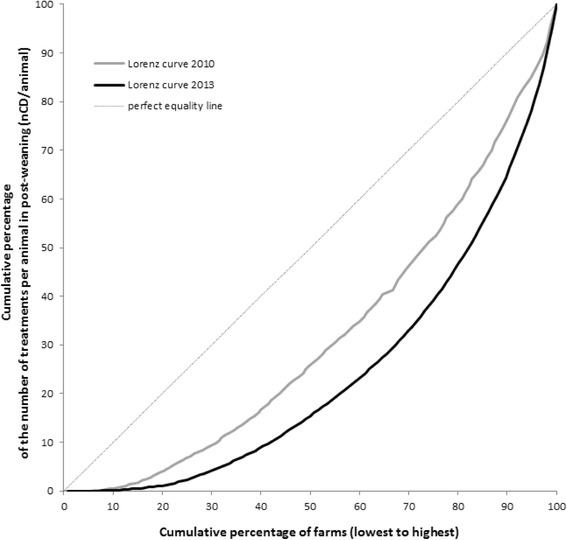
In order to provide detailed information on the 2010 and 2013 antimicrobial use in the French swine industry, the methodology of cross-sectional retrospective study on a representative sample of at least 150 farms has been elected. The analysis of the collected data shows a strong and significant decrease in antimicrobial exposure of pigs between 2010 and 2013. Over three years, the average number of days of treatment significantly decreased by 29% in suckling piglets and by 19% in weaned piglets. In fattening pigs, the drop (- 29%) was not statistically significant. Only usage in sows did increase over that period (+ 17%, non-significant), which might be associated with the transition to group-housing of pregnant sows that took place at the time. Also, over that period, the use of third- and fourth generation cephalosporins in suckling piglets decreased by 89%, and by 82% in sows, which confirms that the voluntary moratorium on these classes of antimicrobials decided at the end of 2010 has been effectively implemented.
The methodology of random sampling of farms appears as a precise and robust tool to monitor antimicrobial use within a production animal species, able to fulfil industry and national authorities' objectives and requirements to assess the outcome of concerted efforts on antimicrobial use reduction. It demonstrates that the use of antimicrobials decreased in the French swine industry between 2010 and 2013, including the classes considered as critical for human medicine.
自2010年以来,法国养猪业和国家当局一直大力推动减少养猪生产中抗菌药物的使用。法国兽药局(Anses - ANMV)对抗菌药物销售的年度监测提供了估计数据,但没有关于养猪生产中实际农场使用抗菌药物的详细数字。
为了提供2010年和2013年法国养猪业抗菌药物使用的详细信息,选择了对至少150个农场的代表性样本进行横断面回顾性研究的方法。对收集数据的分析表明,2010年至2013年期间猪的抗菌药物暴露量大幅显著下降。在三年时间里,哺乳仔猪的平均治疗天数显著下降了29%,断奶仔猪下降了19%。育肥猪的降幅(-29%)无统计学意义。在此期间,只有母猪的用药量有所增加(+17%,无统计学意义),这可能与当时怀孕母猪向群体饲养方式的转变有关。此外,在此期间,哺乳仔猪中第三代和第四代头孢菌素的使用量下降了89%,母猪中下降了82%,这证实了2010年底决定的这些类别的抗菌药物自愿暂停使用已得到有效实施。
农场随机抽样方法似乎是监测生产动物物种内抗菌药物使用的精确而有力的工具,能够实现行业和国家当局评估减少抗菌药物使用协同努力成果的目标和要求。它表明,2010年至2013年期间法国养猪业抗菌药物的使用有所减少,包括对人类医学至关重要的类别。