Organismal Evolutionary Biology Research Program, Faculty of Biology and Environmental Sciences, Viikki Plant Science Centre, University of Helsinki, Helsinki, Finland.
Finnish Museum of Natural History (Botany), University of Helsinki, Helsinki, Finland.
PLoS One. 2018 Apr 25;13(4):e0196069. doi: 10.1371/journal.pone.0196069. eCollection 2018.
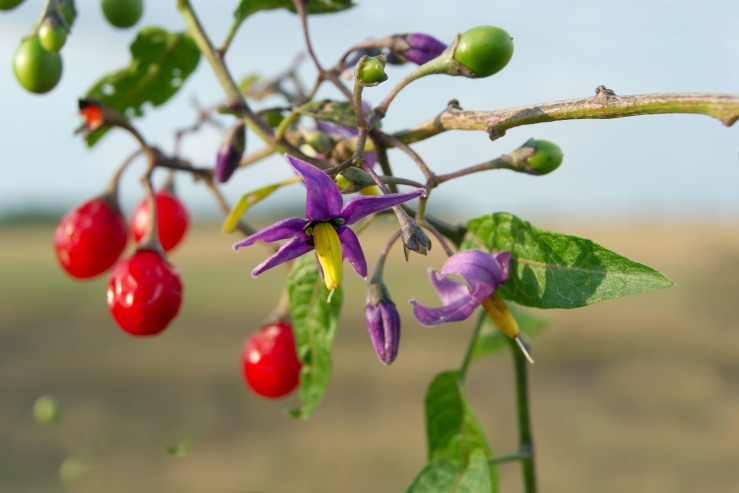
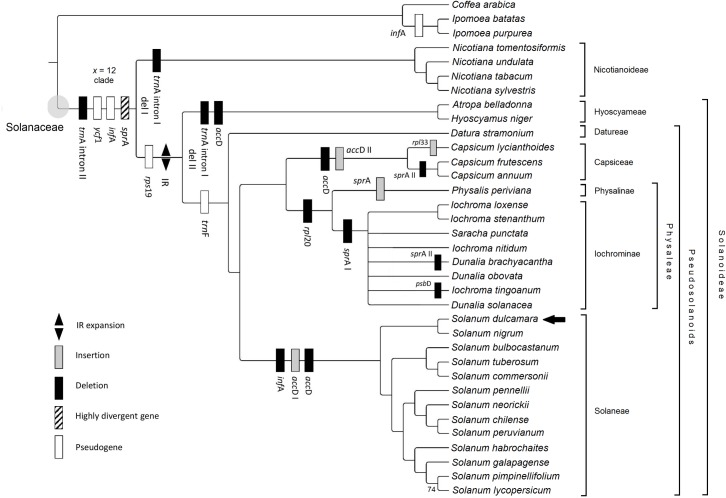
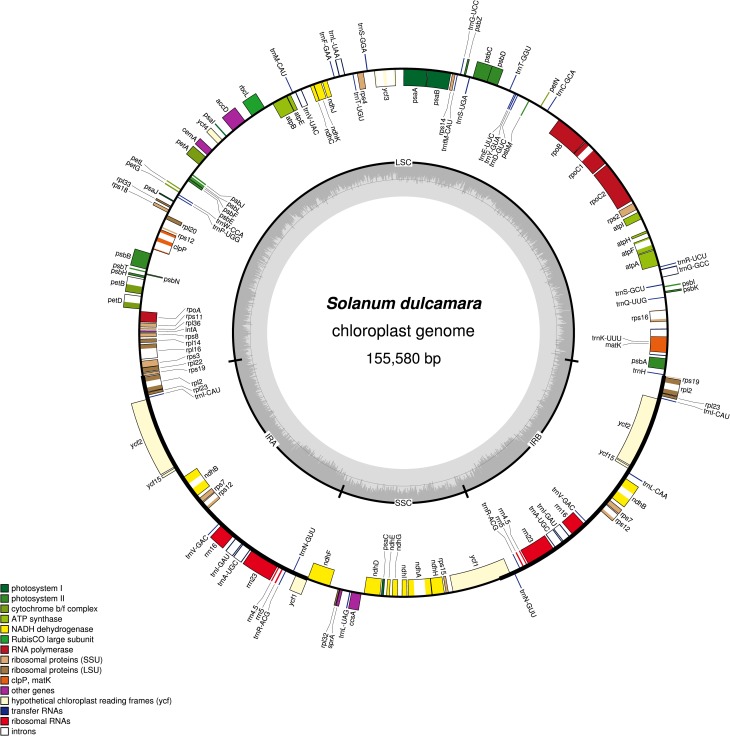
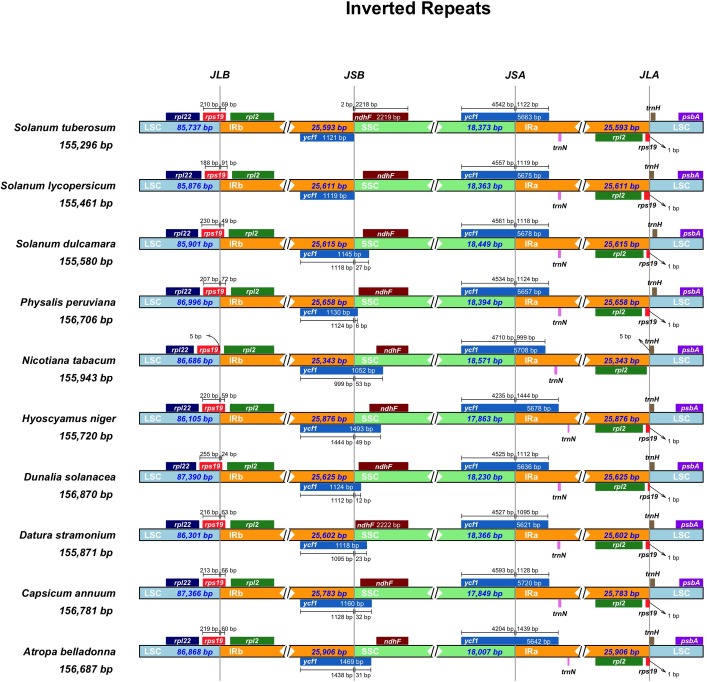
Bittersweet (Solanum dulcamara) is a native Old World member of the nightshade family. This European diploid species can be found from marshlands to high mountainous regions and it is a common weed that serves as an alternative host and source of resistance genes against plant pathogens such as late blight (Phytophthora infestans). We sequenced the complete chloroplast genome of bittersweet, which is 155,580 bp in length and it is characterized by a typical quadripartite structure composed of a large (85,901 bp) and small (18,449 bp) single-copy region interspersed by two identical inverted repeats (25,615 bp). It consists of 112 unique genes from which 81 are protein-coding, 27 tRNA and four rRNA genes. All bittersweet plastid genes including non-functional ones and even intergenic spacer regions are transcribed in primary plastid transcripts covering 95.22% of the genome. These are later substantially edited in a post-transcriptional phase to activate gene functions. By comparing the bittersweet plastid genome with all available Solanaceae sequences we found that gene content and synteny are highly conserved across the family. During genome comparison we have identified several annotation errors, which we have corrected in a manual curation process then we have identified the major plastid genome structural changes in Solanaceae. Interpreted in a phylogenetic context they seem to provide additional support for larger clades. The plastid genome sequence of bittersweet could help to benchmark Solanaceae plastid genome annotations and could be used as a reference for further studies. Such reliable annotations are important for gene diversity calculations, synteny map constructions and assigning partitions for phylogenetic analysis with de novo sequenced plastomes of Solanaceae.
甜叶悬钩子(Solanum dulcamara)是茄科的一个原产于旧大陆的种。这种欧洲二倍体种可以在沼泽地到高山地区找到,是一种常见的杂草,它可以作为替代宿主,并为植物病原体(如晚疫病(Phytophthora infestans))提供抗性基因的来源。我们对甜叶悬钩子的完整叶绿体基因组进行了测序,其长度为 155580bp,具有典型的四分体结构,由一个大(85901bp)和小(18449bp)单拷贝区组成,两个相同的反向重复序列(25615bp)穿插其中。它由 112 个独特的基因组成,其中 81 个是蛋白质编码基因,27 个 tRNA 和 4 个 rRNA 基因。所有甜叶悬钩子叶绿体基因,包括非功能基因甚至基因间间隔区,都在覆盖基因组 95.22%的初级叶绿体转录物中转录。这些基因在转录后阶段被大量编辑,以激活基因功能。通过将甜叶悬钩子叶绿体基因组与所有可用的茄科序列进行比较,我们发现基因内容和基因排列在整个家族中高度保守。在基因组比较过程中,我们发现了一些注释错误,我们在手动校对过程中对这些错误进行了纠正,然后确定了茄科植物中主要的叶绿体基因组结构变化。在系统发育背景下解释这些变化似乎为更大的分支提供了额外的支持。甜叶悬钩子的叶绿体基因组序列可以帮助基准茄科叶绿体基因组的注释,并可作为进一步研究的参考。这种可靠的注释对于基因多样性计算、基因图谱构建以及为茄科植物的从头测序叶绿体基因组进行分区分析分配都很重要。