Laboratory of Genetics, Salk Institute for Biological Studies, La Jolla, CA 92037, USA.
The Razavi Newman Integrative Genomics and Bioinformatics Core Facility, Salk Institute for Biological Studies, La Jolla, CA, USA.
Cell Rep. 2018 Apr 24;23(4):1220-1229. doi: 10.1016/j.celrep.2018.03.105.
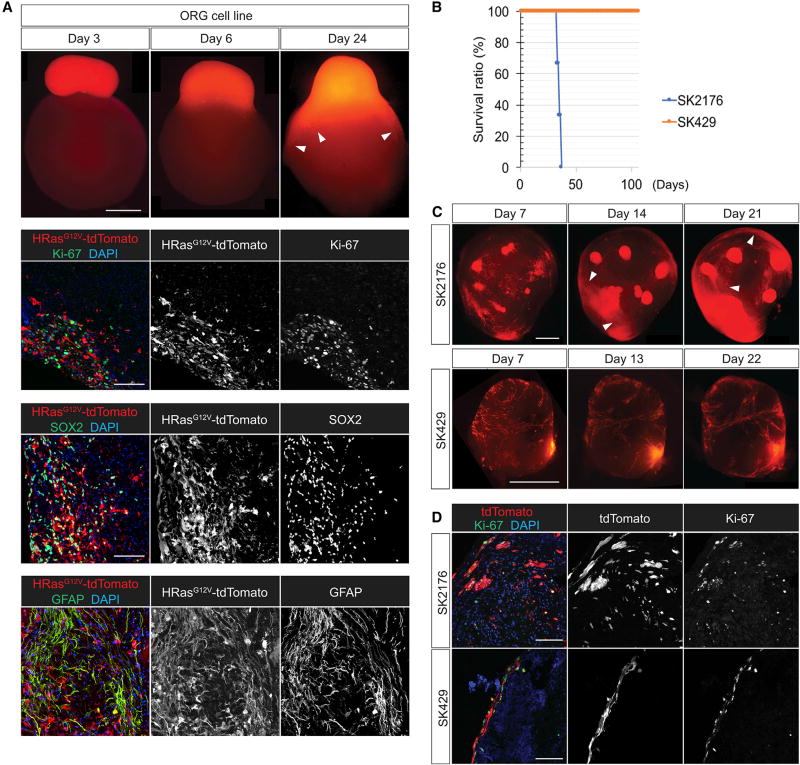
We have developed a cancer model of gliomas in human cerebral organoids that allows direct observation of tumor initiation as well as continuous microscopic observations. We used CRISPR/Cas9 technology to target an HRas-IRES-tdTomato construct by homologous recombination into the TP53 locus. Results show that transformed cells rapidly become invasive and destroy surrounding organoid structures, overwhelming the entire organoid. Tumor cells in the organoids can be orthotopically xenografted into immunodeficient NOD/SCID IL2RG animals, exhibiting an invasive phenotype. Organoid-generated putative tumor cells show gene expression profiles consistent with mesenchymal subtype human glioblastoma. We further demonstrate that human-organoid-derived tumor cell lines or primary human-patient-derived glioblastoma cell lines can be transplanted into human cerebral organoids to establish invasive tumor-like structures. Our results show potential for the use of organoids as a platform to test human cancer phenotypes that recapitulate key aspects of malignancy.
我们已经开发出一种人类脑类器官中的神经胶质瘤癌症模型,该模型允许直接观察肿瘤的起始以及持续的微观观察。我们使用 CRISPR/Cas9 技术通过同源重组将 HRas-IRES-tdTomato 构建体靶向到 TP53 基因座。结果表明,转化细胞迅速侵袭并破坏周围的类器官结构,从而使整个类器官受到破坏。类器官中的肿瘤细胞可以原位异种移植到免疫缺陷的 NOD/SCID IL2RG 动物中,表现出侵袭表型。类器官生成的潜在肿瘤细胞显示出与间充质亚型人胶质母细胞瘤一致的基因表达谱。我们进一步证明,人源类器官衍生的肿瘤细胞系或原发性人源患者衍生的胶质母细胞瘤细胞系可以被移植到人脑类器官中,以建立侵袭性肿瘤样结构。我们的结果表明,类器官有潜力作为一个平台,用于测试能够重现恶性关键方面的人类癌症表型。