Kocher David C, Apostoaei A Iulian, Hoffman F Owen, Trabalka John R
*Oak Ridge Center for Risk Analysis, Inc., 102 Donner Drive, Oak Ridge, TN 37830; †Deceased.
Health Phys. 2018 Jun;114(6):602-622. doi: 10.1097/HP.0000000000000838.
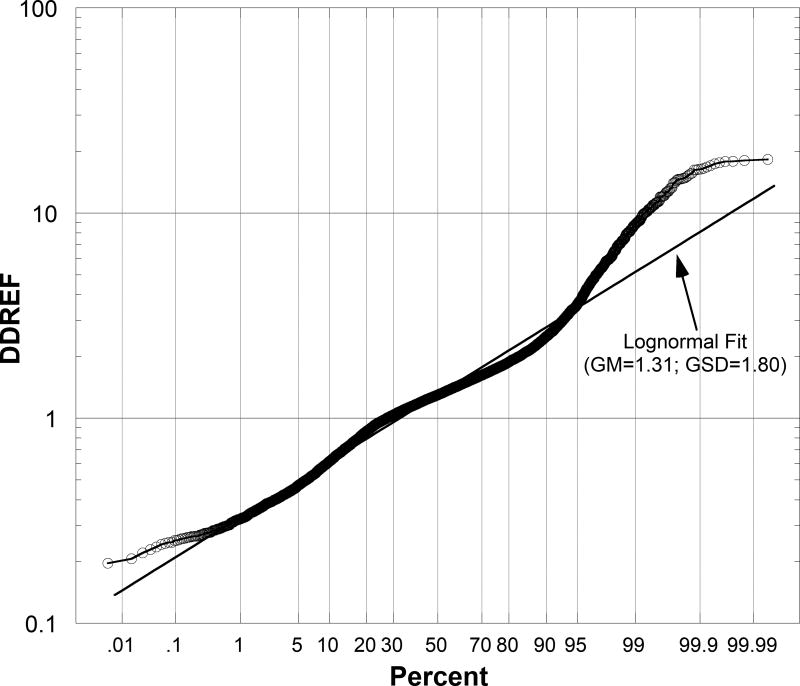
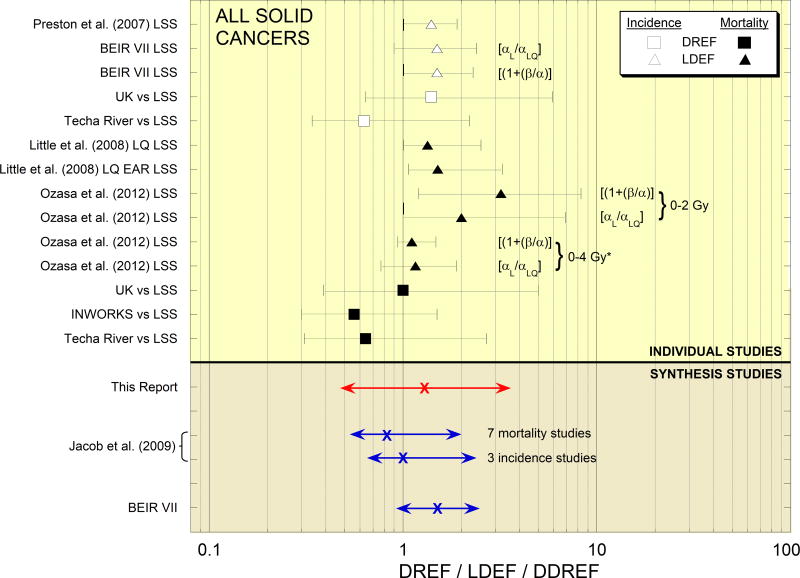
This paper presents an analysis to develop a subjective state-of-knowledge probability distribution of a dose and dose-rate effectiveness factor for use in estimating risks of solid cancers from exposure to low linear energy transfer radiation (photons or electrons) whenever linear dose responses from acute and chronic exposure are assumed. A dose and dose-rate effectiveness factor represents an assumption that the risk of a solid cancer per Gy at low acute doses or low dose rates of low linear energy transfer radiation, RL, differs from the risk per Gy at higher acute doses, RH; RL is estimated as RH divided by a dose and dose-rate effectiveness factor, where RH is estimated from analyses of dose responses in Japanese atomic-bomb survivors. A probability distribution to represent uncertainty in a dose and dose-rate effectiveness factor for solid cancers was developed from analyses of epidemiologic data on risks of incidence or mortality from all solid cancers as a group or all cancers excluding leukemias, including (1) analyses of possible nonlinearities in dose responses in atomic-bomb survivors, which give estimates of a low-dose effectiveness factor, and (2) comparisons of risks in radiation workers or members of the public from chronic exposure to low linear energy transfer radiation at low dose rates with risks in atomic-bomb survivors, which give estimates of a dose-rate effectiveness factor. Probability distributions of uncertain low-dose effectiveness factors and dose-rate effectiveness factors for solid cancer incidence and mortality were combined using assumptions about the relative weight that should be assigned to each estimate to represent its relevance to estimation of a dose and dose-rate effectiveness factor. The probability distribution of a dose and dose-rate effectiveness factor for solid cancers developed in this study has a median (50th percentile) and 90% subjective confidence interval of 1.3 (0.47, 3.6). The harmonic mean is 1.1, which implies that the arithmetic mean of an uncertain estimate of the risk of a solid cancer per Gy at low acute doses or low dose rates of low linear energy transfer radiation is only about 10% less than the mean risk per Gy at higher acute doses. Data were also evaluated to define a low acute dose or low dose rate of low linear energy transfer radiation, i.e., a dose or dose rate below which a dose and dose-rate effectiveness factor should be applied in estimating risks of solid cancers.
本文进行了一项分析,以建立剂量与剂量率有效性因子的主观知识状态概率分布,用于在假设急性和慢性照射的线性剂量响应情况下,估算因暴露于低线性能量传递辐射(光子或电子)而导致实体癌的风险。剂量与剂量率有效性因子表示这样一种假设:对于低线性能量传递辐射RL,在低急性剂量或低剂量率下每Gy发生实体癌的风险与在较高急性剂量下每Gy的风险RH不同;RL估计为RH除以剂量与剂量率有效性因子,其中RH是根据对日本原子弹幸存者剂量响应的分析得出的。通过对所有实体癌或除白血病外的所有癌症的发病或死亡风险的流行病学数据进行分析,建立了一个表示实体癌剂量与剂量率有效性因子不确定性的概率分布,分析包括:(1)对原子弹幸存者剂量响应中可能的非线性进行分析,以估计低剂量有效性因子;(2)将辐射工作人员或公众因长期低剂量率暴露于低线性能量传递辐射而产生的风险与原子弹幸存者的风险进行比较,以估计剂量率有效性因子。使用关于应赋予每个估计值的相对权重的假设,将实体癌发病率和死亡率的不确定低剂量有效性因子和剂量率有效性因子的概率分布进行组合,以表示其与剂量与剂量率有效性因子估计的相关性。本研究中建立的实体癌剂量与剂量率有效性因子的概率分布的中位数(第50百分位数)和90%主观置信区间为1.3(0.47,3.6)。调和均值为1.1,这意味着在低急性剂量或低剂量率下,低线性能量传递辐射每Gy发生实体癌风险的不确定估计值的算术均值仅比在较高急性剂量下每Gy的平均风险低约10%。还对数据进行了评估,以确定低线性能量传递辐射的低急性剂量或低剂量率,即在估算实体癌风险时应应用剂量与剂量率有效性因子的剂量或剂量率。