National Research Centre "Kurchatov Institute", Kurchatov Sq. 1, Moscow, 123182, Russia.
Nat Commun. 2018 Apr 26;9(1):1672. doi: 10.1038/s41467-018-04012-2.
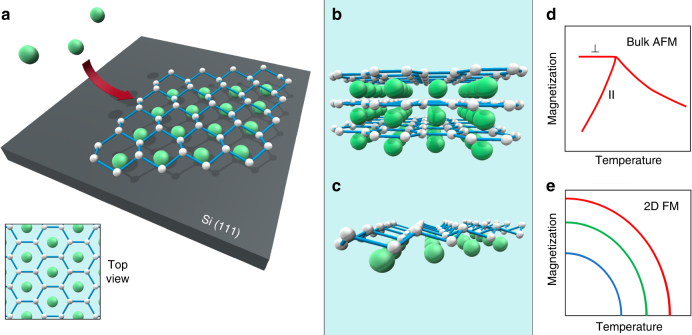
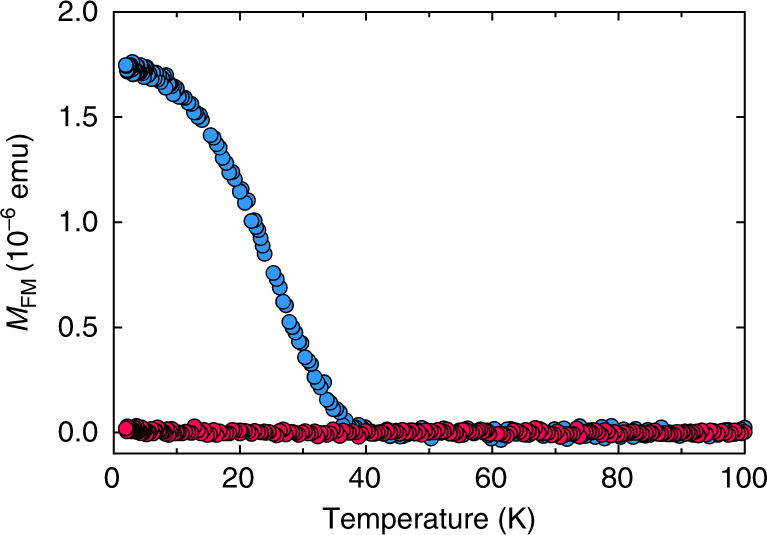
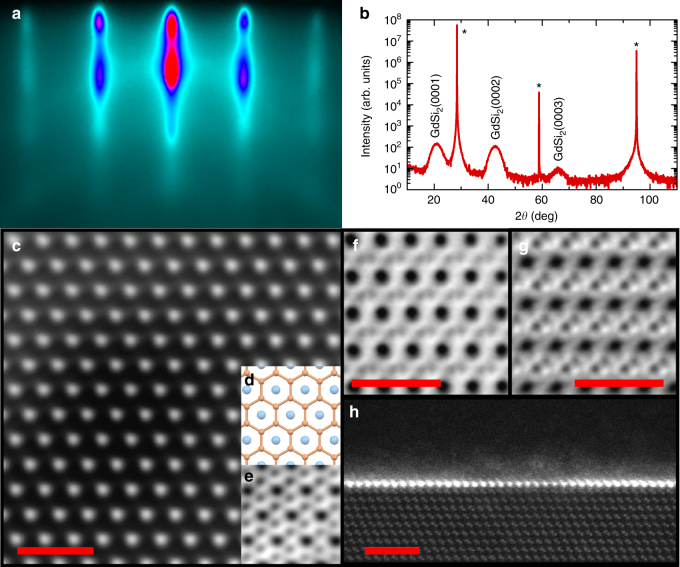
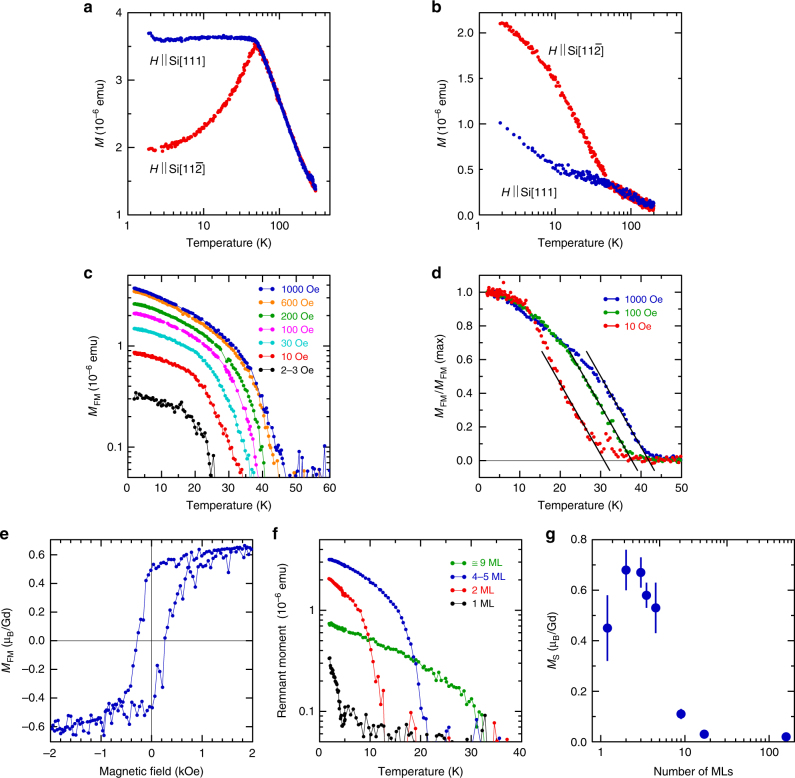
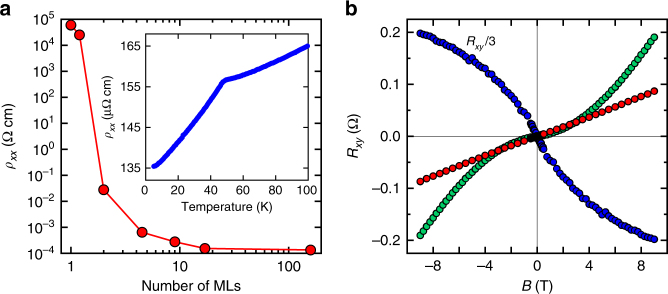
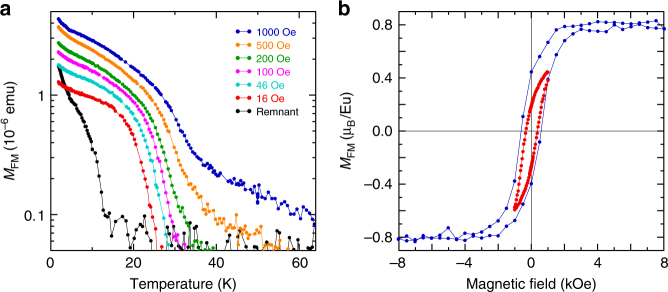
The appeal of ultra-compact spintronics drives intense research on magnetism in low-dimensional materials. Recent years have witnessed remarkable progress in engineering two-dimensional (2D) magnetism via defects, edges, adatoms, and magnetic proximity. However, intrinsic 2D ferromagnetism remained elusive until recent discovery of out-of-plane magneto-optical response in Cr-based layers, stimulating the search for 2D magnets with tunable and diverse properties. Here we employ a bottom-up approach to produce layered structures of silicene (a Si counterpart of graphene) functionalized by rare-earth atoms, ranging from the bulk down to one monolayer. We track the evolution from the antiferromagnetism of the bulk to intrinsic 2D in-plane ferromagnetism of ultrathin layers, with its characteristic dependence of the transition temperature on low magnetic fields. The emerging ferromagnetism manifests itself in the electron transport. The discovery of a class of robust 2D magnets, compatible with the mature Si technology, is instrumental for engineering new devices and understanding spin phenomena.
超紧凑自旋电子学的吸引力推动了对低维材料中磁学的深入研究。近年来,通过缺陷、边缘、吸附原子和磁近邻来工程二维(2D)磁体方面取得了显著进展。然而,直到最近在基于 Cr 的层中发现了面外磁光响应,才实现了本征 2D 铁磁性,这激发了对具有可调谐和多样化性质的 2D 磁体的探索。在这里,我们采用自下而上的方法制备了由稀土原子功能化的硅烯(石墨烯的 Si 对应物)的层状结构,从体相到单层。我们跟踪了从体相的反铁磁性到超薄层的本征 2D 面内铁磁性的演变,其特征是转变温度对低磁场的依赖性。新兴的铁磁性在电子输运中表现出来。一类与成熟的 Si 技术兼容的稳健 2D 磁体的发现,对于工程新器件和理解自旋现象具有重要意义。