Department of Biochemistry, School of Biology, Moscow State University, Moscow 119234, Russian Federation.
Department of Biochemistry, School of Biology, Moscow State University, Moscow 119234, Russian Federation.
Redox Biol. 2018 Jul;17:192-199. doi: 10.1016/j.redox.2018.04.014. Epub 2018 Apr 14.
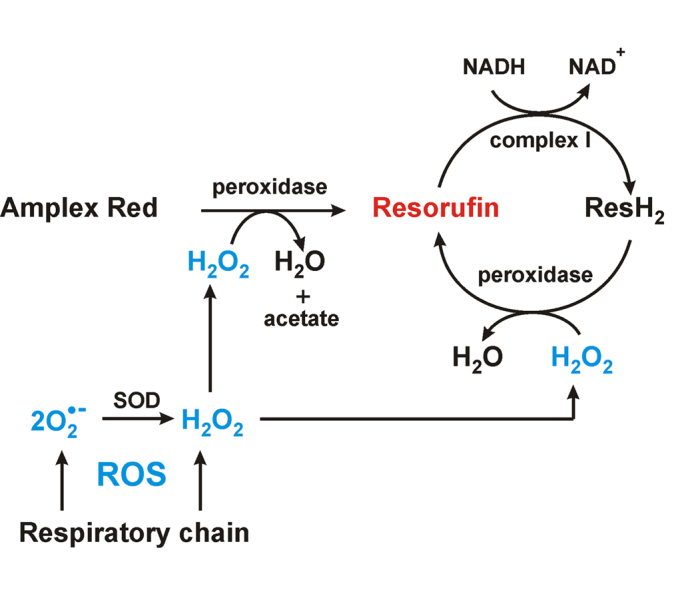
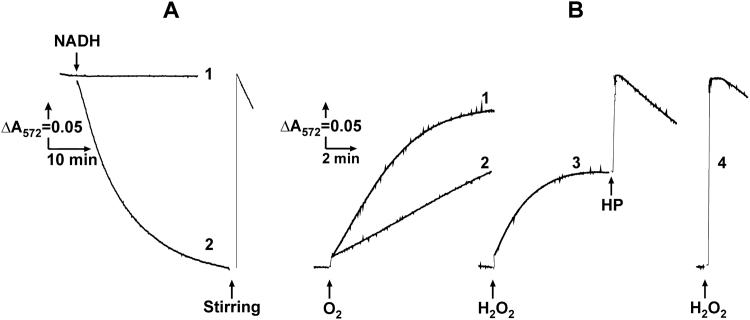
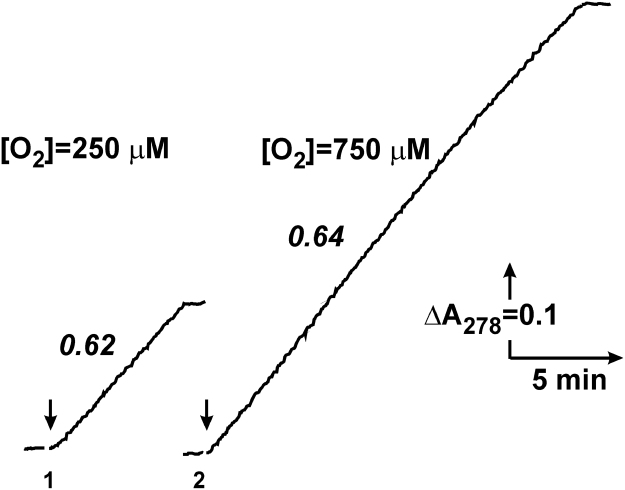
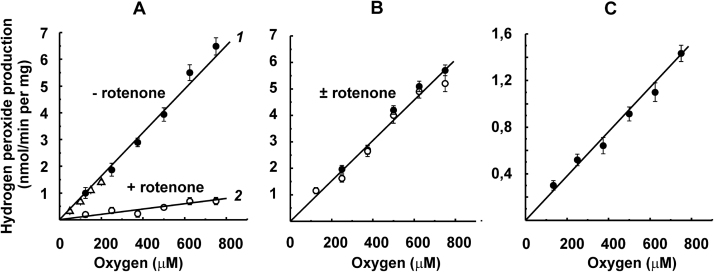
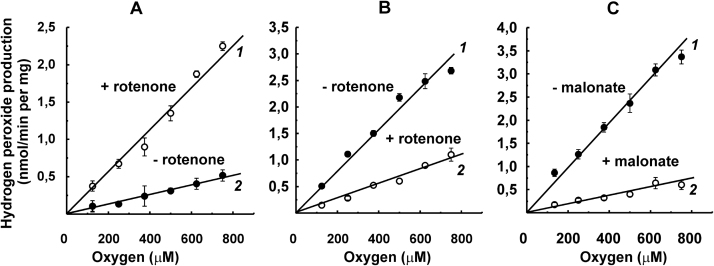
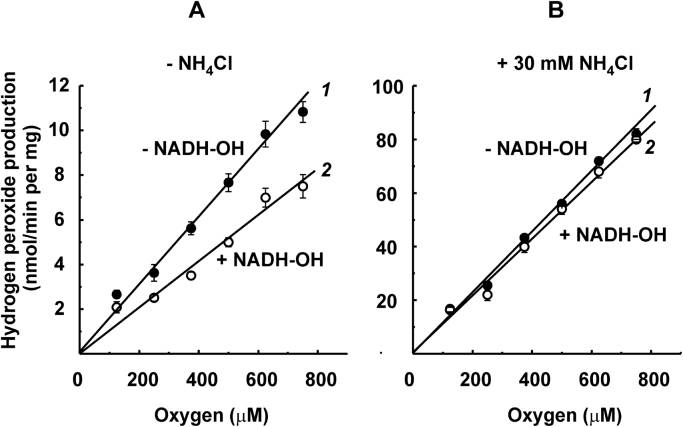
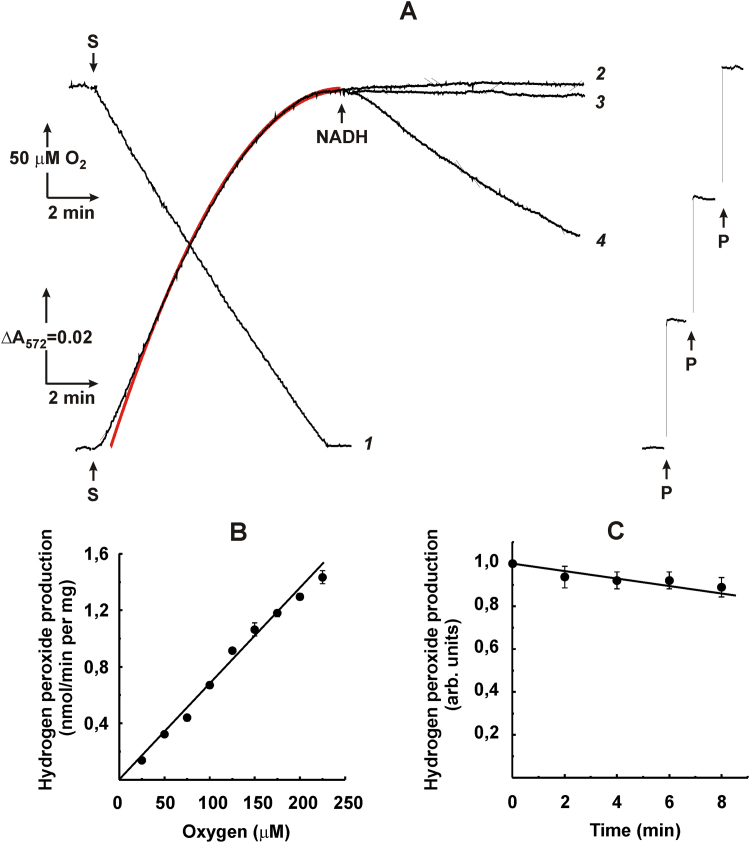
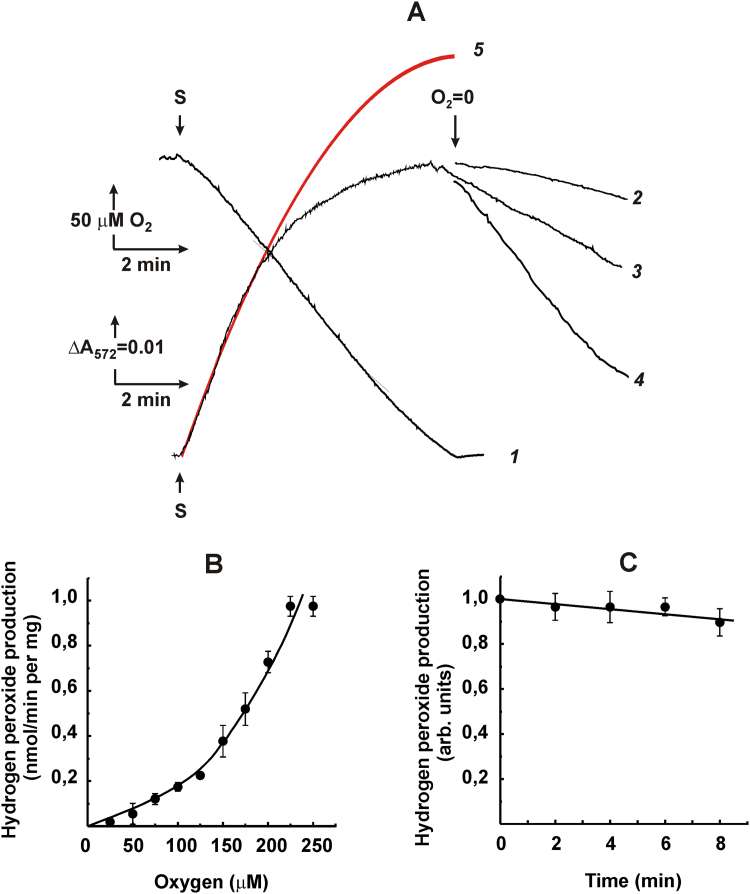
The initial rates of superoxide plus hydrogen peroxide (ROS) generation by intact or permeabilized rat heart mitochondria and coupled inside-out bovine heart submitochondrial particles (SMP) oxidizing NAD-dependent substrates, NADH, and succinate were measured by detecting resorufin formation in the Amplex Red assay at various oxygen concentrations. Linear dependences of the initial rates on oxygen concentration within the range of ~125-750 μM were found for all significant mitochondrial generators, i.e. the respiratory complexes and ammonium-stimulated dihydrolipoamide dehydrogenase. At lower oxygen concentrations upon its decrease from air saturation level to zero, the time-course of resorufin formation by SMP catalyzing coupled oxidation of succinate (the total ROS production by respiratory complexes II and III and by the reverse electron transfer (RET)-mediated by complex I) also corresponds to the linear dependence on oxygen with the same first-order rate constant determined in the initial rate studies. Prolonged incubation of SMP generating succinate-supported complex I-mediated ROS affected neither their NADH oxidase nor ROS generating activity. In contrast to SMP significant deviation from the first-order oxygen dependence in the time-course kinetics during coupled oxidation of succinate by intact mitochondria was evident. Complex I catalyzes the NADH:resorufin oxidoreductase reaction resulting in formation of colorless reduced resorufin. Hydrogen peroxide oxidizes reduced resorufin in the presence of peroxidase, thus showing its dihydroresorufin peroxidase activity. Combined NADH:resorufin reductase and dihydroresorufin peroxidase activities result in underestimation of the amount of hydrogen peroxide generated by mitochondria. We conclude that only initial rates of the mitochondrial ROS production, not the amount of resorufin accumulated, should be taken as the reliable measure of the mitochondrial ROS-generating activity, because of the cycling of the oxidized and reduced resorufin during Amplex Red assays fed by NADH and other possible reductant(s) present in mitochondria.
完整或通透化的大鼠心脏线粒体和偶联的牛心线粒体基质颗粒(SMP)氧化 NAD 依赖性底物 NADH 和琥珀酸时,超氧阴离子加过氧化氢(ROS)的初始生成速率通过检测 Amplex Red 测定法中各种氧浓度下的 Resorufin 形成来测量。对于所有重要的线粒体生成器,即呼吸复合物和铵刺激的二氢硫辛酸脱氢酶,在 ~125-750 μM 的范围内,初始速率与氧浓度呈线性关系。在氧气浓度从空气饱和水平降低到零时,SMP 催化偶联氧化琥珀酸(呼吸复合物 II 和 III 的总 ROS 生成和由复合物 I 介导的逆向电子传递(RET))时 Resorufin 形成的时程也与氧气呈线性关系,相同的一级速率常数在初始速率研究中确定。SMP 长时间孵育生成琥珀酸支持的复合物 I 介导的 ROS 既不影响其 NADH 氧化酶也不影响其 ROS 生成活性。与 SMP 相比,完整线粒体偶联氧化琥珀酸时,在时间过程动力学中明显偏离一级氧依赖性。复合物 I 催化 NADH:Resorufin 氧化还原酶反应,导致无色还原 Resorufin 的形成。过氧化氢在过氧化物酶存在下氧化还原 Resorufin,从而显示其二氢 Resorufin 过氧化物酶活性。NADH:Resorufin 还原酶和二氢 Resorufin 过氧化物酶的联合活性导致低估了线粒体生成的过氧化氢量。我们得出的结论是,只有线粒体 ROS 生成的初始速率,而不是积累的 Resorufin 量,才应该作为线粒体 ROS 生成活性的可靠衡量标准,因为在 Amplex Red 测定中,氧化和还原的 Resorufin 之间会发生循环,NADH 和其他可能存在于线粒体中的还原物会为其提供电子。