Reagh Zachariah M, Ranganath Charan
Center for Neuroscience, United States; Department of Neurology, University of California, Davis, United States.
Center for Neuroscience, United States; Memory and Plasticity (MAP) Program, United States; Department of Psychology, University of California, Davis, United States.
Neurosci Lett. 2018 Jul 27;680:69-76. doi: 10.1016/j.neulet.2018.04.050. Epub 2018 Apr 25.
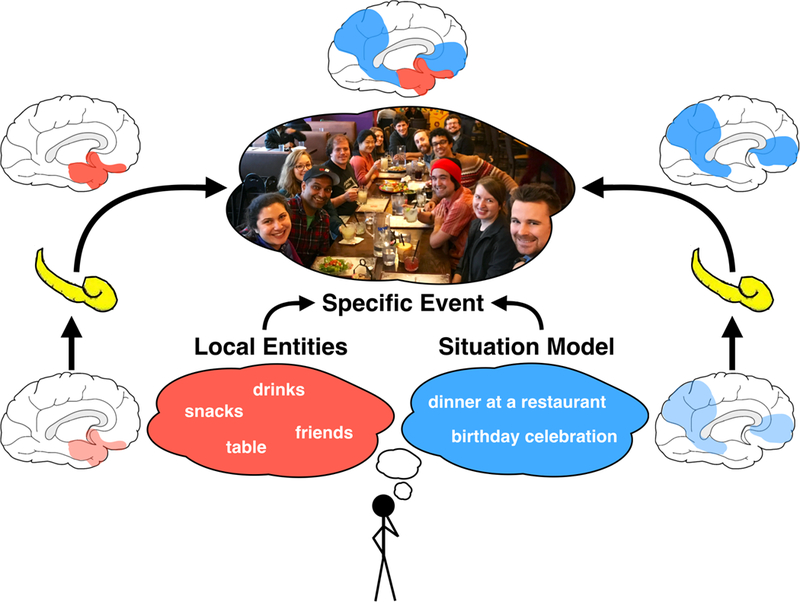
Historically, research on the cognitive processes that support human memory proceeded, to a large extent, independently of research on the neural basis of memory. Accumulating evidence from neuroimaging, however, has enabled the field to develop a broader and more integrative perspective. Here, we briefly outline how advances in cognitive neuroscience can potentially shed light on concepts and controversies in human memory research. We argue that research on the functional properties of cortico-hippocampal networks informs us about how memories might be organized in the brain, which, in turn, helps to reconcile seemingly disparate perspectives in cognitive psychology. Finally, we discuss several open questions and directions for future research.
从历史角度来看,对支持人类记忆的认知过程的研究在很大程度上独立于对记忆神经基础的研究。然而,来自神经成像的越来越多的证据使该领域能够形成更广泛、更综合的观点。在这里,我们简要概述认知神经科学的进展如何有可能阐明人类记忆研究中的概念和争议。我们认为,对皮质-海马网络功能特性的研究让我们了解记忆在大脑中可能是如何组织的,这反过来又有助于调和认知心理学中看似不同的观点。最后,我们讨论了几个开放性问题和未来研究的方向。