Department of Medical Biochemistry and Biophysics, Section for Medical Inflammation Research, Karolinska Institute, Stockholm, Sweden.
Department of Pathophysiology, Key Laboratory for Shock and Microcirculation Research of Guangdong, Southern Medical University, Guangzhou, China.
Front Immunol. 2018 Apr 12;9:451. doi: 10.3389/fimmu.2018.00451. eCollection 2018.
Collagen XI (CXI) is a heterotrimeric molecule with triple helical structure in which the α3(XI) chain is identical to the α1(II) chain of collagen II (CII), but with extensive posttranslational modifications. CXI molecules are intermingled in the cartilage collagen fibers, which are mainly composed of CII. One of the alpha chains in CXI is shared with CII and contains the immunodominant T cell epitope, but it is unclear whether there are shared B cell epitopes as the antibodies tend to recognize the triple helical structures.
Mice expressing the susceptible immune response gene were immunized with CII or CXI. Serum antibody responses were measured, monoclonal antibodies were isolated and analyzed for specificity to CII, CXI, and triple helical collagen peptides using bead-based multiplex immunoassays, enzyme-linked immunosorbent assays, and Western blots. Arthritogenicity of the antibodies was investigated by passive transfer experiments.
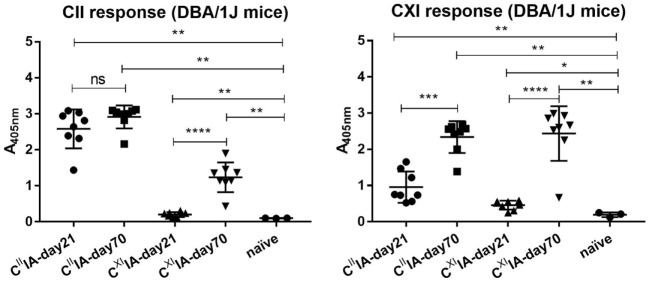
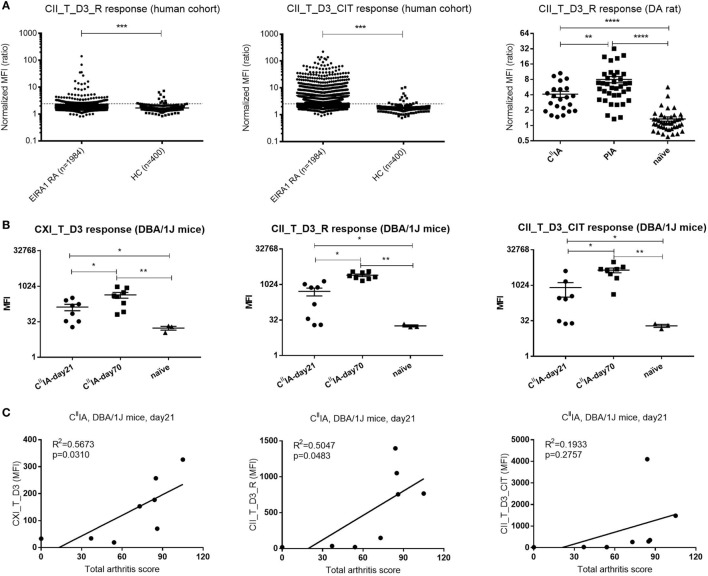
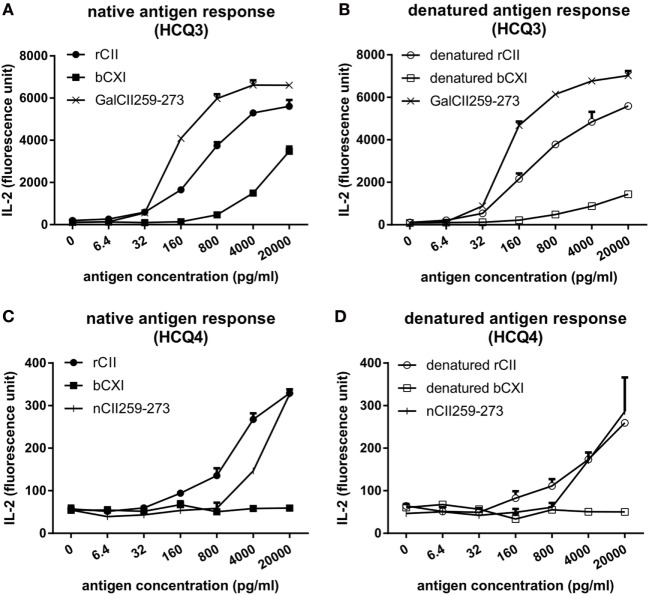
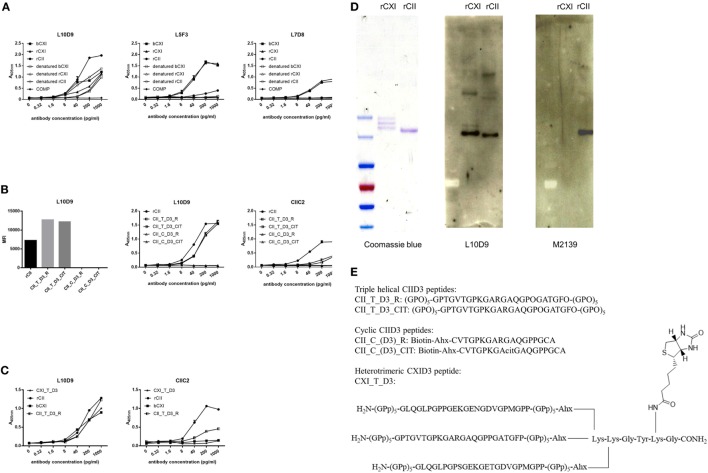
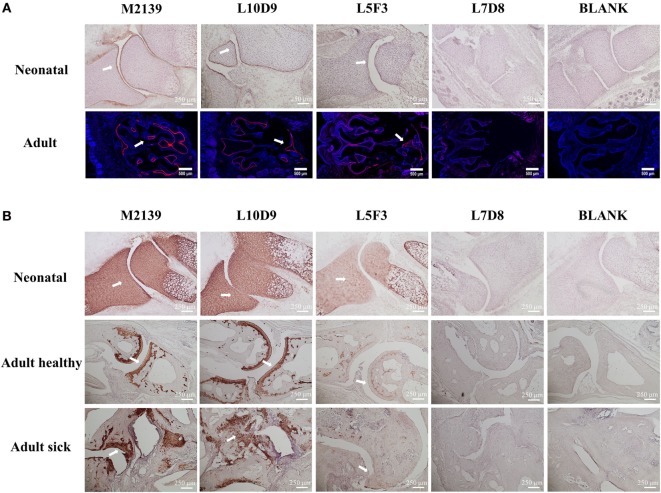
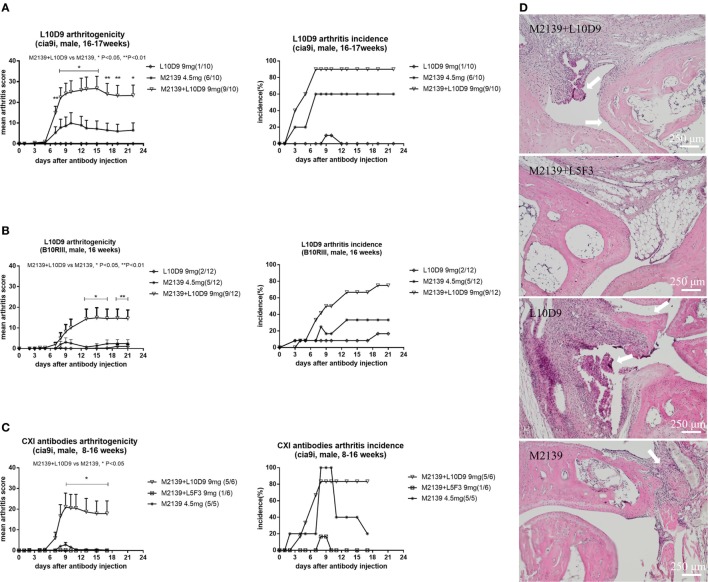
Immunization with CII or CXI leads to a strong T and B cell response, including a cross-reactive response to both collagen types. Immunization with CII leads to severe arthritis in mice, with a response toward CXI at the chronic stage, whereas CXI immunization induces very mild arthritis only. A series of monoclonal antibodies to CXI were isolated and of these, the L10D9 antibody bound to both CXI and CII equally strong, with a specific binding for the D3 epitope region of α3(XI) or α1(II) chain. The L10D9 antibody binds cartilage and induced severe arthritis. In contrast, the L5F3 antibody only showed weak binding and L7D8 antibody has no binding to cartilage and did not induce arthritis. The arthritogenic L10D9 antibody bound to an epitope shared with CII, the triple helical D3 epitope. Antibody levels to the shared D3 epitope were elevated in the sera from mice with arthritis as well as in rheumatoid arthritis.
CXI is immunologically not exposed in healthy cartilage but contains T and B cell epitopes cross-reactive with CII, which could be activated in both mouse and human arthritis and could evoke an arthritogenic response.
胶原 XI(CXI)是一种三聚体分子,具有三螺旋结构,其中α3(XI)链与胶原 II(CII)的α1(II)链相同,但具有广泛的翻译后修饰。CXI 分子混在主要由 CII 组成的软骨胶原纤维中。CXI 的一个α链与 CII 共有,并含有免疫显性 T 细胞表位,但尚不清楚是否存在共享的 B 细胞表位,因为抗体往往识别三螺旋结构。
表达易感免疫反应基因的小鼠用 CII 或 CXI 免疫。通过基于珠子的多重免疫分析、酶联免疫吸附测定和 Western blot 测量血清抗体反应,分离并分析单克隆抗体对 CII、CXI 和三螺旋胶原肽的特异性。通过被动转移实验研究抗体的关节炎发病机制。
用 CII 或 CXI 免疫会引起强烈的 T 和 B 细胞反应,包括对两种胶原类型的交叉反应。用 CII 免疫会导致小鼠发生严重关节炎,在慢性阶段会对 CXI 产生反应,而 CXI 免疫仅引起非常轻微的关节炎。分离出一系列针对 CXI 的单克隆抗体,其中 L10D9 抗体对 CXI 和 CII 的结合强度相等,对 α3(XI)或α1(II)链的 D3 表位区域具有特异性结合。L10D9 抗体结合软骨并诱导严重关节炎。相比之下,L5F3 抗体仅显示弱结合,而 L7D8 抗体对软骨无结合且不引起关节炎。致关节炎的 L10D9 抗体结合与 CII 共享的表位,即三螺旋 D3 表位。关节炎小鼠和类风湿关节炎患者血清中共享 D3 表位的抗体水平升高。
健康软骨中 CXI 没有免疫暴露,但含有与 CII 交叉反应的 T 和 B 细胞表位,在人和小鼠关节炎中均可被激活,并可引发致关节炎反应。