Department of Oncology, Radiation Oncology, University of Turin at AOU Citta' della Salute e della Scienza, Via Genova 3, 10126, Turin, Italy.
Department of Oncology, Medical Oncology, ASL Biella, Biella, Italy.
Radiat Oncol. 2018 May 2;13(1):83. doi: 10.1186/s13014-018-1035-9.
Concurrent chemo-radiation (CT-RT) is a standard therapy for squamous cell carcinoma of anal canal. Different clinical and biological factors may potentially affect outcome. We investigated the prognostic role of baseline hemoglobin (Hb) in a cohort of anal cancer patients submitted to CT-RT with 5-fluorouracil and mitomycin C.
Up to 161 patients with clinical stage T1-T4/N0-N3/M0 were treated. Response was assessed at 6 weeks and thereafter at 3, 6 and 12 months. Two different approaches were used:a)simultaneous integrated boost following RTOG 05-29 indications;b)first sequence of 45Gy/25 fractions to the pelvis followed by 9-14.4 Gy/5-8 fractions to the macroscopic disease. Primary endpoints were progression-free survival (PFS) and overall survival (OS).
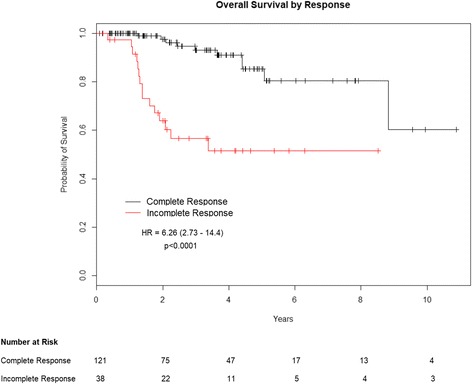
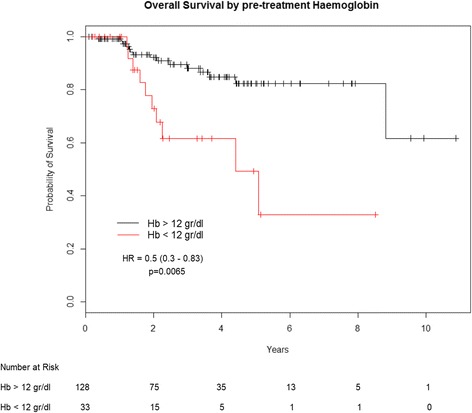
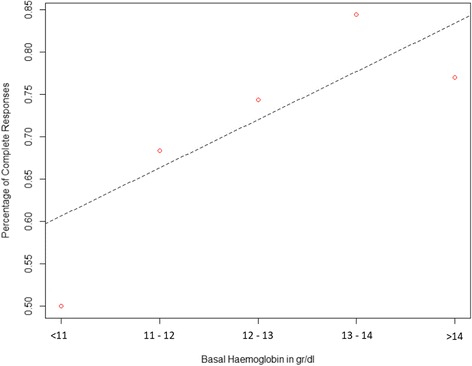
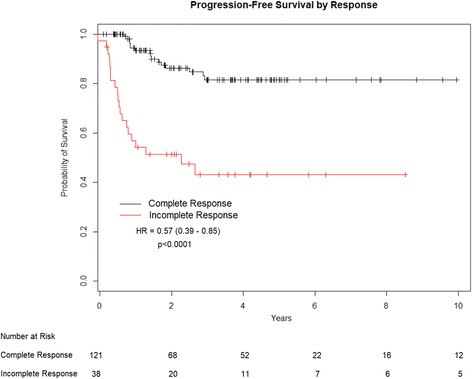
On multivariate analysis, pre-treatment Hb level had a significant correlation to OS (HR:0.53;95% CI:0.33-0.87; p = 0.001), but not to PFS (HR:0.78;95% CI:0.53-1.15; p = 0.12) Patients with pre-treatment Hb ≥ 12 g/dl had 5-year PFS and OS of 82.2%, compared to 29.3% and 32.8% for those below the threshold. The likelihood to achieve a complete remission increased by 5.6% for every single-unit (g/dl) increase in baseline Hb level over 11 g/dl. On multivariate analysis, response to treatment had a significant correlation to PFS (incomplete vs complete response - HR:5.43;95% CI:2.75-10.7; p < 0.0001) and OS (HR: 6.96;95% CI:2.96-16.5; p < 0.0001).
We showed that baseline Hb level is a strong indicator for poor response to RT-CT in anal cancer patients. A close clinical monitoring for incomplete response to treatment should be advised in patients with low pre-treatment Hb. The hypothesis that the preservation of adequate Hb level during treatment may lead to a better outcome needs prospective evaluation.
同期放化疗(CT-RT)是肛管鳞癌的标准治疗方法。不同的临床和生物学因素可能会影响治疗效果。我们研究了血红蛋白(Hb)基线水平在接受氟尿嘧啶和丝裂霉素 C 联合 CT-RT 的肛门癌患者队列中的预后作用。
共纳入 161 例临床分期为 T1-T4/N0-N3/M0 的患者。在 6 周时以及之后的 3、6 和 12 个月时评估反应。我们采用了两种不同的方法:a)根据 RTOG 05-29 指南进行同步整合增敏;b)首先给予骨盆 45Gy/25 次分割,然后给予宏观疾病 9-14.4Gy/5-8 次分割。主要终点为无进展生存期(PFS)和总生存期(OS)。
多因素分析显示,治疗前 Hb 水平与 OS 显著相关(HR:0.53;95%CI:0.33-0.87;p=0.001),但与 PFS 无关(HR:0.78;95%CI:0.53-1.15;p=0.12)。治疗前 Hb≥12g/dl 的患者 5 年 PFS 和 OS 率分别为 82.2%和 32.8%,而低于该阈值的患者分别为 29.3%和 32.8%。与治疗前 Hb 水平每增加 1 单位(g/dl)相比,完全缓解的可能性增加了 5.6%。多因素分析显示,治疗反应与 PFS(不完全缓解与完全缓解 - HR:5.43;95%CI:2.75-10.7;p<0.0001)和 OS(HR:6.96;95%CI:2.96-16.5;p<0.0001)显著相关。
我们表明,Hb 基线水平是肛门癌患者对 RT-CT 治疗反应不良的一个重要指标。对于治疗前 Hb 水平较低的患者,应建议密切监测治疗反应不完全的情况。在治疗过程中保持足够的 Hb 水平可能会导致更好的结果,这一假说需要前瞻性评估。