Sandia National Laboratories, Albuquerque, NM, 87185, USA.
Center for Computing Research, Sandia National Laboratories, Albuquerque, NM, 87185, USA.
Nat Commun. 2018 May 2;9(1):1768. doi: 10.1038/s41467-018-04200-0.
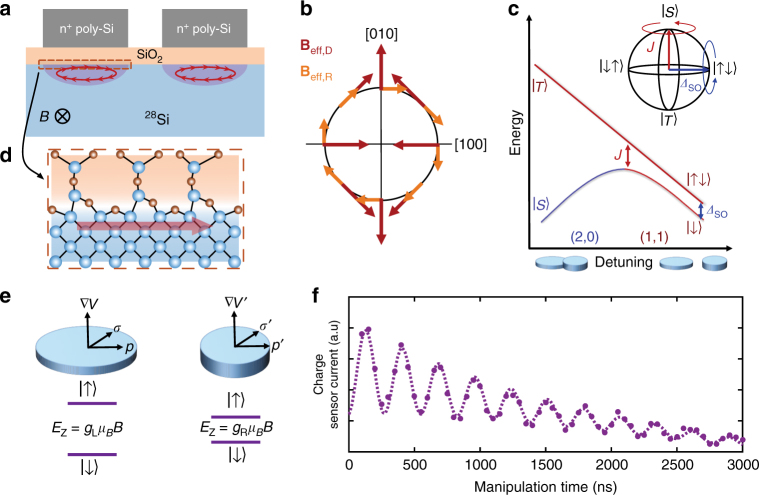
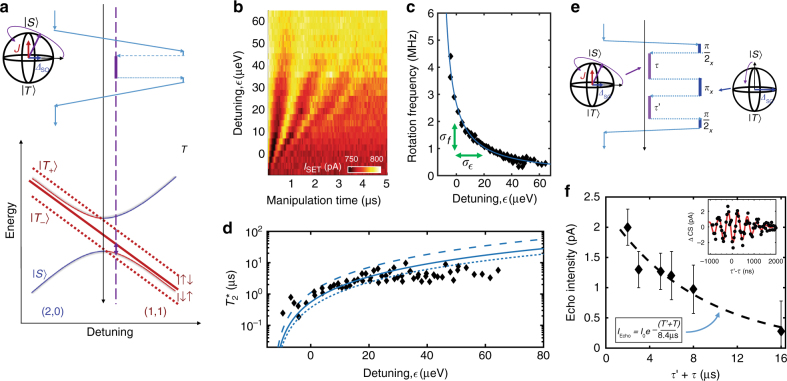
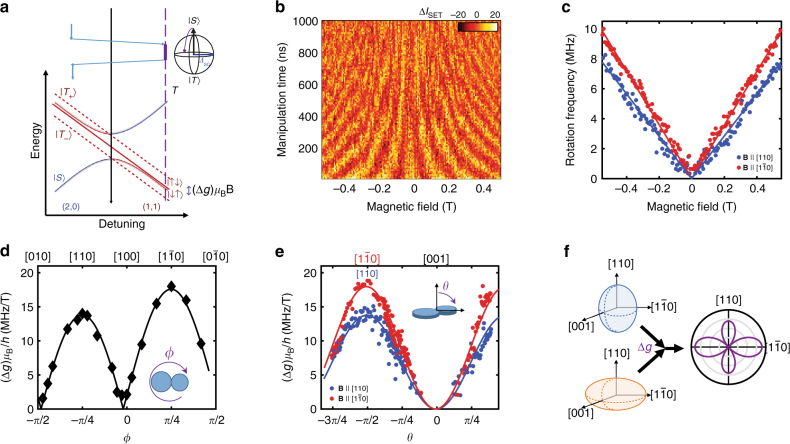
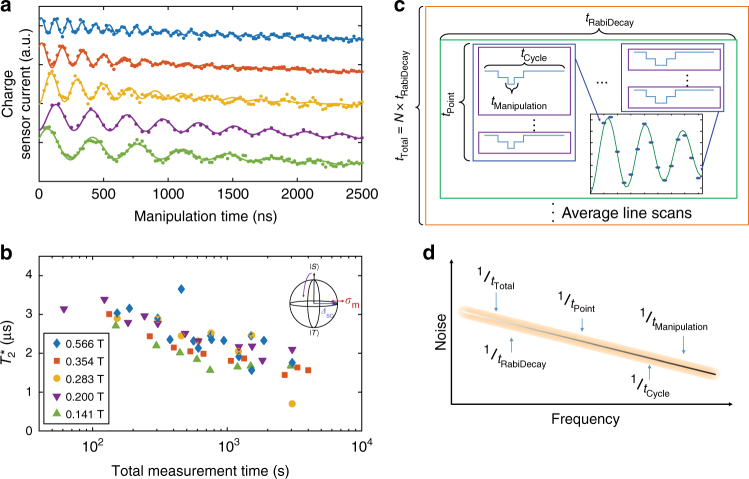
The silicon metal-oxide-semiconductor (MOS) material system is a technologically important implementation of spin-based quantum information processing. However, the MOS interface is imperfect leading to concerns about 1/f trap noise and variability in the electron g-factor due to spin-orbit (SO) effects. Here we advantageously use interface-SO coupling for a critical control axis in a double-quantum-dot singlet-triplet qubit. The magnetic field-orientation dependence of the g-factors is consistent with Rashba and Dresselhaus interface-SO contributions. The resulting all-electrical, two-axis control is also used to probe the MOS interface noise. The measured inhomogeneous dephasing time, [Formula: see text], of 1.6 μs is consistent with 99.95% Si enrichment. Furthermore, when tuned to be sensitive to exchange fluctuations, a quasi-static charge noise detuning variance of 2 μeV is observed, competitive with low-noise reports in other semiconductor qubits. This work, therefore, demonstrates that the MOS interface inherently provides properties for two-axis qubit control, while not increasing noise relative to other material choices.
硅金属氧化物半导体 (MOS) 材料系统是基于自旋的量子信息处理的一种重要技术实现。然而,MOS 界面并不完美,这导致人们对 1/f 陷阱噪声以及由于自旋轨道 (SO) 效应引起的电子 g 因子变化性表示担忧。在这里,我们利用界面 SO 耦合,在双量子点单重态-三重态量子比特中作为关键控制轴。g 因子的磁场方向依赖性与 Rashba 和 Dresselhaus 界面 SO 贡献一致。由此产生的全电、双轴控制也可用于探测 MOS 界面噪声。测量得到的非均匀退相时间 [Formula: see text] 为 1.6 μs,与 99.95%的硅富集一致。此外,当调谐为对交换涨落敏感时,观察到准静态电荷噪声失谐方差为 2 μeV,与其他半导体量子比特的低噪声报告相当。因此,这项工作表明,MOS 界面固有地提供了用于双轴量子比特控制的特性,而与其他材料选择相比,不会增加噪声。