Riccò R, Nizzero S, Penna E, Meneghello A, Cretaio E, Enrichi F
1Institute of Physical and Theoretical Chemistry, Graz University of Technology, Stremayrgasse 9, 8010 Graz, Austria.
2Department of Physics, University of Padova, via Marzolo 8, 35131 Padua, Italy.
J Nanopart Res. 2018;20(5):117. doi: 10.1007/s11051-018-4227-1. Epub 2018 Apr 25.
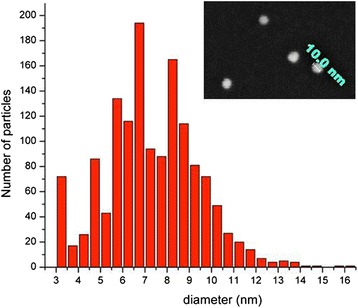
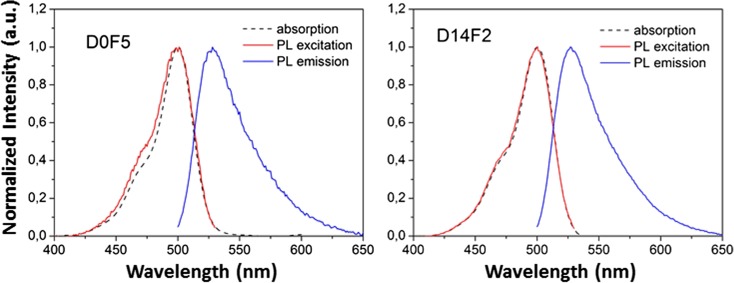
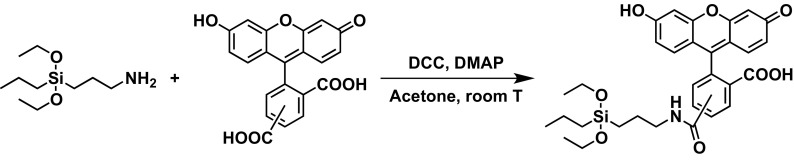
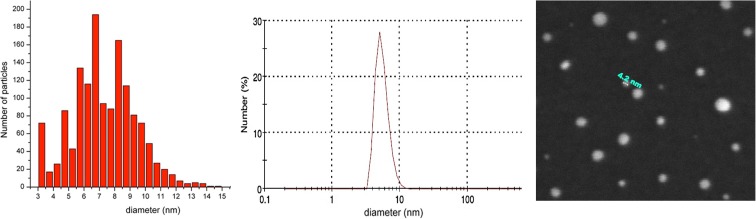
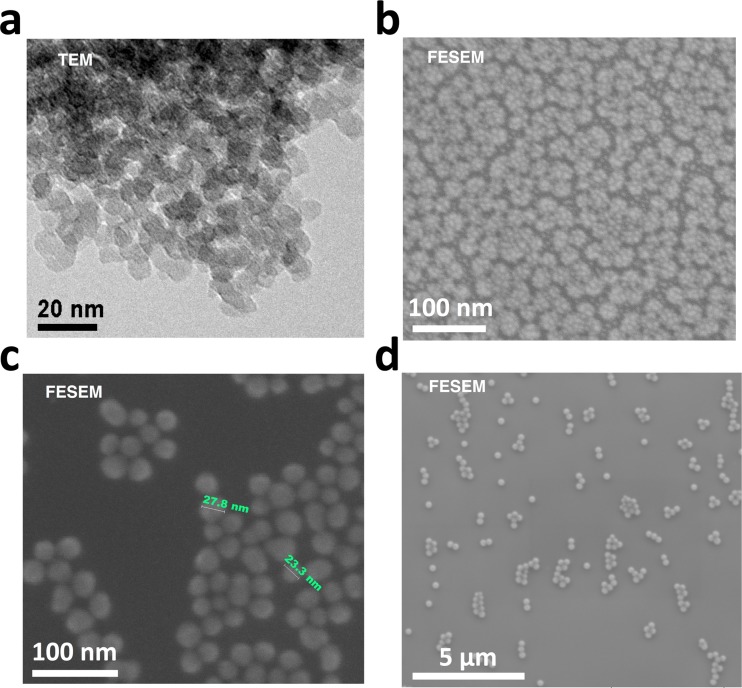
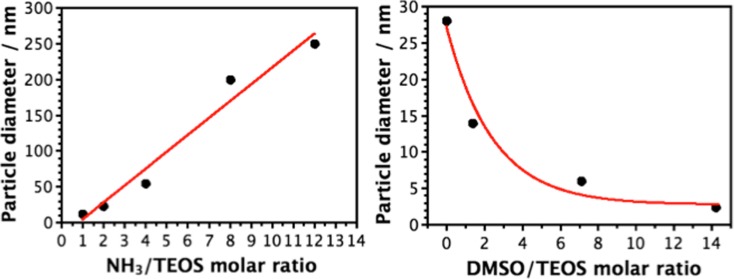
In modern biosensing and imaging, fluorescence-based methods constitute the most diffused approach to achieve optimal detection of analytes, both in solution and on the single-particle level. Despite the huge progresses made in recent decades in the development of plasmonic biosensors and label-free sensing techniques, fluorescent molecules remain the most commonly used contrast agents to date for commercial imaging and detection methods. However, they exhibit low stability, can be difficult to functionalise, and often result in a low signal-to-noise ratio. Thus, embedding fluorescent probes into robust and bio-compatible materials, such as silica nanoparticles, can substantially enhance the detection limit and dramatically increase the sensitivity. In this work, ultra-small fluorescent silica nanoparticles (NPs) for optical biosensing applications were doped with a fluorescent dye, using simple water-based sol-gel approaches based on the classical Stöber procedure. By systematically modulating reaction parameters, controllable size tuning of particle diameters as low as 10 nm was achieved. Particles morphology and optical response were evaluated showing a possible single-molecule behaviour, without employing microemulsion methods to achieve similar results. Graphical abstractWe report a simple, cheap, reliable protocol for the synthesis and systematic tuning of ultra-small (< 10 nm) dye-doped luminescent silica nanoparticles.
在现代生物传感与成像领域,基于荧光的方法是在溶液和单颗粒水平上实现对分析物进行最佳检测的最广泛应用的方法。尽管近几十年来等离子体生物传感器和无标记传感技术取得了巨大进展,但荧光分子仍是迄今为止商业成像和检测方法中最常用的造影剂。然而,它们稳定性低,功能化困难,并且常常导致低信噪比。因此,将荧光探针嵌入到诸如二氧化硅纳米颗粒等坚固且生物相容的材料中,可以显著提高检测限并大幅增加灵敏度。在这项工作中,采用基于经典斯托伯方法的简单水基溶胶 - 凝胶法,将用于光学生物传感应用的超小荧光二氧化硅纳米颗粒(NPs)掺杂荧光染料。通过系统地调节反应参数,实现了直径低至10纳米的颗粒直径的可控尺寸调节。评估了颗粒形态和光学响应,显示出可能的单分子行为,无需采用微乳液方法来获得类似结果。图形摘要我们报告了一种用于合成和系统调节超小(<10纳米)染料掺杂发光二氧化硅纳米颗粒的简单、廉价、可靠的方案。