Ruiz-Clavijo Alejandra, Hurt Andrew P, Kotha Arun K, Coleman Nichola J
Facultad de Ciencias Químicas, Universidad Complutense de Madrid, Av. Complutense, 28040 Madrid, Spain.
Faculty of Engineering and Science, University of Greenwich, Chatham Maritime, Kent ME4 4TB, UK.
J Funct Biomater. 2019 Feb 23;10(1):13. doi: 10.3390/jfb10010013.
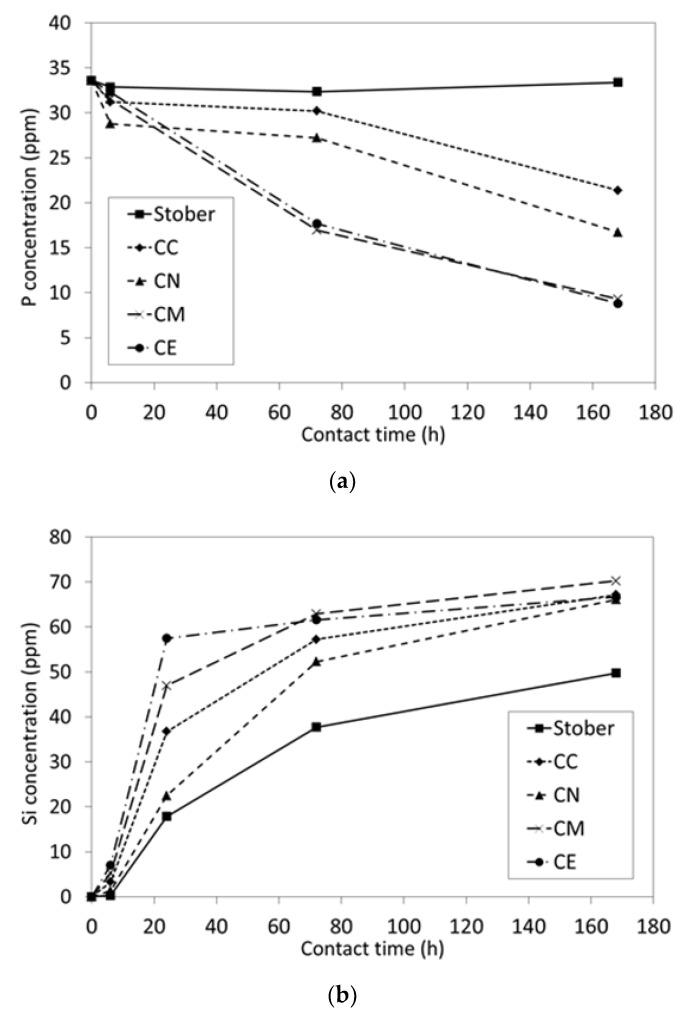
This study investigated the impact of different calcium reagents on the morphology, composition, bioactivity and biocompatibility of two-component (CaO-SiO₂) glasses produced by the Stöber process with respect to their potential application in guided tissue regeneration (GTR) membranes for periodontal repair. The properties of the binary glasses were compared with those of pure silica Stöber particles. The direct addition of calcium chloride (CC), calcium nitrate (CN), calcium methoxide (CM) or calcium ethoxide (CE) at 5 mol % with respect to tetraethyl orthosilicate in the reagent mixture gave rise to textured, micron-sized aggregates rather than monodispersed ~500 nm spheres obtained from the pure silica Stöber synthesis. The broadening of the Si-O-Si band at ~1100 cm in the infrared spectra of the calcium-doped glasses indicated that the silicate network was depolymerised by the incorporation of Ca ions and energy dispersive X-ray analysis revealed that, in all cases, the Ca:Si ratios were significantly lower than the nominal value of 0.05. The distribution of Ca ions was also found to be highly inhomogeneous in the methoxide-derived glass. All samples released soluble silica species on exposure to simulated body fluid, although only calcium-doped glasses exhibited bioactivity the formation of hydroxyapatite. The biocompatibilities of model chitosan-glass GTR membranes were assessed using human MG63 osteosarcoma cells and were found to be of the order: CN < pure silica ≈ CC << CM ≈ CE. Calcium nitrate is the most commonly reported precursor for the sol-gel synthesis of bioactive glasses; however, the incomplete removal of nitrate ions during washing compromised the cytocompatibility of the resulting glass. The superior bioactivity and biocompatibility of the alkoxide-derived glasses is attributed to their ease of dissolution and lack of residual toxic anions. Overall, calcium ethoxide was found to be the preferred precursor with respect to extent of calcium-incorporation, homogeneity, bioactivity and biocompatibility.
本研究调查了不同钙试剂对通过施托伯法制备的双组分(CaO-SiO₂)玻璃的形态、组成、生物活性和生物相容性的影响,这些玻璃有望应用于牙周修复的引导组织再生(GTR)膜。将二元玻璃的性能与纯二氧化硅施托伯颗粒的性能进行了比较。在试剂混合物中,相对于正硅酸四乙酯直接添加5 mol%的氯化钙(CC)、硝酸钙(CN)、甲醇钙(CM)或乙醇钙(CE),会产生有纹理的微米级聚集体,而不是从纯二氧化硅施托伯合成中获得的单分散500 nm球体。钙掺杂玻璃的红外光谱中1100 cm处Si-O-Si带的变宽表明,硅酸盐网络因Ca离子的掺入而解聚,能量色散X射线分析表明,在所有情况下,Ca:Si比均显著低于标称值0.05。还发现甲醇衍生玻璃中Ca离子的分布高度不均匀。所有样品在暴露于模拟体液时都会释放可溶性硅物种,尽管只有钙掺杂玻璃表现出生物活性——形成羟基磷灰石。使用人MG63骨肉瘤细胞评估了模型壳聚糖-玻璃GTR膜的生物相容性,发现其生物相容性顺序为:CN < 纯二氧化硅 ≈ CC << CM ≈ CE。硝酸钙是生物活性玻璃溶胶-凝胶合成中最常报道的前驱体;然而,洗涤过程中硝酸根离子未完全去除,损害了所得玻璃的细胞相容性。醇盐衍生玻璃优异的生物活性和生物相容性归因于它们易于溶解且缺乏残留的有毒阴离子。总体而言,就钙掺入程度、均匀性、生物活性和生物相容性而言,乙醇钙被认为是首选的前驱体。