Tecnologico de Monterrey, Campus Monterrey, Escuela de Ingeniería y Ciencias, Ave. Eugenio Garza Sada 2501, 64849, Monterrey, NL, México.
Planta. 2018 Jul;248(1):1-18. doi: 10.1007/s00425-018-2910-1. Epub 2018 May 7.
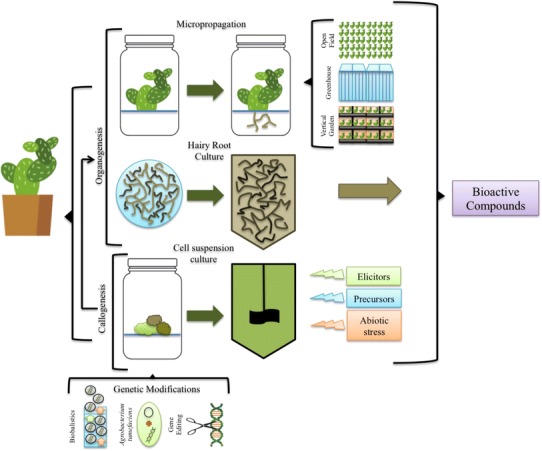
Plant tissue culture as an important tool for the continuous production of active compounds including secondary metabolites and engineered molecules. Novel methods (gene editing, abiotic stress) can improve the technique. Humans have a long history of reliance on plants for a supply of food, shelter and, most importantly, medicine. Current-day pharmaceuticals are typically based on plant-derived metabolites, with new products being discovered constantly. Nevertheless, the consistent and uniform supply of plant pharmaceuticals has often been compromised. One alternative for the production of important plant active compounds is in vitro plant tissue culture, as it assures independence from geographical conditions by eliminating the need to rely on wild plants. Plant transformation also allows the further use of plants for the production of engineered compounds, such as vaccines and multiple pharmaceuticals. This review summarizes the important bioactive compounds currently produced by plant tissue culture and the fundamental methods and plants employed for their production.
植物组织培养作为一种重要的工具,用于连续生产包括次生代谢物和工程分子在内的活性化合物。新方法(基因编辑、非生物胁迫)可以改进该技术。人类长期以来一直依赖植物来获取食物、住所,最重要的是药物。目前的药物通常基于植物衍生的代谢物,并且不断有新产品被发现。然而,植物药物的持续和统一供应经常受到影响。植物组织培养是生产重要植物活性化合物的一种替代方法,因为它通过消除对野生植物的依赖,确保了对地理条件的独立性。植物转化还允许进一步利用植物生产工程化合物,如疫苗和多种药物。本文综述了目前通过植物组织培养生产的重要生物活性化合物,以及用于生产这些化合物的基本方法和植物。