Department of Otorhinolaryngology-Head & Neck Surgery, College of Medicine, Korea University, Seoul, South Korea.
Neuroscience Research Institute, Korea University, College of Medicine, Seoul, Republic of Korea.
PLoS One. 2018 May 10;13(5):e0197355. doi: 10.1371/journal.pone.0197355. eCollection 2018.
In airway epithelium, thymus and activation-regulated chemokine (CCL17) and macrophage-derived chemokine (CCL22) are induced by defective epithelial barriers such as E-cadherin and attract the effector cells of Th2 immunity. However, the association between the epithelial barrier and CCL17 expression has not been studied in chronic rhinosinusitis with nasal polyp (CRSwNP). Thus, we aimed to evaluate the expression of CCL17 and its regulation by Th cytokines in nasal polyp (NP) epithelial cells.
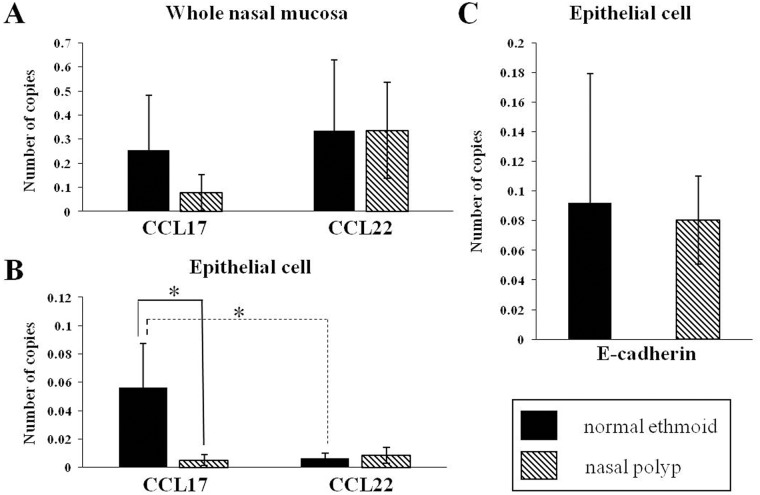
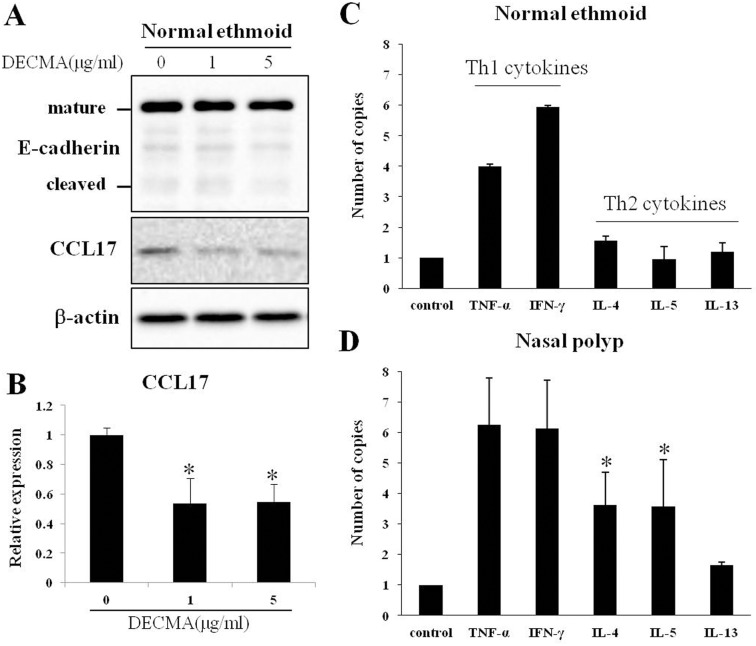
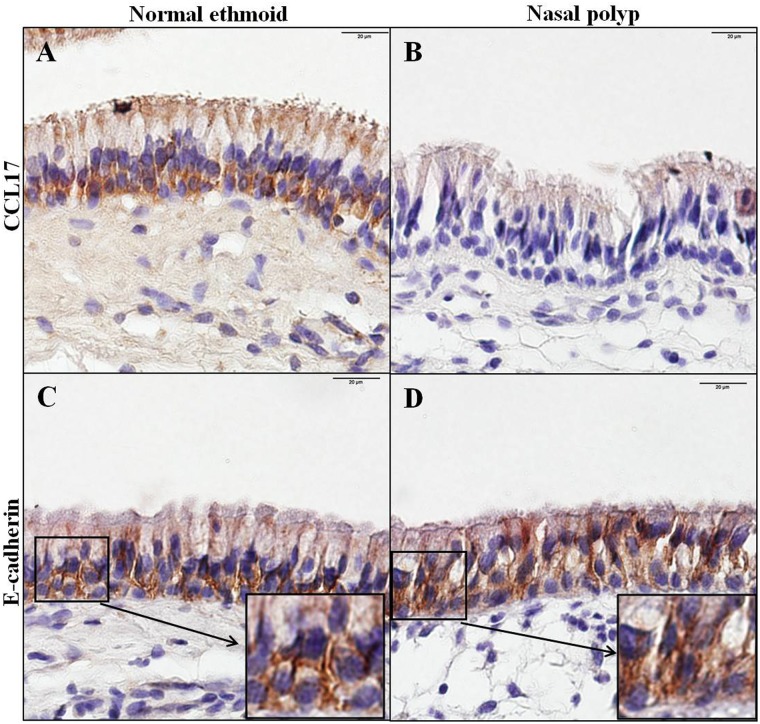
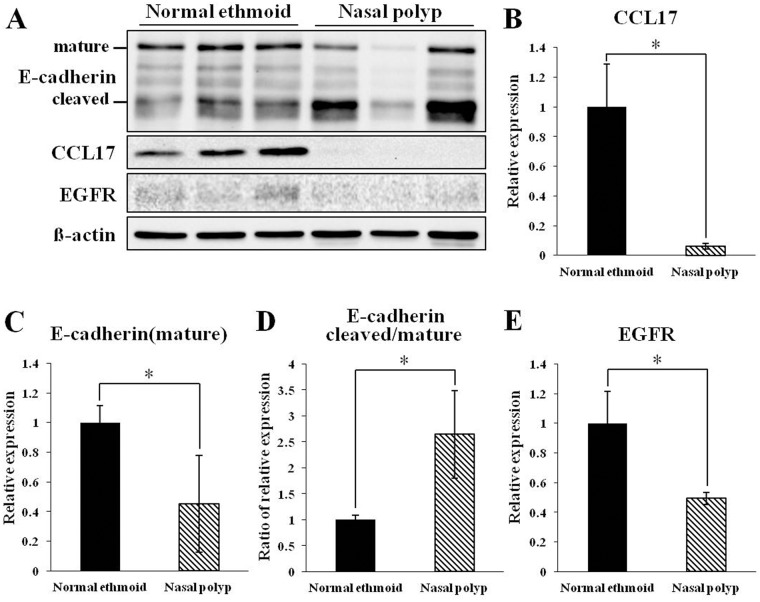
The expression and distribution of CCL17, CCL22, E-cadherin and/or epidermal growth factor receptor (EGFR) were measured using real-time PCR, western blot, and immunohistochemistry and compared between normal ethmoid sinus epithelium and NP epithelium. In addition, the expression level of CCL17 was determined in cultured epithelial cells treated with IL-4, IL-5, IL-13, TNF-α, and IFN-γ.
The expression of CCL17 was decreased in the NP epithelium compared to the epithelium of normal ethmoid sinus, whereas the expression of CCL22 was not decreased. E-cadherin was differentially distributed between the epithelium of normal ethmoid sinus and NP epithelium. EGFR was also decreased in NPs. Interestingly, the stimulation of cultured epithelial cells with Th2 cytokines, IL-4 and IL-5, resulted in an upregulation of CCL17 expression only in NP epithelial cells whereas the expression of CCL17 was increased in both normal epithelial cells and NP epithelial cells by Th1 cytokines.
Our results suggest that the decreased expression of CCL17 in defective NP epithelium may be closely connected to NP pathogenesis and can be differentially regulated by cytokines in the NP epithelium of patients with CRSwNP.
在气道上皮细胞中,胸腺和活化调节趋化因子(CCL17)和巨噬细胞来源的趋化因子(CCL22)在 E-钙黏蛋白等上皮屏障缺陷的情况下被诱导,并吸引 Th2 免疫的效应细胞。然而,在慢性鼻息肉鼻窦炎(CRSwNP)中,上皮屏障与 CCL17 表达之间的关系尚未得到研究。因此,我们旨在评估 CCL17 的表达及其在鼻息肉(NP)上皮细胞中被 Th 细胞因子调节的情况。
使用实时 PCR、western blot 和免疫组织化学方法测量 CCL17、CCL22、E-钙黏蛋白和/或表皮生长因子受体(EGFR)的表达和分布,并将其与正常筛窦上皮和 NP 上皮进行比较。此外,还在经 IL-4、IL-5、IL-13、TNF-α 和 IFN-γ 处理的培养上皮细胞中测定 CCL17 的表达水平。
与正常筛窦上皮相比,NP 上皮中 CCL17 的表达降低,而 CCL22 的表达并未降低。E-钙黏蛋白在正常筛窦上皮和 NP 上皮之间的分布不同。NP 中 EGFR 也减少。有趣的是,Th2 细胞因子 IL-4 和 IL-5 刺激培养的上皮细胞,仅在 NP 上皮细胞中导致 CCL17 表达上调,而 Th1 细胞因子可使正常上皮细胞和 NP 上皮细胞中 CCL17 的表达均增加。
我们的结果表明,在有缺陷的 NP 上皮中 CCL17 的表达降低可能与 NP 的发病机制密切相关,并可由 CRSwNP 患者的 NP 上皮细胞中的细胞因子差异调节。