Departamento de Bioquímica, Biología Molecular y Celular, Universidad de Zaragoza, 50009 Zaragoza, Spain.
Instituto de Investigación Sanitaria de Aragón (ISS), 50009 Zaragoza, Spain.
Int J Mol Sci. 2018 May 13;19(5):1449. doi: 10.3390/ijms19051449.
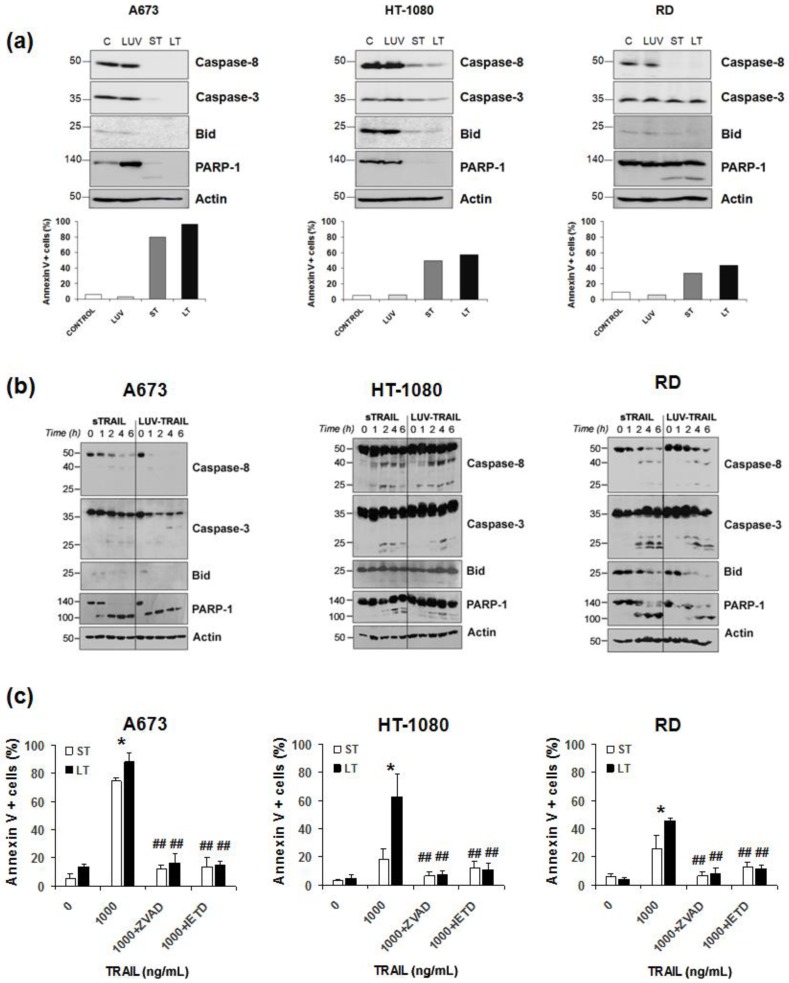
Sarcomas are rare and heterogeneous cancers classically associated with a poor outcome. Sarcomas are 1% of the cancer but recent estimations indicate that sarcomas account for 2% of the estimated cancer-related deaths. Traditional treatment with surgery, radiotherapy, and chemotherapy has improved the outcome for some types of sarcomas. However, novel therapeutic strategies to treat sarcomas are necessary. TNF-related apoptosis-inducing ligand (TRAIL) is a death ligand initially described as capable of inducing apoptosis on tumor cell while sparing normal cells. Only few clinical trials have used TRAIL-based treatments in sarcoma, but they show only low or moderate efficacy of TRAIL. Consequently, novel TRAIL formulations with an improved TRAIL bioactivity are necessary. Our group has developed a novel TRAIL formulation based on tethering this death ligand on a lipid nanoparticle surface (LUV-TRAIL) resembling the physiological secretion of TRAIL as a trasmembrane protein inserted into the membrane of exosomes. We have already demonstrated that LUV-TRAIL shows an improved cytotoxic activity when compared to soluble recombinant TRAIL both in hematological malignancies and epithelial-derived cancers. In the present study, we have tested LUV-TRAIL in several human sarcoma tumor cell lines with different sensitivity to soluble recombinant TRAIL, finding that LUV-TRAIL was more efficient than soluble recombinant TRAIL. Moreover, combined treatment of LUV-TRAIL with distinct drugs proved to be especially effective, sensitizing even more resistant cell lines to TRAIL.
肉瘤是一种罕见且异质性的癌症,通常与预后不良相关。肉瘤占癌症的 1%,但最近的估计表明,肉瘤占癌症相关死亡的 2%。传统的治疗方法包括手术、放疗和化疗,已经改善了某些类型肉瘤的预后。然而,需要新的治疗策略来治疗肉瘤。肿瘤坏死因子相关凋亡诱导配体(TRAIL)是一种死亡配体,最初被描述为能够诱导肿瘤细胞凋亡而不损伤正常细胞。只有少数临床试验在肉瘤中使用了基于 TRAIL 的治疗方法,但它们只显示出 TRAIL 的低或中等疗效。因此,需要具有改善的 TRAIL 生物活性的新型 TRAIL 制剂。我们的团队开发了一种新型的 TRAIL 制剂,即将这种死亡配体连接到脂质纳米颗粒表面(LUV-TRAIL)上,这种制剂类似于 TRAIL 作为跨膜蛋白插入到外体膜中的生理分泌方式。我们已经证明,与可溶性重组 TRAIL 相比,LUV-TRAIL 在血液恶性肿瘤和上皮来源的癌症中显示出更高的细胞毒性活性。在本研究中,我们在几种对可溶性重组 TRAIL 敏感性不同的人肉瘤肿瘤细胞系中测试了 LUV-TRAIL,发现 LUV-TRAIL 比可溶性重组 TRAIL 更有效。此外,LUV-TRAIL 与不同药物的联合治疗被证明特别有效,甚至使更耐药的细胞系对 TRAIL 更敏感。