Division of Public Health Sciences, Fred Hutchinson Cancer Research Center, 1100 Fairview Ave. N, M3-B232, Seattle, WA, 98109-1024, USA.
Department of Health Services, University of Washington School of Public Health, Seattle, WA, USA.
BMC Public Health. 2018 May 16;18(1):634. doi: 10.1186/s12889-018-5547-x.
Hispanics bear some of the highest burden of the obesity epidemic and the disparities gap is bigger among Hispanics in rural communities. This mixed methods study examined the objective and subjective assessment of food availability and food access in four rural, agricultural, and predominantly Hispanic communities.
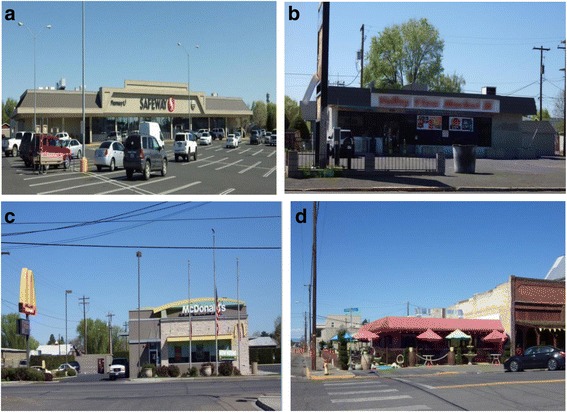
In this convergent parallel mixed methods study, we used the Nutrition Environment Measures Survey (NEMS) of Food Stores and Restaurants to objectively assess 57 food stores and 69 restaurants in four rural agricultural communities in Washington State. To complement the objective assessment findings, we conducted semi-structured interviews with 32 community residents. The data were collected from 2013 to 2014. Frequencies and means were calculated for quantitative data and content analysis conducted for interview data.
Participants (n = 32) had a mean age of 35.6 (SD 6.2) years, were mostly women, uninsured, low income, and had less than a high school education. Grocery and convenience stores had low NEMS composite scores indicating low overall availability of food items, low quality, and high food prices. Composite scores for sit-down restaurants, fast casual restaurants, and fast-food restaurants were similarly low in all four towns indicating limited availability of healthier options. Semi-structured interviews revealed participants perceived high availability and accessibility of quality fresh produce. Most participants reported eating out regularly several times a week, frequenting restaurant chains that serve buffets or fast foods, and allowing children to make decisions regarding their own food choices.
Community members' perception of food availability and food access may be different from the objective assessment of food environment. This information can be used to inform community-wide interventions to address food environment in these rural communities.
西班牙裔人群承受着肥胖流行带来的沉重负担,农村社区的西班牙裔人群之间的差异更为明显。本混合方法研究旨在评估四个农村农业社区中食物供应和获取的客观和主观情况,这些社区以西班牙裔居民为主。
在这项汇聚平行混合方法研究中,我们使用了《食品商店和餐馆营养环境测量工具》(NEMS)对华盛顿州四个农村农业社区的 57 家食品店和 69 家餐馆进行了客观评估。为了补充客观评估结果,我们对 32 名社区居民进行了半结构化访谈。数据收集于 2013 年至 2014 年。对定量数据进行了频率和平均值计算,对访谈数据进行了内容分析。
参与者(n=32)的平均年龄为 35.6(6.2)岁,大多数为女性,没有保险,收入较低,受教育程度较低。杂货店和便利店的 NEMS 综合评分较低,表明食品种类总体供应不足、质量低、食品价格高。四个城镇的坐式餐厅、休闲快餐餐厅和快餐店的综合评分也较低,表明健康选择有限。半结构化访谈显示,参与者认为高质量新鲜农产品的供应充足且易于获取。大多数参与者报告说他们每周经常外出就餐几次,光顾提供自助餐或快餐的连锁餐厅,并允许孩子自己选择食物。
社区成员对食物供应和获取的看法可能与食物环境的客观评估不同。这些信息可用于为这些农村社区的社区范围干预提供依据,以解决食物环境问题。