Department of General and Interventional Cardiology, University Heart Center Hamburg-Eppendorf, Hamburg, Germany.
DZHK Affiliation, partner site Hamburg/Kiel/Lübeck, Germany.
PLoS One. 2018 May 17;13(5):e0197497. doi: 10.1371/journal.pone.0197497. eCollection 2018.
Growth differentiation factor-15 (GDF-15), Cystatin C and C-reactive protein (CRP) have been discussed as biomarkers for prediction of cardiac diseases. The aim of this study was to investigate the predictive value of single and repeated measurements of GDF-15 compared to Cystatin C and CRP for incidence of heart failure (HF) and death due to coronary heart disease (CHD) in the general population.
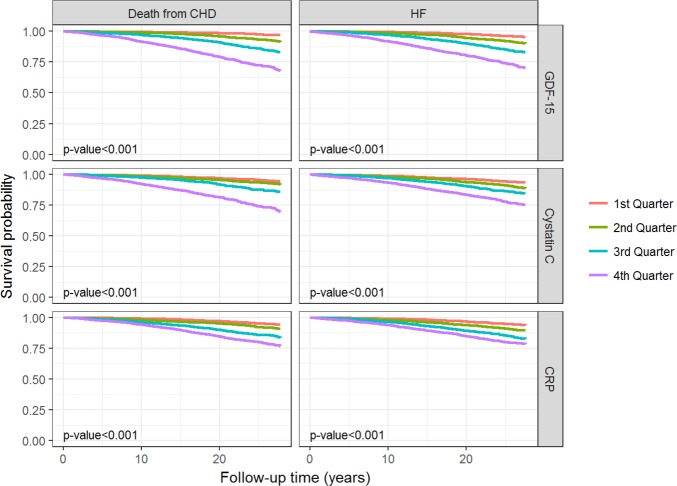
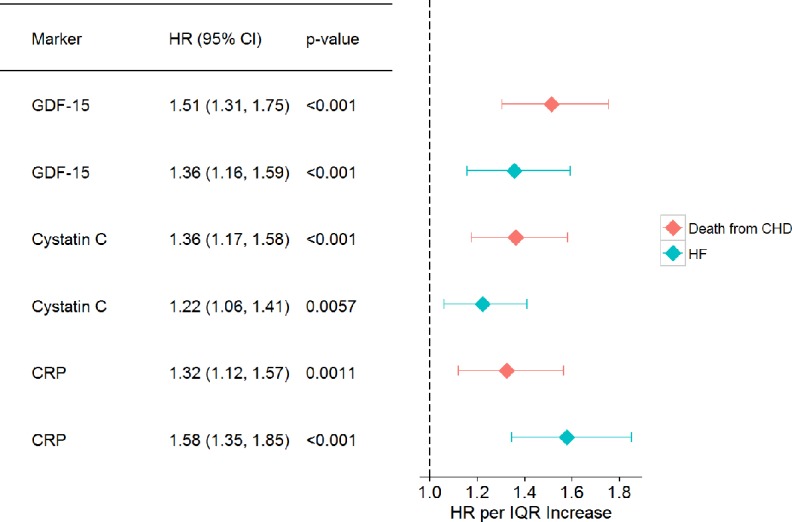
Levels of GDF-15, CRP and Cystatin C were determined in three repeated measurements collected 5 years apart in the DAN-MONICA (Danish-Multinational MONitoring of trends and determinants in Cardiovascular disease) cohort (participants at baseline n = 3785). Cox regression models adjusted for cardiovascular risk factors revealed significantly increased hazard ratios (HR) for GDF-15 for incident HF 1.36 (HR per interquartile range (IQR) increase, 95% confidence interval (CI): 1.16; 1.59) and for death from CHD 1.51 (HR per IQR increase, 95% CI: 1.31, 1.75) (both with p<0.001). Joint modeling of time-to-event and longitudinal GDF-15 over a median 27-year follow-up period showed that the marker evolution was positively associated with death of CHD (HR per IQR increase 3.02 95% CI: (2.26, 4.04), p < 0.001) and HF (HR per IQR increase 2.12 95% CI: (1.54, 2.92), p<0.001). However using Cox models with follow-up time starting at the time of the third examination, serial measurement of GDF-15, modeled as changes between the measurements, did not improve prediction over that of the most recent measurement.
GDF-15 is a promising biomarker for prediction of HF and death due to CHD in the general population, which may provide prognostic information to already established clinical biomarkers. Repeated measurements of GDF-15 displayed only a slight improvement in the prediction of these endpoints compared to a single measurement.
生长分化因子 15(GDF-15)、胱抑素 C 和 C 反应蛋白(CRP)已被讨论为预测心脏疾病的生物标志物。本研究旨在探讨单次和多次测量 GDF-15 与胱抑素 C 和 CRP 相比,对一般人群心力衰竭(HF)和冠心病(CHD)死亡发生率的预测价值。
在丹麦-多国 MONitoring 趋势和心血管疾病决定因素(DAN-MONICA)队列中,在 5 年内进行了 3 次重复测量(基线时的参与者 n = 3785),测定了 GDF-15、CRP 和胱抑素 C 的水平。经过心血管危险因素调整的 Cox 回归模型显示,GDF-15 对 HF 发生率的风险比(HR)显著增加(每增加一个四分位距(IQR)的 HR,95%置信区间(CI):1.16;1.59)和 CHD 死亡率的 HR 增加 1.51(每 IQR 增加的 HR,95%CI:1.31,1.75)(均<0.001)。对中位 27 年随访期间时间事件和纵向 GDF-15 的联合建模显示,该标志物的演变与 CHD 死亡呈正相关(每 IQR 增加的 HR 为 3.02,95%CI:(2.26,4.04),p<0.001)和 HF(每 IQR 增加的 HR 为 2.12,95%CI:(1.54,2.92),p<0.001)。然而,在第三次检查时开始随访时间的 Cox 模型中,GDF-15 的连续测量,作为测量之间的变化,并未改善对最新测量的预测。
GDF-15 是预测一般人群 HF 和 CHD 死亡的有前途的生物标志物,它可以为已经建立的临床生物标志物提供预后信息。与单次测量相比,多次测量 GDF-15 对这些终点的预测仅略有改善。