Department of Pediatrics, Severance Children's Hospital, Yonsei University College of Medicine, Seoul, Korea.
Department of Pediatrics, Seoul National University Hospital, Seoul, Korea.
PLoS One. 2022 Feb 17;17(2):e0264184. doi: 10.1371/journal.pone.0264184. eCollection 2022.
Triage is an essential emergency department (ED) process designed to provide timely management depending on acuity and severity; however, the process may be inconsistent with clinical and hospitalization outcomes. Therefore, studies have attempted to augment this process with machine learning models, showing advantages in predicting critical conditions and hospitalization outcomes. The aim of this study was to utilize nationwide registry data to develop a machine learning-based classification model to predict the clinical course of pediatric ED visits.
This cross-sectional observational study used data from the National Emergency Department Information System on emergency visits of children under 15 years of age from January 1, 2016, to December 31, 2017. The primary and secondary outcomes were to identify critically ill children and predict hospitalization from triage data, respectively. We developed and tested a random forest model with the under sampled dataset and validated the model using the entire dataset. We compared the model's performance with that of the conventional triage system.
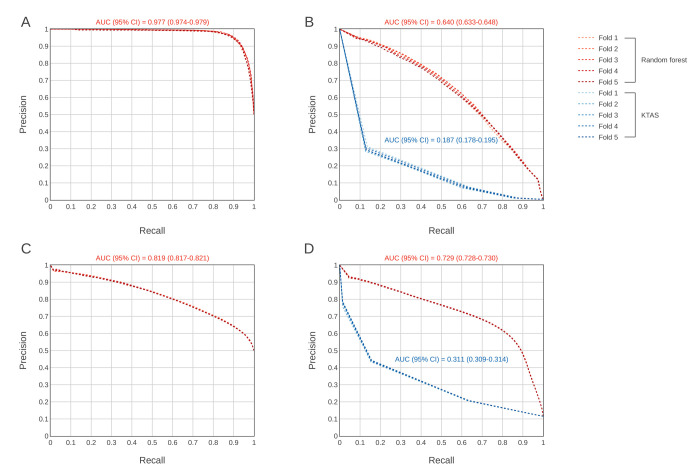
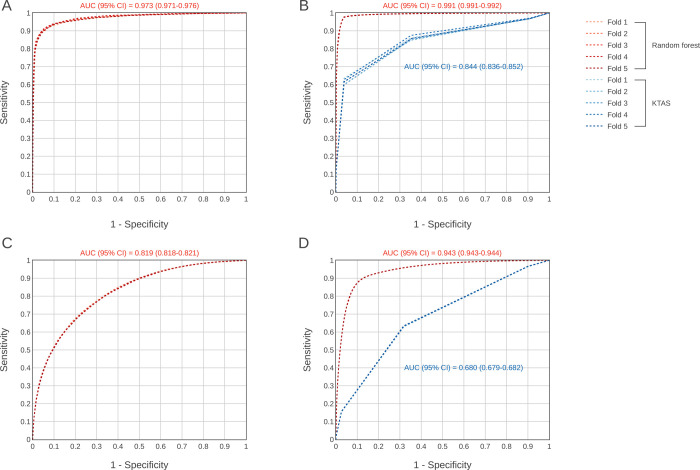
A total of 2,621,710 children were eligible for the analysis and included 12,951 (0.5%) critical outcomes and 303,808 (11.6%) hospitalizations. After validation, the area under the receiver operating characteristic curve was 0.991 (95% confidence interval [CI] 0.991-0.992) for critical outcomes and 0.943 (95% CI 0.943-0.944) for hospitalization, which were higher than those of the conventional triage system.
The machine learning-based model using structured triage data from a nationwide database can effectively predict critical illness and hospitalizations among children visiting the ED.
分诊是急诊科的一项基本流程,旨在根据病情的紧急和严重程度进行及时管理;然而,该流程可能与临床和住院结局不一致。因此,研究已经尝试使用机器学习模型来增强该流程,这些模型在预测危急情况和住院结局方面显示出了优势。本研究旨在利用全国性的登记数据开发一个基于机器学习的分类模型,以预测儿科急诊科就诊的临床过程。
本横断面观察性研究使用了全国性的急诊部门信息系统(National Emergency Department Information System)的数据,纳入了 2016 年 1 月 1 日至 2017 年 12 月 31 日期间 15 岁以下儿童的急诊就诊数据。主要和次要结局分别是识别危重症患儿和根据分诊数据预测住院。我们开发并测试了一个基于欠采样数据集的随机森林模型,并使用整个数据集对模型进行了验证。我们比较了模型与传统分诊系统的性能。
共有 2621710 名儿童符合分析条件,其中 12951 例(0.5%)为危急结局,303808 例(11.6%)为住院治疗。经过验证,该模型对危急结局的受试者工作特征曲线下面积为 0.991(95%置信区间[CI]0.991-0.992),对住院治疗的面积为 0.943(95% CI 0.943-0.944),均高于传统分诊系统。
使用来自全国性数据库的结构化分诊数据的基于机器学习的模型可以有效地预测儿童急诊科就诊的危重症和住院情况。