Li Zhongchao, Liu Hu, Li Yakui, Lv Zhiqian, Liu Ling, Lai Changhua, Wang Junjun, Wang Fenglai, Li Defa, Zhang Shuai
State Key Laboratory of Animal Nutrition, Ministry of Agriculture Feed Industry Centre, China Agricultural University, Beijing, 100193 China.
J Anim Sci Biotechnol. 2018 May 16;9:39. doi: 10.1186/s40104-018-0254-0. eCollection 2018.
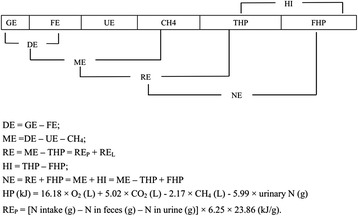
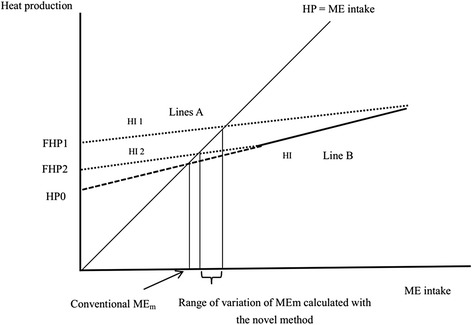
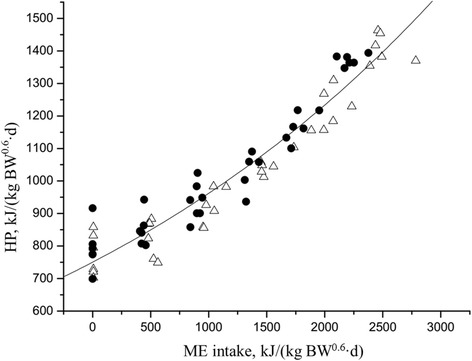
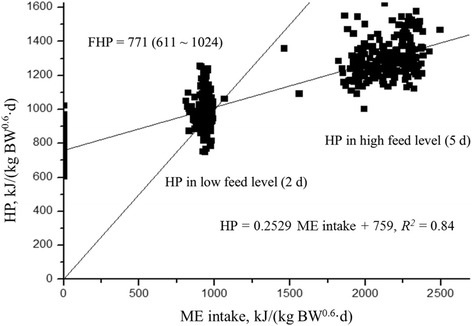
In the past two decades, a considerable amount of research has focused on the determination of the digestible (DE) and metabolizable energy (ME) contents of feed ingredients fed to swine. Compared with the DE and ME systems, the net energy (NE) system is assumed to be the most accurate estimate of the energy actually available to the animal. However, published data pertaining to the measured NE content of ingredients fed to growing pigs are limited. Therefore, the Feed Data Group at the Ministry of Agricultural Feed Industry Centre (MAFIC) located at China Agricultural University has evaluated the NE content of many ingredients using indirect calorimetry. The present review summarizes the NE research works conducted at MAFIC and compares these results with those from other research groups on methodological aspect. These research projects mainly focus on estimating the energy requirements for maintenance and its impact on the determination, prediction, and validation of the NE content of several ingredients fed to swine. The estimation of maintenance energy is affected by methodology, growth stage, and previous feeding level. The fasting heat production method and the curvilinear regression method were used in MAFIC to estimate the NE requirement for maintenance. The NE contents of different feedstuffs were determined using indirect calorimetry through standard experimental procedure in MAFIC. Previously generated NE equations can also be used to predict NE in situations where calorimeters are not available. Although popular, the caloric efficiency is not a generally accepted method to validate the energy content of individual feedstuffs. In the future, more accurate and dynamic NE prediction equations aiming at specific ingredients should be established, and more practical validation approaches need to be developed.
在过去二十年中,大量研究聚焦于测定猪饲料原料的消化能(DE)和代谢能(ME)含量。与DE和ME系统相比,净能(NE)系统被认为是对动物实际可利用能量的最准确估计。然而,关于生长猪所喂饲料原料实测NE含量的已发表数据有限。因此,位于中国农业大学的农业农村部饲料工业中心(MAFIC)饲料数据组采用间接测热法评估了多种原料的NE含量。本综述总结了MAFIC开展的NE研究工作,并在方法学方面将这些结果与其他研究组的结果进行了比较。这些研究项目主要集中于估计维持能量需求及其对几种猪饲料原料NE含量的测定、预测和验证的影响。维持能量的估计受方法、生长阶段和先前饲喂水平的影响。MAFIC采用禁食产热法和曲线回归法估计维持所需的NE。MAFIC通过标准实验程序采用间接测热法测定了不同饲料原料的NE含量。在没有热量计的情况下,先前生成的NE方程也可用于预测NE。尽管热量效率很常用,但它并非验证单个饲料原料能量含量的普遍接受的方法。未来,应建立针对特定原料的更准确、更具动态性的NE预测方程,并开发更实用的验证方法。