Aryani Arash, Hsu Chun-Ting, Jacobs Arthur M
Department of Experimental and Neurocognitive Psychology, Freie Universität Berlin, Habelschwerdter Allee 45, D⁻14195 Berlin, Germany.
Department of Psychology, Pennsylvania State University, PA 16802, USA.
Brain Sci. 2018 May 23;8(6):94. doi: 10.3390/brainsci8060094.
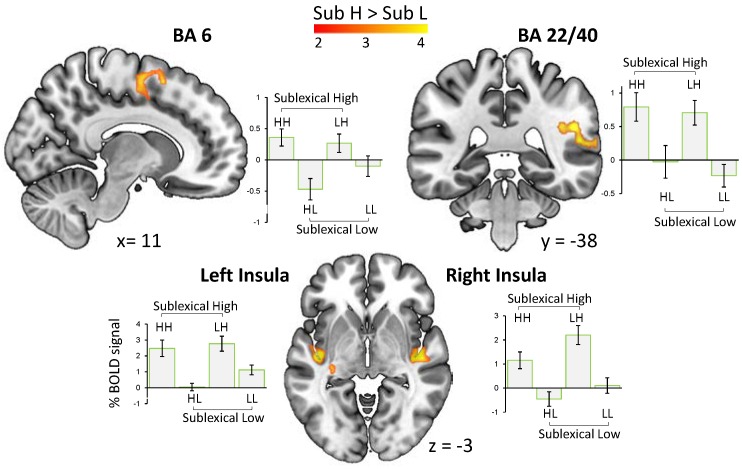
The long history of poetry and the arts, as well as recent empirical results suggest that the way a word sounds (e.g., soft vs. harsh) can convey affective information related to emotional responses (e.g., pleasantness vs. harshness). However, the neural correlates of the affective potential of the sound of words remain unknown. In an fMRI study involving passive listening, we focused on the affective dimension of arousal and presented words organized in two discrete groups of sublexical (i.e., sound) arousal (high vs. low), while controlling for lexical (i.e., semantic) arousal. Words sounding high arousing, compared to their low arousing counterparts, resulted in an enhanced BOLD signal in bilateral posterior insula, the right auditory and premotor cortex, and the right supramarginal gyrus. This finding provides first evidence on the neural correlates of affectivity in the sound of words. Given the similarity of this neural network to that of nonverbal emotional expressions and affective prosody, our results support a unifying view that suggests a core neural network underlying any type of affective sound processing.
诗歌与艺术的悠久历史以及近期的实证结果表明,一个单词的发音方式(例如,柔和与刺耳)能够传达与情感反应相关的情感信息(例如,愉悦与刺耳)。然而,单词声音的情感潜能的神经关联仍然未知。在一项涉及被动聆听的功能磁共振成像(fMRI)研究中,我们聚焦于唤醒的情感维度,并呈现了按照两个离散的次词汇(即声音)唤醒组(高与低)组织的单词,同时控制词汇(即语义)唤醒。与低唤醒的对应单词相比,高唤醒的发音单词在双侧后岛叶、右侧听觉和运动前皮层以及右侧缘上回产生了增强的血氧水平依赖(BOLD)信号。这一发现为单词声音情感性的神经关联提供了首个证据。鉴于这个神经网络与非言语情感表达和情感韵律的神经网络相似,我们的结果支持一种统一观点,即表明存在一个潜在的核心神经网络用于任何类型的情感声音处理。