Department of Neuropsychiatry, Seoul National University Bundang Hospital, 166 Gumiro, Bundanggu, Seongnamsi, Gyeonggido, 463-707, Korea.
Department of Psychiatry, Yonsei University Wonju Severance Christian Hospital, Wonju, Gangwon-do, Korea.
Alzheimers Res Ther. 2018 May 24;10(1):50. doi: 10.1186/s13195-018-0380-0.
We investigated the effects of lifetime cumulative ginseng intake on cognitive function in a community-dwelling population-based prospective cohort of Korean elders.
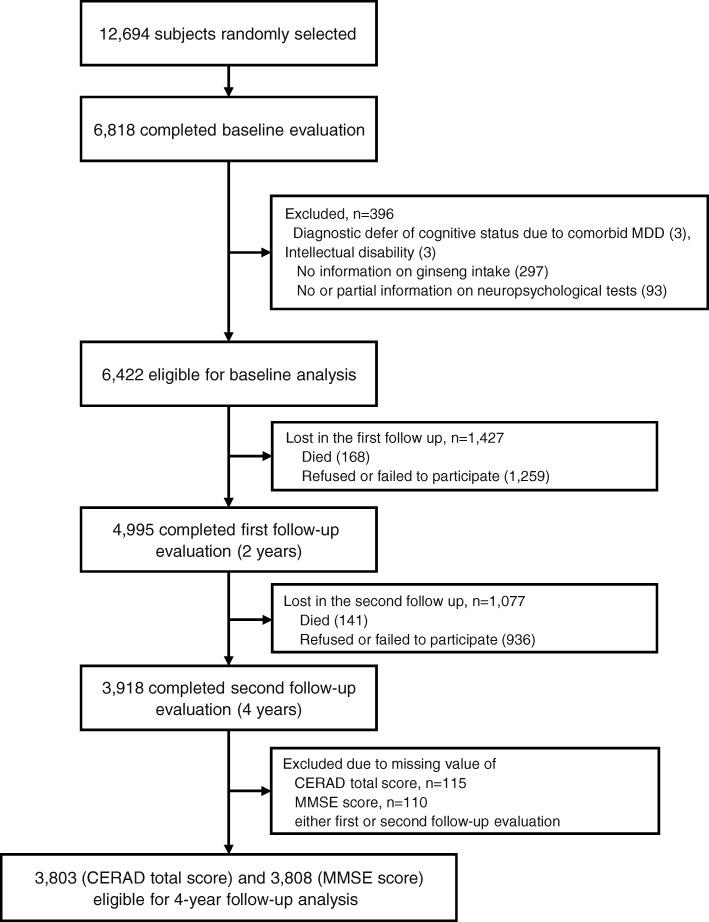
Community-dwelling elders (N = 6422; mean age = 70.2 ± 6.9 years, education = 8.0 ± 5.3 years, female = 56.8%) from the Korean Longitudinal Study on Cognitive Aging and Dementia were included. Among them, 3918 participants (61.0%) completed the 2-year and 4-year follow-up evaluations. Subjects were categorized according to cumulative ginseng intake at baseline evaluation; no use group, low use (< 5 years) group, and high use (≥ 5 years) group. One-way analysis of covariance (ANCOVA) was conducted to compare the impact of cumulative ginseng intake on baseline Consortium to Establish a Registry for Alzheimer's Disease Assessment Packet neuropsychological battery total score (CERAD total score) and Mini-Mental State Examination (MMSE) score among the three groups while adjusting for potential covariates. A repeated-measures ANCOVA was performed to investigate the impacts on the changes in CERAD total scores and MMSE scores during the 4 years of follow-up.
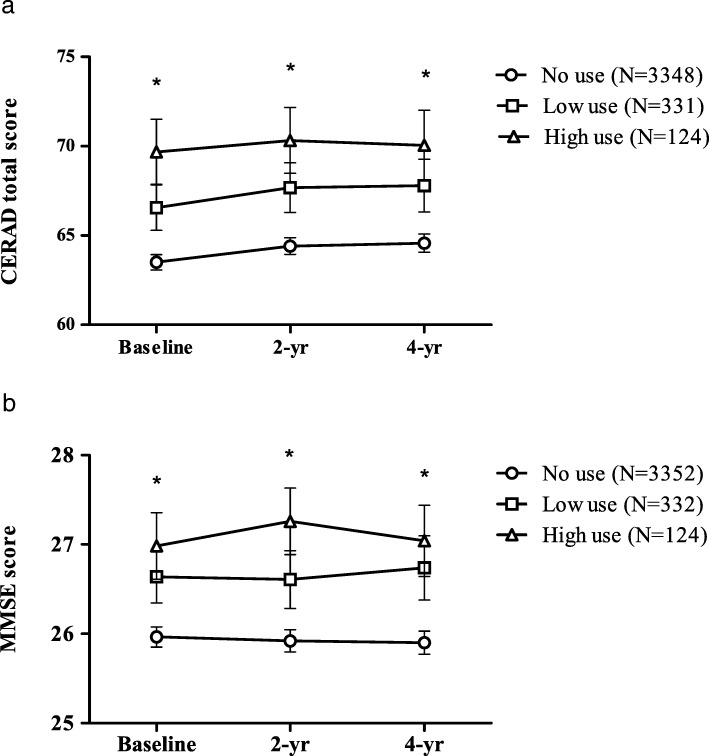
The high use group showed higher CERAD total scores compared to the no use group after controlling for age, sex, education years, socioeconomic status, smoking, alcohol intake, presence of hypertension, stroke history, Geriatric Depression Scale, Cumulative Illness Rating Scale, and presence of the APOE e4 allele (F(2, 4762) = 3.978, p = 0.019). The changes of CERAD total score for 2 or 4 years of follow-up did not differ according to the use of ginseng.
Cumulative ginseng use for longer than 5 years may be beneficial to cognitive function in late life.
我们调查了终生累积人参摄入量对韩国老年人社区居住人群前瞻性队列认知功能的影响。
纳入了来自韩国认知老化与痴呆纵向研究的社区居住老年人(N=6422;平均年龄 70.2±6.9 岁,教育年限 8.0±5.3 年,女性 56.8%)。其中 3918 名参与者(61.0%)完成了 2 年和 4 年的随访评估。根据基线评估时的累积人参摄入量将受试者分为无使用组、低使用组(<5 年)和高使用组(≥5 年)。采用单因素方差分析(ANCOVA)比较三组累积人参摄入量对基线 Consortium to Establish a Registry for Alzheimer's Disease Assessment Packet 神经心理成套测验总分(CERAD 总分)和简易精神状态检查(MMSE)评分的影响,同时调整潜在混杂因素。采用重复测量 ANCOVA 分析 4 年随访期间 CERAD 总分和 MMSE 评分的变化。
在校正年龄、性别、教育年限、社会经济地位、吸烟、饮酒、高血压、卒中史、老年抑郁量表、累积疾病评分和 APOE e4 等位基因后,高使用组的 CERAD 总分高于无使用组(F(2, 4762)=3.978,p=0.019)。人参使用 2 年或 4 年的 CERAD 总分变化无差异。
累积使用人参超过 5 年可能对晚年认知功能有益。