Liu Hu, Chen Yifan, Ming Dongxu, Wang Ji, Li Zhen, Ma Xi, Wang Junjun, van Milgen Jaap, Wang Fenglai
1State Key Laboratory of Animal Nutrition, China Agricultural University, Beijing, 100193 China.
2State Key Laboratory of Plant Physiology and Biochemistry, College of Biological Sciences, China Agricultural University, Beijing, 100193 China.
J Anim Sci Biotechnol. 2018 May 16;9:41. doi: 10.1186/s40104-018-0257-x. eCollection 2018.
Fasting is a simple metabolic strategy that is used to estimate the maintenance energy requirement where the energy supply for basic physiological functions is provided by the mobilization of body reserves. However, the underlying metabolic components of maintenance energy expenditure are not clear. This study investigated the differences in heat production (HP), respiratory quotient (RQ) and plasma metabolites in pigs in the fed and fasted state, using the techniques of indirect calorimetry and metabolomics.
Nine barrows (45.2 ± 1.7 kg BW) were fed corn-soybean based meal diets and were kept in metabolism crates for a period of 14 d. After 7 d adaptation, pigs were transferred to respiratory chambers to determine HP and RQ based on indirect calorimetry. Pigs were fed the diet at 2,400 kJ ME/(kg BW·d) during d 8 to 12. The last 2 d were divided into 24 h fasting and 48 h fasting treatment, respectively. Plasma samples of each pig were collected from the anterior vena cava during the last 3 d (1 d while pigs were fed and 2 d during which they were fasted). The metabolites of plasma were determined by high-resolution mass spectrometry using a metabolomics approach.
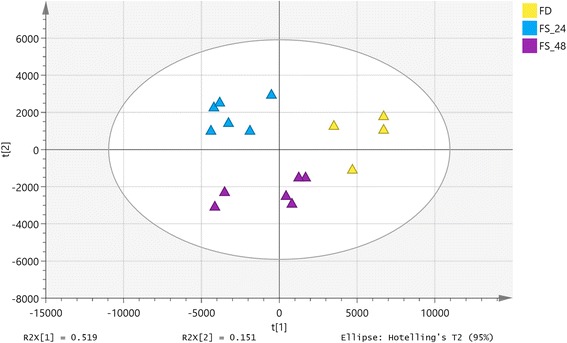
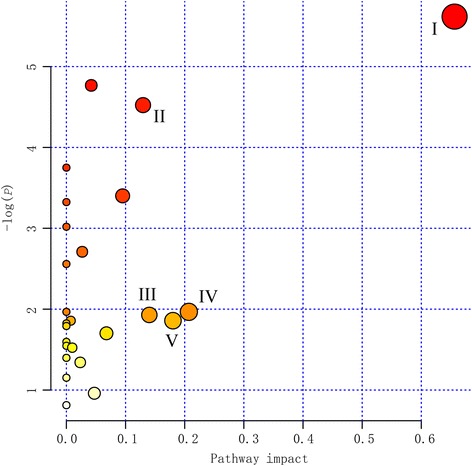
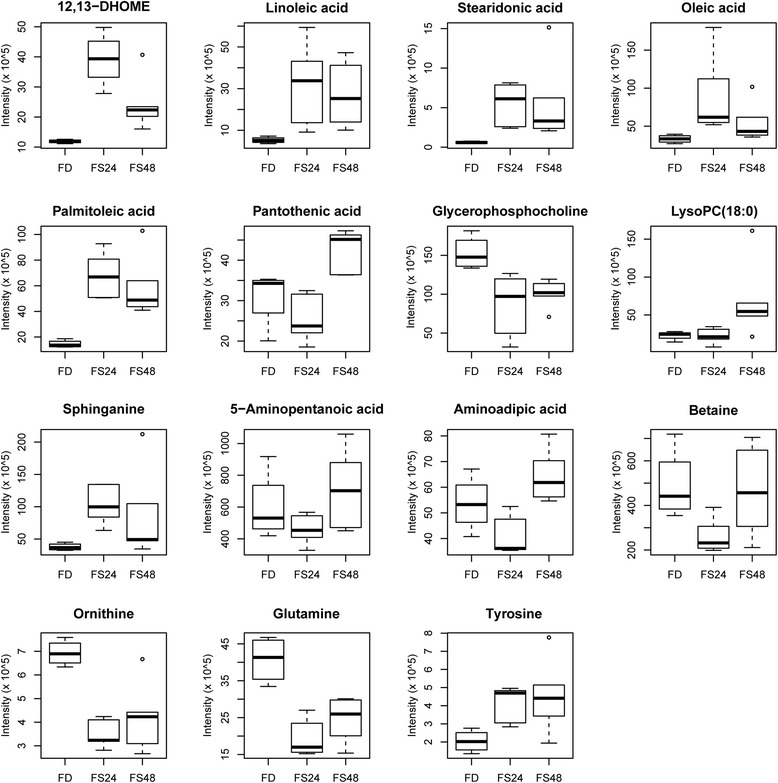
Indirect calorimetry analysis revealed that HP and RQ were no significant difference between 24 h fasting and 48 h fasting, which were lower than those of fed state ( < 0.01). The nitrogen concentration of urine tended to decrease with fasting ( = 0.054). Metabolomics analysis between the fed and fasted state revealed differences in 15 compounds, most of which were not significantly different between 24 h fasting and 48 h fasting. Identified compounds were enriched in metabolic pathways related to linoleic acid metabolism, amino acid metabolism, sphingolipid metabolism, and pantothenate and CoA biosynthesis.
These results suggest that the decreases in HP and RQ of growing pigs under fasting conditions were associated with the alterations of linoleic acid metabolism and amino acid metabolism. The integrative analysis also revealed that growing pigs under a 24-h fasting were more appropriate than a 48-h fasting to investigate the metabolic components of maintenance energy expenditure.
禁食是一种简单的代谢策略,用于估算维持能量需求,即通过动员身体储备来为基本生理功能提供能量供应。然而,维持能量消耗的潜在代谢成分尚不清楚。本研究采用间接测热法和代谢组学技术,研究了采食和禁食状态下猪的产热(HP)、呼吸商(RQ)和血浆代谢物的差异。
选用9头公猪(体重45.2±1.7 kg),饲喂玉米-豆粕型日粮,置于代谢笼中饲养14 d。适应7 d后,将猪转移至呼吸室,采用间接测热法测定HP和RQ。第8至12天,按2400 kJ ME/(kg体重·d)的量给猪饲喂日粮。最后2 d分别分为24 h禁食和48 h禁食处理。在最后3 d(采食1 d和禁食2 d)从每头猪的前腔静脉采集血浆样本。采用代谢组学方法,通过高分辨率质谱法测定血浆代谢物。
间接测热法分析表明,24 h禁食和48 h禁食之间的HP和RQ无显著差异,均低于采食状态(P<0.01)。尿液中的氮浓度随禁食时间延长呈下降趋势(P = 0.054)。采食和禁食状态之间的代谢组学分析显示,有15种化合物存在差异,其中大多数在24 h禁食和48 h禁食之间无显著差异。鉴定出的化合物在与亚油酸代谢、氨基酸代谢、鞘脂代谢以及泛酸和辅酶A生物合成相关的代谢途径中富集。
这些结果表明,禁食条件下生长猪的HP和RQ降低与亚油酸代谢和氨基酸代谢的改变有关。综合分析还表明,24 h禁食的生长猪比48 h禁食的生长猪更适合用于研究维持能量消耗的代谢成分。