Hong Jeeyoung, Kong Hyoun-Joong, Yoon Hyung-Jin
Biomedical Research Institute, Seoul National University Hospital, Seoul, Republic Of Korea.
Institute of Medical & Biological Engineering, Medical Research Center, Seoul National University College of Medicine, Seoul, Republic Of Korea.
JMIR Mhealth Uhealth. 2018 May 28;6(5):e132. doi: 10.2196/mhealth.9563.
While physical exercise is known to help prevent falls in the elderly, bad weather and long distance between the home and place of exercise represent substantial deterrents for the elderly to join or continue attending exercise programs outside their residence. Conventional modalities for home exercise can be helpful but do not offer direct and prompt feedback to the participant, which minimizes the benefit.
We aimed to develop an elderly-friendly telepresence exercise platform and to evaluate the effects of a 12-week telepresence exercise program on fall-related risk factors in community-dwelling elderly women with a high risk of falling.
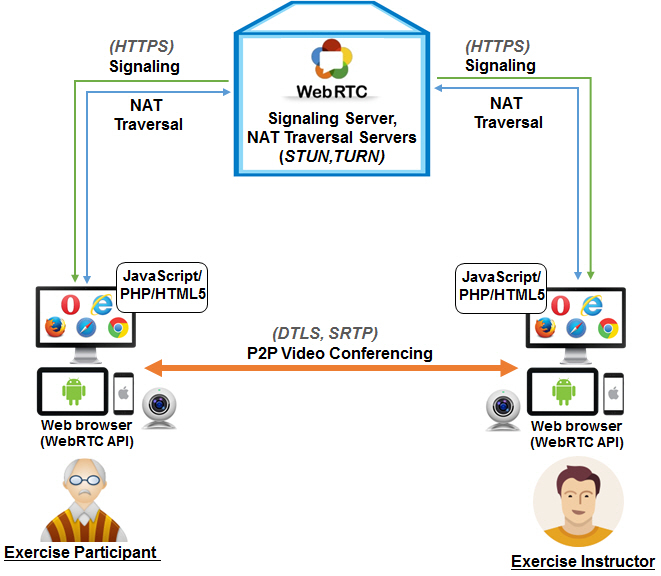
In total, 34 women aged 68-91 years with Fall Risk Assessment scores >14 and no medical contraindication to physical training-based therapy were recruited in person from a senior citizen center. The telepresence exercise platform included a 15-inch tablet computer, custom-made peer-to-peer video conferencing server system, and broadband Internet connectivity. The Web-based program included supervised resistance exercises performed using elastic resistance bands and balance exercise for 20-40 minutes a day, three times a week, for 12 weeks. During the telepresence exercise session, each participant in the intervention group was supervised remotely by a specialized instructor who provided feedback in real time. The women in the control group maintained their lifestyle without any intervention. Fall-related physical factors (body composition and physical function parameters) and psychological factors (Korean Falls Efficacy Scale score, Fear of Falling Questionnaire score) before and after the 12-week interventional period were examined in person by an exercise specialist blinded to the group allocation scheme.
Of the 30 women enrolled, 23 completed the study. Compared to women in the control group (n=13), those in the intervention group (n=10) showed significant improvements on the scores for the chair stand test (95% confidence interval -10.45 to -5.94, P<.001), Berg Balance Scale (95% confidence interval -2.31 to -0.28, P=.02), and Fear of Falling Questionnaire (95% confidence interval 0.69-3.5, P=.01).
The telepresence exercise program had positive effects on fall-related risk factors in community-dwelling elderly women with a high risk of falling. Elderly-friendly telepresence technology for home-based exercises can serve as an effective intervention to improve fall-related physical and psychological factors.
Clinical Research Information Service KCT0002710; https://cris.nih.go.kr/cris/en/search/ search_result_st01.jsp?seq=11246 (Archived by WebCite at http://www.webcitation.org/6zdSUEsmb).

虽然体育锻炼有助于预防老年人跌倒,但恶劣天气以及住所与锻炼场所之间的长距离对老年人参加或继续参加住所外的锻炼项目构成了重大阻碍。传统的家庭锻炼方式可能会有所帮助,但无法为参与者提供直接和即时的反馈,从而降低了益处。
我们旨在开发一个方便老年人使用的远程临场锻炼平台,并评估一项为期12周的远程临场锻炼项目对社区居住的高跌倒风险老年女性跌倒相关风险因素的影响。
从一个老年中心亲自招募了34名年龄在68 - 91岁之间、跌倒风险评估得分>14且无体育锻炼治疗医学禁忌证的女性。远程临场锻炼平台包括一台15英寸平板电脑、定制的点对点视频会议服务器系统和宽带互联网连接。基于网络的项目包括使用弹力带进行的有监督的阻力锻炼和平衡锻炼,每天20 - 40分钟,每周三次,共12周。在远程临场锻炼期间,干预组的每位参与者由一名专业教练进行远程监督,教练实时提供反馈。对照组的女性保持其生活方式,不进行任何干预。在为期12周的干预期前后,由一名对分组方案不知情的运动专家亲自检查与跌倒相关的身体因素(身体成分和身体功能参数)和心理因素(韩国跌倒效能量表得分、跌倒恐惧问卷得分)。
在登记的30名女性中,23名完成了研究。与对照组(n = 13)的女性相比,干预组(n = 10)的女性在椅子站立测试得分(95%置信区间 - 10.45至 - 5.94,P <.001)、伯格平衡量表得分(95%置信区间 - 2.31至 - 0.28,P =.02)和跌倒恐惧问卷得分(95%置信区间0.69 - 3.5,P =.01)方面有显著改善。
远程临场锻炼项目对社区居住的高跌倒风险老年女性的跌倒相关风险因素有积极影响。方便老年人使用的基于家庭锻炼的远程临场技术可作为一种有效的干预措施,以改善与跌倒相关的身体和心理因素。
临床研究信息服务KCT0002710;https://cris.nih.go.kr/cris/en/search/search_result_st01.jsp?seq=11246(由WebCite存档于http://www.webcitation.org/6zdSUEsmb)