Cui Peiyuan, Pang Qing, Wang Yong, Qian Zhen, Hu Xiaosi, Wang Wei, Li Zongkuang, Zhou Lei, Man Zhongran, Yang Song, Jin Hao, Liu Huichun
Department of Hepatobiliary Surgery, the First Affiliated Hospital of Bengbu Medical College, Bengbu, Anhui, China.
Medicine (Baltimore). 2018 Jun;97(22):e11000. doi: 10.1097/MD.0000000000011000.
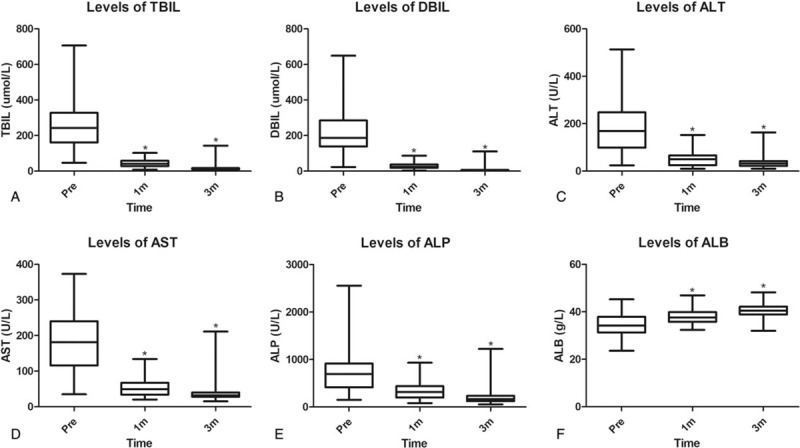
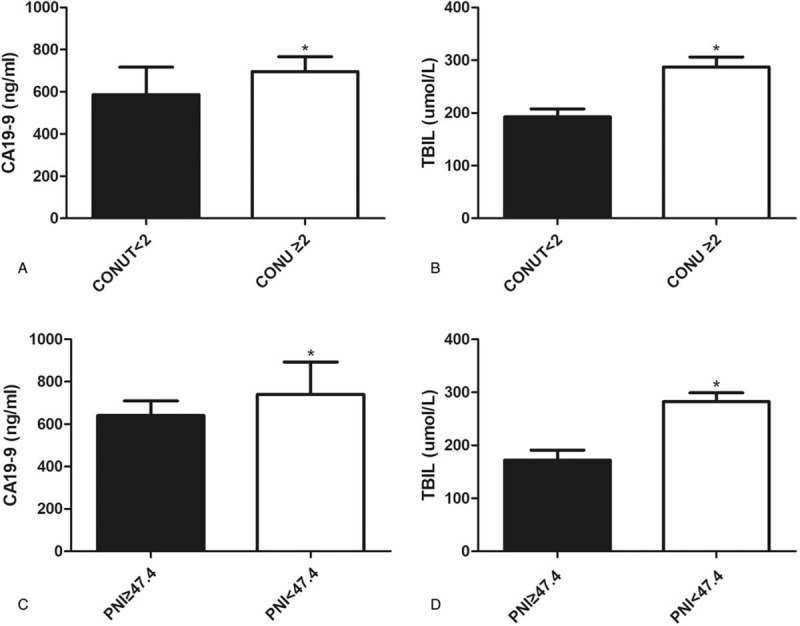
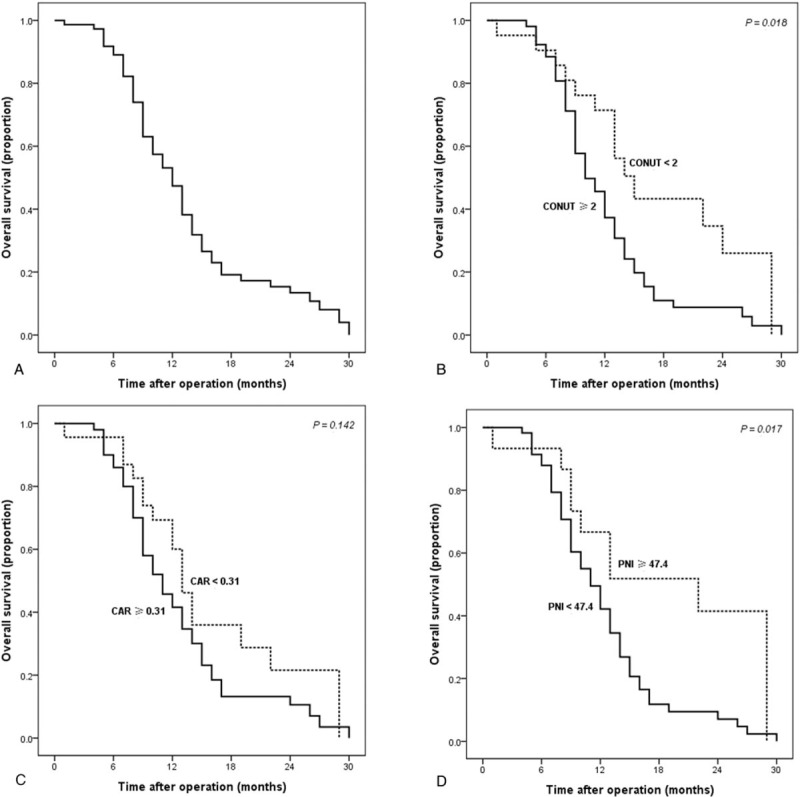
We mainly aimed to preliminarily explore the prognostic values of nutrition-based prognostic scores in patients with advanced hilar cholangiocarcinoma (HCCA).We retrospectively analyzed 73 cases of HCCA, who underwent percutaneous transhepatic biliary stenting (PTBS) combined with I seed intracavitary irradiation from November 2012 to April 2017 in our department. The postoperative changes of total bilirubin (TBIL), direct bilirubin (DBIL), alanine aminotransferase (ALT), aspartate aminotransferase (AST), alkaline phosphatase (ALP), and albumin (ALB) were observed. The preoperative clinical data were collected to calculate the nutrition-based scores, including controlling nutritional status (CONUT), C-reactive protein/albumin ratio (CAR), and prognostic nutritional index (PNI). Kaplan-Meier curve and Cox regression model were used for overall survival (OS) analyses.The serum levels of TBIL, DBIL, ALT, AST, and ALP significantly reduced, and ALB significantly increased at 1 month and 3 months postoperatively. The median survival time of the cohort was 12 months and the 1-year survival rate was 53.1%. Univariate analysis revealed that the statistically significant factors related to OS were CA19-9, TBIL, ALB, CONUT, and PNI. Multivariate analysis further identified CA19-9, CONUT, and PNI as independent prognostic factors.Nutrition-based prognostic scores, CONUT and PNI in particular, can be used as predictors of survival in unresectable HCCA.
我们主要旨在初步探讨基于营养的预后评分在晚期肝门部胆管癌(HCCA)患者中的预后价值。我们回顾性分析了2012年11月至2017年4月在我科接受经皮经肝胆道支架置入术(PTBS)联合碘 - 125粒子腔内照射的73例HCCA患者。观察术后总胆红素(TBIL)、直接胆红素(DBIL)、丙氨酸氨基转移酶(ALT)、天冬氨酸氨基转移酶(AST)、碱性磷酸酶(ALP)和白蛋白(ALB)的变化。收集术前临床资料以计算基于营养的评分,包括控制营养状况(CONUT)、C反应蛋白/白蛋白比值(CAR)和预后营养指数(PNI)。采用Kaplan-Meier曲线和Cox回归模型进行总生存(OS)分析。术后1个月和3个月时,血清TBIL、DBIL、ALT、AST和ALP水平显著降低,ALB显著升高。该队列的中位生存时间为12个月,1年生存率为53.1%。单因素分析显示,与OS相关的统计学显著因素为CA19-9、TBIL、ALB、CONUT和PNI。多因素分析进一步确定CA19-9、CONUT和PNI为独立预后因素。基于营养的预后评分,尤其是CONUT和PNI,可作为不可切除HCCA患者生存的预测指标。