School of Psychology, University of Nottingham, Nottingham, United Kingdom.
PLoS One. 2018 Jun 1;13(6):e0198426. doi: 10.1371/journal.pone.0198426. eCollection 2018.
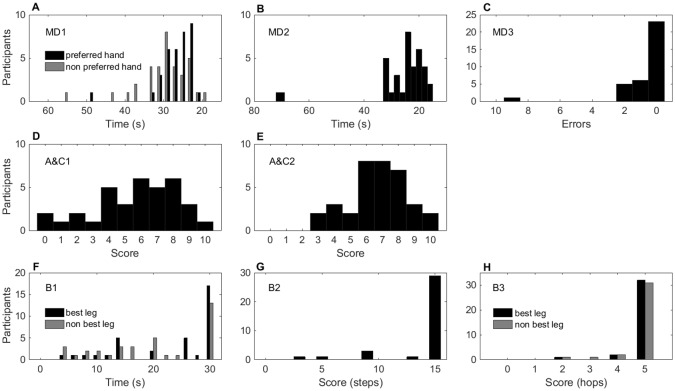
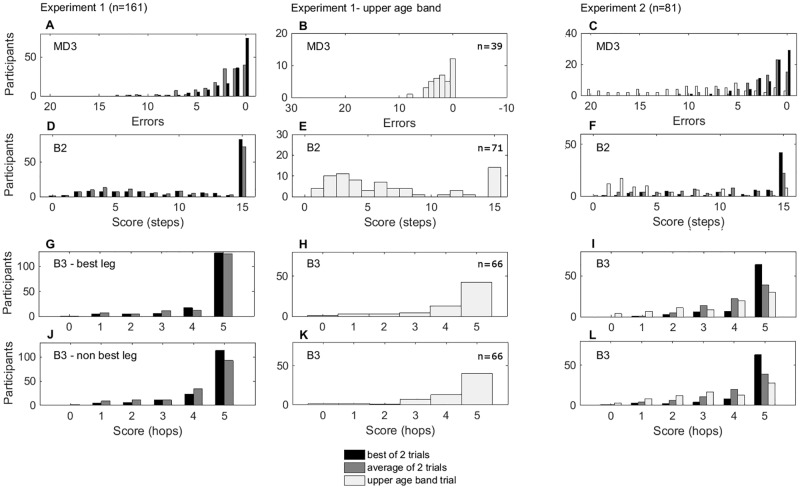
Initially designed to identify children's movement impairments in clinical settings, the Movement Assessment Battery for Children-2 (MABC-2) is also widely used to evaluate children's movement in research. Standardised scores on the test are calculated using parametric methods under the assumption of normally-distributed data. In a pilot study with thirty five 8-10 year old children (i.e., in Age Band 2 of the MABC-2), we found that maximal performance was often reached. These 'ceiling effects' created distributions of scores that may violate parametric assumptions. Tests of normality, skew, and goodness-of-fit revealed this violation, most clearly on three of the eight sub-tests. A strong deviation from normality was again observed in a sample of 161 children (8-10 years, Experiment 1), however ceiling effects were reduced by modifying the scoring methods, and administering items designed for older children when maximal performance was reached. Experiment 2 (n = 81, 7-10 years) further refined the administration and scoring methods, and again improved the distributions of scores. Despite reducing ceiling effects, scores remained non-parametrically distributed, justifying non-parametric analytic approaches. By randomly and repeatedly resampling from the raw data, we generated non-parametric reference distributions for assigning percentiles to each child's performance, and compared the results with the standardised scores. Distributions of scores obtained with both parametric and non-parametric methods were skewed, and the methods resulted in different rankings of the same data. Overall, we demonstrate that some MABC-2 item scores are not normally-distributed, and violate parametric assumptions. Changes in administering and scoring may partially address these issues. We propose that resampling or other non-parametric methods are required to create new reference distributions to which an individual child's performance can be referred. The modifications we propose are preliminary, but the implication is that a new standardisation is required to deal with the non-parametric data acquired with the MABC-2 performance test.
最初设计用于在临床环境中识别儿童的运动障碍,运动评估电池为儿童-2 (MABC-2)也广泛用于评估儿童的运动研究。测试的标准化分数是使用参数方法计算的,假设数据是正态分布的。在一项对 35 名 8-10 岁儿童(即 MABC-2 的年龄组 2)的初步研究中,我们发现最大表现通常达到。这些“天花板效应”创建了可能违反参数假设的分数分布。正态性、偏度和拟合优度检验表明了这种违反,在八项子测试中的三项上最为明显。在 161 名儿童(8-10 岁,实验 1)的样本中再次观察到与正态性的强烈偏离,然而通过修改评分方法和在达到最大表现时使用针对年龄较大儿童的项目,减少了天花板效应。实验 2(n=81,7-10 岁)进一步完善了管理和评分方法,并再次改善了分数分布。尽管减少了天花板效应,分数仍然是非参数分布的,证明了非参数分析方法的合理性。通过从原始数据中随机和重复抽样,我们生成了非参数参考分布,为每个孩子的表现分配百分位数,并将结果与标准化分数进行比较。使用参数和非参数方法获得的分数分布均呈偏态,并且两种方法导致相同数据的排名不同。总体而言,我们证明了一些 MABC-2 项目分数不是正态分布的,违反了参数假设。管理和评分的变化可能部分解决这些问题。我们建议使用重新采样或其他非参数方法来创建新的参考分布,以便将个体儿童的表现与之进行比较。我们提出的修改是初步的,但这意味着需要进行新的标准化来处理 MABC-2 表现测试获得的非参数数据。