Hunter Lori M, Luna Jessie K, Norton Rachel M
University of Colorado Boulder.
University of Colorado Denver.
Annu Rev Sociol. 2015 Aug;41:377-397. doi: 10.1146/annurev-soc-073014-112223. Epub 2015 Apr 16.
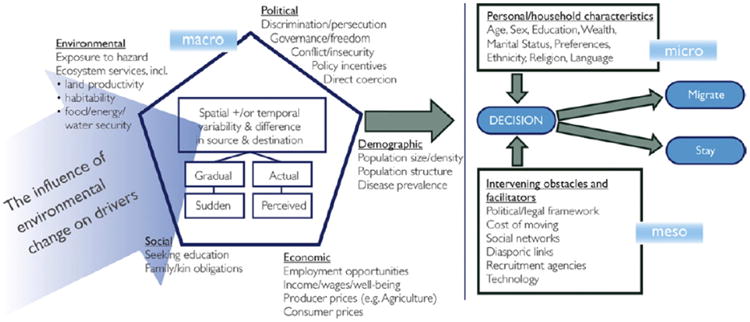
Research on the environmental dimensions of human migration has made important strides in recent years. However, findings have been spread across multiple disciplines with wide ranging methodologies and limited theoretical development. This article reviews key findings of the field and identifies future directions for sociological research. We contend that the field has moved beyond linear environmental "push" theories towards a greater integration of context, including micro-, meso-, and macro-level interactions. We highlight findings that migration is often a household strategy to diversify risk (NELM), interacting with household composition, individual characteristics, social networks, and historical, political and economic contexts. We highlight promising developments in the field, including the recognition that migration is a long-standing form of environmental adaptation and yet only one among many forms of adaptation. Finally, we argue that sociologists could contribute significantly to migration-environment inquiry through attention to issues of inequality, perceptions, and agency vis-à-vis structure.
近年来,关于人类迁移环境维度的研究取得了重要进展。然而,研究结果分散在多个学科中,方法多样且理论发展有限。本文回顾了该领域的关键研究结果,并确定了社会学研究的未来方向。我们认为,该领域已超越线性环境“推力”理论,朝着更全面地整合背景因素发展,包括微观、中观和宏观层面的相互作用。我们强调的研究结果是,迁移往往是家庭分散风险的一种策略(新经济迁移理论),与家庭构成、个人特征、社会网络以及历史、政治和经济背景相互作用。我们突出了该领域有前景的发展,包括认识到迁移是一种长期的环境适应形式,但只是众多适应形式之一。最后,我们认为社会学家通过关注不平等、认知以及结构与能动性等问题,能够为迁移与环境的研究做出重大贡献。