Mueller V, Gray C, Kosec K
International Food Policy Research Institute, Washington, DC 20006, USA.
Department of Geography, University of North Carolina, Chapel Hill, NC 27599.
Nat Clim Chang. 2014 Mar 1;4:182-185. doi: 10.1038/nclimate2103.
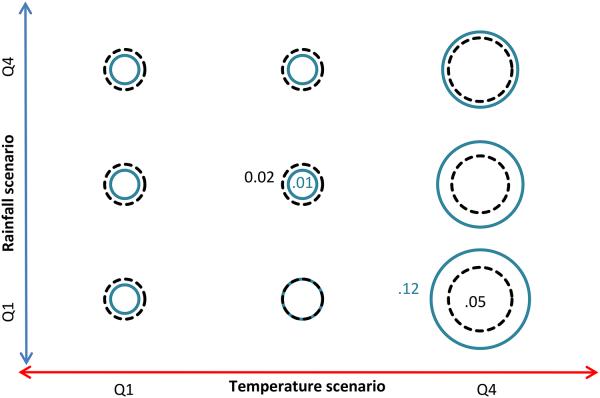
Human migration attributable to climate events has recently received significant attention from the academic and policy communities (1-2). Quantitative evidence on the relationship between individual, permanent migration and natural disasters is limited (3-9). A 21-year longitudinal survey conducted in rural Pakistan (1991-2012) provides a unique opportunity to understand the relationship between weather and long-term migration. We link individual-level information from this survey to satellite-derived measures of climate variability and control for potential confounders using a multivariate approach. We find that flooding-a climate shock associated with large relief efforts-has modest to insignificant impacts on migration. Heat stress, however-which has attracted relatively little relief-consistently increases the long-term migration of men, driven by a negative effect on farm and non-farm income. Addressing weather-related displacement will require policies that both enhance resilience to climate shocks and lower barriers to welfare-enhancing population movements.
因气候事件导致的人口迁移最近受到了学术界和政策界的广泛关注(1-2)。关于个人永久性迁移与自然灾害之间关系的定量证据有限(3-9)。在巴基斯坦农村地区进行的一项为期21年的纵向调查(1991-2012年)为了解天气与长期迁移之间的关系提供了一个独特的机会。我们将这项调查中的个人层面信息与卫星衍生的气候变率测量数据相联系,并采用多变量方法控制潜在的混杂因素。我们发现,洪水——一种与大规模救灾努力相关的气候冲击——对迁移的影响较小或不显著。然而,热应激——相对而言获得的救灾较少——持续增加男性的长期迁移,这是由其对农业和非农业收入的负面影响所驱动的。应对与天气相关的流离失所问题需要制定政策,既要增强对气候冲击的抵御能力,又要降低有利于增进福利的人口流动的障碍。