
使用传统技术的短跑和越野滑雪比赛之间的宏观运动学差异。
Macro-Kinematic Differences Between Sprint and Distance Cross-Country Skiing Competitions Using the Classical Technique.
作者信息
Marsland Finn, Anson Judith, Waddington Gordon, Holmberg Hans-Christer, Chapman Dale W
机构信息
UC Research Institute for Sport and Exercise, University of Canberra, Canberra, ACT, Australia.
Australian Institute of Sport, Canberra, ACT, Australia.
出版信息
Front Physiol. 2018 May 17;9:570. doi: 10.3389/fphys.2018.00570. eCollection 2018.
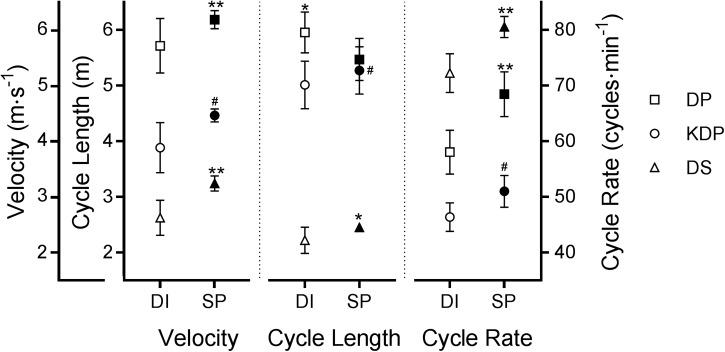
We compare the macro-kinematics of six elite female cross-country skiers competing in 1.1-km Sprint and 10.5-km Distance classical technique events on consecutive days under similar weather and track conditions. The relative use of double pole (DP), kick-double pole (KDP), diagonal stride (DS), tucking (Tuck) and turning (Turn) sub-techniques, plus each technique's respective velocities, cycle lengths and cycle rates were monitored using a single micro-sensor unit worn by each skier during the Sprint qualification, semi-final and finals, and multiple laps of the Distance race. Over a 1.0-km section of track common to both Sprint and Distance events, the mean race velocity, cyclical sub-technique velocities, and cycle rates were higher during the Sprint race, while Tuck and Turn velocities were similar. Velocities with KDP and DS on the common terrain were higher in the Sprint (KDP +12%, DS +23%) due to faster cycle rates (KDP +8%, DS +11%) and longer cycle lengths (KDP +5%, DS +10%), while the DP velocity was higher (+8%) with faster cycle rate (+16%) despite a shorter cycle length (-9%). During the Sprint the percentage of total distance covered using DP was greater (+15%), with less use of Tuck (-19%). Across all events and rounds, DP was the most used sub-technique in terms of distance, followed by Tuck, DS, Turn and KDP. KDP was employed relatively little, and during the Sprint by only half the participants. Tuck was the fastest sub-technique followed by Turn, DP, KDP, and DS. These findings reveal differences in the macro-kinematic characteristics and strategies utilized during Sprint and Distance events, confirm the use of higher cycle rates in the Sprint, and increase our understanding of the performance demands of cross-country skiing competition.
我们比较了六名优秀女子越野滑雪运动员在连续两天、天气和赛道条件相似的情况下,参加1.1公里短距离赛和10.5公里传统技术距离赛的宏观运动学。在短距离赛资格赛、半决赛和决赛以及距离赛的多圈比赛中,通过每位滑雪者佩戴的单个微传感器单元,监测双杖(DP)、蹬冰双杖(KDP)、斜向跨步(DS)、蜷缩(Tuck)和转弯(Turn)子技术的相对使用情况,以及每种技术各自的速度、周期长度和周期率。在短距离赛和距离赛共有的1.0公里赛道区间内,短距离赛中的平均比赛速度、周期性子技术速度和周期率更高,而蜷缩和转弯速度相似。在共同地形上,短距离赛中KDP和DS的速度更高(KDP提高12%,DS提高23%),这是由于周期率更快(KDP提高8%,DS提高11%)和周期长度更长(KDP提高5%,DS提高10%),而DP速度更高(提高8%),尽管周期长度较短(缩短9%),但周期率更快(提高16%)。在短距离赛中,使用DP覆盖的总距离百分比更大(提高15%),使用蜷缩的比例更小(降低19%)。在所有赛事和轮次中,就距离而言,DP是使用最多的子技术,其次是蜷缩、DS、转弯和KDP。KDP的使用相对较少,在短距离赛中只有一半的参与者使用。蜷缩是最快的子技术,其次是转弯、DP、KDP和DS。这些发现揭示了短距离赛和距离赛中宏观运动学特征和策略的差异,证实了短距离赛中使用更高的周期率,并增进了我们对越野滑雪比赛性能要求的理解。


 Zotero 插件