Sullivan Timothy, Ichikawa Osamu, Dudley Joel, Li Li, Aberg Judith
Division of Infectious Diseases, Icahn School of Medicine at Mount Sinai, New York, New York.
Department of Genetics and Genomic Sciences, Institute of Next Generation Healthcare, Icahn School of Medicine at Mount Sinai, New York, New York.
Open Forum Infect Dis. 2018 Apr 28;5(5):ofy091. doi: 10.1093/ofid/ofy091. eCollection 2018 May.
The administration of active antibiotics is often delayed in cases of carbapenem-resistant gram-negative bacteremia. Using electronic medical record (EMR) data to rapidly predict carbapenem resistance in patients with bacteremia could help reduce the time to active therapy.
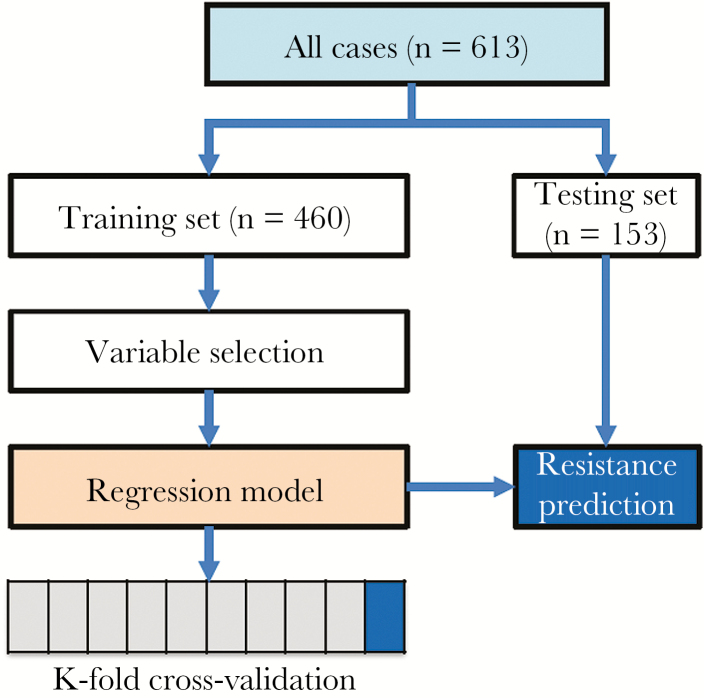
All cases of bacteremia at Mount Sinai Hospital from September 2012 through September 2016 were included. Cases were randomly divided into a "training set" and a "testing set." EMR data from the training set cases were reviewed, and significant risk factors for carbapenem resistance were entered into a multiple logistic regression model. Performance was assessed by repeated K-fold cross-validation and by applying the training set model to the testing set. All cases were also reviewed to determine the time to effective antibiotic therapy.
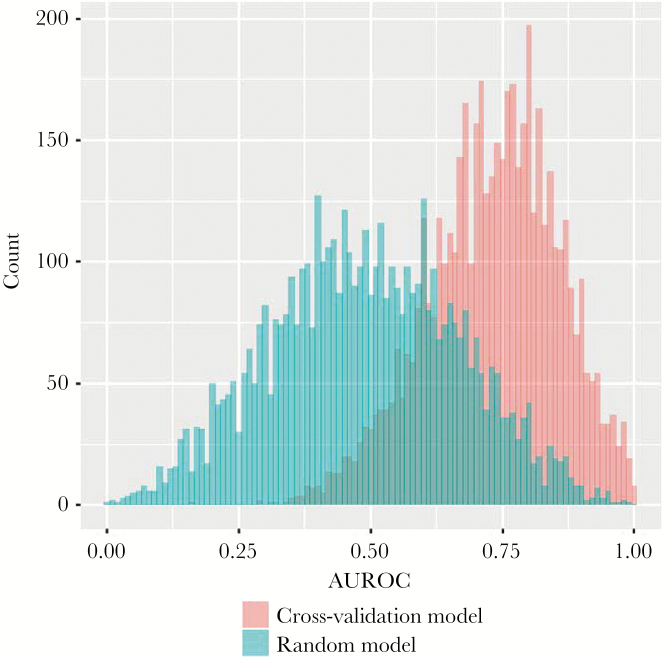
A total of 613 cases of bacteremia were included, 61 (10%) of which were carbapenem-resistant. The training and testing sets consisted of 460 and 153 cases, respectively. The regression model derived from the training set correctly predicted 73% of carbapenem-resistant cases and 59% of carbapenem-susceptible cases in the testing set (sensitivity, 73%; specificity, 59%; positive predictive value, 16%; negative predictive value, 95%). The mean area under the receiver operator characteristic curve of the K-fold cross-validation repeats was 0.731. Patients with carbapenem-resistant infections received active antibiotics significantly later than those with susceptible infections (40.4 hours vs 9.6 hours, < .0001).
A multiple logistic regression model using EMR data can generate rapid, sensitive predictions of carbapenem resistance in patients with bacteremia, which could help shorten the time to effective therapy in these cases.
在耐碳青霉烯类革兰阴性菌血症病例中,活性抗生素的使用往往会延迟。利用电子病历(EMR)数据快速预测菌血症患者的碳青霉烯耐药性有助于缩短开始有效治疗的时间。
纳入2012年9月至2016年9月在西奈山医院发生的所有菌血症病例。病例被随机分为“训练集”和“测试集”。回顾训练集病例的EMR数据,将碳青霉烯耐药的显著危险因素纳入多元逻辑回归模型。通过重复K折交叉验证以及将训练集模型应用于测试集来评估模型性能。还对所有病例进行回顾以确定开始有效抗生素治疗的时间。
共纳入613例菌血症病例,其中61例(10%)为耐碳青霉烯类。训练集和测试集分别包含460例和153例病例。从训练集得出的回归模型在测试集中正确预测了73%的耐碳青霉烯类病例和59%的碳青霉烯敏感病例(敏感性为73%;特异性为59%;阳性预测值为16%;阴性预测值为95%)。K折交叉验证重复的受试者工作特征曲线下的平均面积为0.731。耐碳青霉烯类感染的患者开始使用活性抗生素的时间明显晚于敏感感染患者(40.4小时对9.6小时,<0.0001)。
使用EMR数据的多元逻辑回归模型可以快速、敏感地预测菌血症患者的碳青霉烯耐药性,这有助于缩短这些病例中开始有效治疗的时间。