Laboratory of Animal Husbandry, School of Veterinary Medicine, Faculty of Health Sciences, Aristotle University of Thessaloniki, Thessaloniki, Greece.
Veterinary Research Institute of Thessaloniki, Hellenic Agricultural Organization Demeter, Thessaloniki, Greece.
PLoS One. 2018 Jun 7;13(6):e0198819. doi: 10.1371/journal.pone.0198819. eCollection 2018.
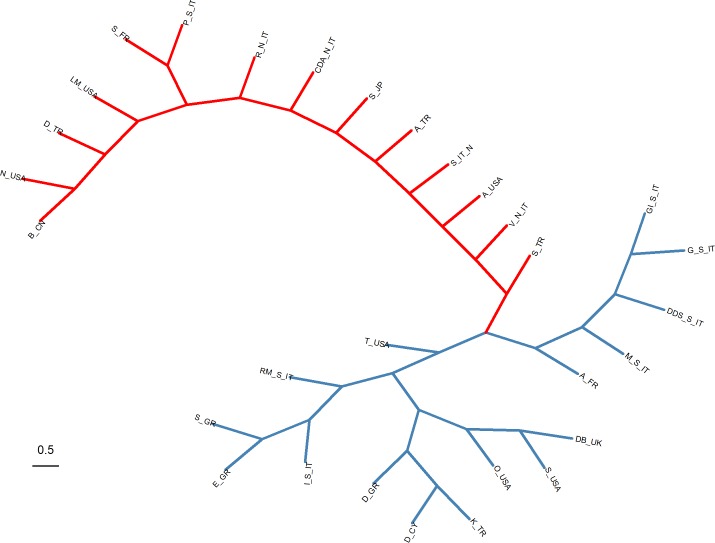
Polymorphisms at PRNP gene locus have been associated with resistance against classical scrapie in goats. Genetic selection on this gene within appropriate breeding programs may contribute to the control of the disease. The present study characterized the genetic profile of codons 146, 211 and 222 in three dairy goat breeds in Greece. A total of 766 dairy goats from seven farms were used. Animals belonged to two indigenous Greek, Eghoria (n = 264) and Skopelos (n = 287) and a foreign breed, Damascus (n = 215). Genomic DNA was extracted from blood samples from individual animals. Polymorphisms were detected in these codons using Real-Time PCR analysis and four different Custom TaqMan® SNP Genotyping Assays. Genotypic, allelic and haplotypic frequencies were calculated based on individual animal genotypes. Chi-square tests were used to examine Hardy-Weinberg equilibrium state and compare genotypic distribution across breeds. Genetic distances among the three breeds, and between these and 30 breeds reared in other countries were estimated based on haplotypic frequencies using fixation index FST with Arlequin v3.1 software; a Neighbor-Joining tree was created using PHYLIP package v3.695. Level of statistical significance was set at P = 0.01. All scrapie resistance-associated alleles (146S, 146D, 211Q and 222K) were detected in the studied population. Significant frequency differences were observed between the indigenous Greek and Damascus breeds. Alleles 222K and 146S had the highest frequency in the two indigenous and the Damascus breed, respectively (ca. 6.0%). The studied breeds shared similar haplotypic frequencies with most South Italian and Turkish breeds but differed significantly from North-Western European, Far East and some USA goat breeds. Results suggest there is adequate variation in the PRNP gene locus to support breeding programs for enhanced scrapie resistance in goats reared in Greece. Genetic comparisons among goat breeds indicate that separate breeding programs should apply to the two indigenous and the imported Damascus breeds.
PRNP 基因座的多态性与山羊对经典羊瘙痒病的抗性有关。在适当的繁殖计划中对该基因进行遗传选择可能有助于控制该疾病。本研究对希腊三个奶山羊品种的密码子 146、211 和 222 的遗传特征进行了描述。总共使用了来自七个农场的 766 只奶山羊。动物分为两个希腊本土品种,Eghoria(n = 264)和 Skopelos(n = 287)和一个外国品种,大马士革(n = 215)。从个体动物的血液样本中提取基因组 DNA。使用实时 PCR 分析和四个不同的 Custom TaqMan® SNP 基因分型测定法在这些密码子中检测到多态性。根据个体动物的基因型计算基因型、等位基因和单倍型频率。卡方检验用于检查 Hardy-Weinberg 平衡状态,并比较不同品种的基因型分布。基于单倍型频率,使用 Arlequin v3.1 软件中的固定指数 FST 估计三个品种之间以及这些品种与其他 30 个国家饲养的品种之间的遗传距离;使用 PHYLIP 包 v3.695 创建邻接聚类树。统计显著性水平设置为 P = 0.01。在研究人群中检测到所有与抗瘙痒病相关的等位基因(146S、146D、211Q 和 222K)。在本土希腊品种和大马士革品种之间观察到显著的频率差异。等位基因 222K 和 146S 在两个本土品种和大马士革品种中的频率最高(约 6.0%)。研究品种与大多数南意大利和土耳其品种具有相似的单倍型频率,但与北欧、远东和一些美国山羊品种有显著差异。结果表明,PRNP 基因座存在足够的变异,可以支持在希腊饲养的山羊增强抗瘙痒病的繁殖计划。山羊品种之间的遗传比较表明,应分别为两个本土品种和进口的大马士革品种制定单独的繁殖计划。