Department of Nutrition, School of Public Health, University of São Paulo, São Paulo, Brazil.
School of Arts, Sciences and Humanities, University of São Paulo, São Paulo, Brazil.
Int J Equity Health. 2018 Jun 7;17(1):72. doi: 10.1186/s12939-018-0784-2.
Recent studies have explored the influence of socioeconomic inequalities on the diet quality. However, there is lack of evidence regarding the level of inequalities in dietary quality and its main contributing factors from population-based follow-up studies. The primary objective of this study was to investigate the level and the determinants of inequalities in diet quality in a representative sample of adolescents, adults and older adults resident in São Paulo, Brazil.
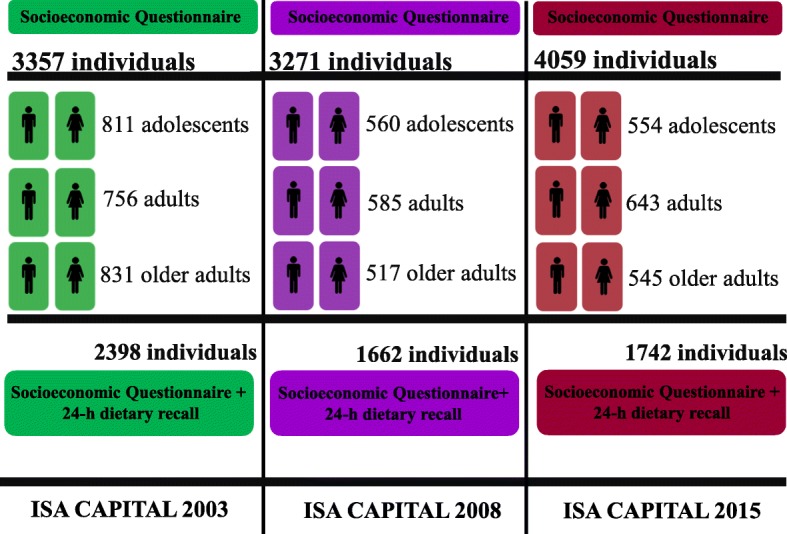
Data from the Health Survey of São Paulo (ISA-Capital) were analyzed for 2003 (n = 2398), 2008 (n = 1662) and 2015 (n = 1742) surveys. Information on food consumption was obtained through 24-h dietary recall, and diet quality was assessed based on the Revised Brazilian Healthy Eating Index (BHEI-R). The descriptive variables were compared using 95% confidence interval. The scores of BHEI-R and its components were compared across age groups and year. The association between socioeconomic inequalities and diet quality was based on the estimation of concentration index.
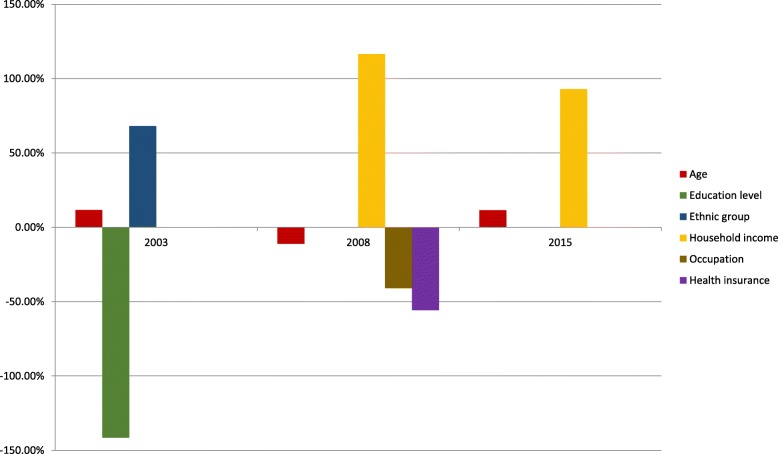
We observed that the BHEI-R scores gradually improved over 12-years, with older adults showing the greatest improvement. The increase in overall population score was observed for total fruits, whole fruits, whole grains, oils and sodium. The main contributor to socioeconomic inequality in diet quality in 2003 was ethnic group, and in 2008 and 2015, it was per capita household income; age was a persistent factor of inequality in the population over the years. Concentration indices indicated that lower income individuals had higher BHEI-R scores in 2003; however, there was a shift in favor of higher income individuals in 2008 and 2015.
Changes in the patterns of determination of inequalities according to age, ethnic group or income during the period analyzed show the existence of ongoing process of contribution of demographic and socioeconomic factors in the diet quality of individuals in a large urban center.
最近的研究探讨了社会经济不平等对饮食质量的影响。然而,缺乏基于人群随访研究的关于饮食质量不平等程度及其主要决定因素的证据。本研究的主要目的是调查巴西圣保罗代表性青少年、成年和老年人群中饮食质量的不平等程度及其决定因素。
分析了圣保罗健康调查(ISA-Capital)2003 年(n=2398)、2008 年(n=1662)和 2015 年(n=1742)调查的数据。通过 24 小时膳食回忆获取食物消费信息,并根据修订后的巴西健康饮食指数(BHEI-R)评估饮食质量。使用 95%置信区间比较描述性变量。比较不同年龄组和年份的 BHEI-R 及其成分得分。基于集中指数估计,评估社会经济不平等与饮食质量之间的关系。
我们观察到,12 年来,BHEI-R 评分逐渐提高,老年人的提高幅度最大。总体人群的评分增加主要体现在总水果、全水果、全谷物、油和钠的摄入量上。2003 年饮食质量社会经济不平等的主要决定因素是族裔群体,2008 年和 2015 年的主要决定因素是人均家庭收入;年龄是多年来人口不平等的持续因素。集中指数表明,2003 年收入较低的个体 BHEI-R 评分较高;然而,2008 年和 2015 年,收入较高的个体的评分有所提高。
分析期间根据年龄、族裔群体或收入确定不平等模式的变化表明,人口和社会经济因素对个体饮食质量的影响存在持续的变化过程。