Yongin in silico Medical Research Centre, Syntekabio Inc., 283 Dongbaekjungang-ro, C508, Giheung-gu, Yongin, Gyeonggi-do, 17006, South Korea.
Gwanghwamun Medical Study Centre, Syntekabio Inc., 92 Saemunan-ro, #1708, Jongno-gu, Seoul, 03186, South Korea.
Sci Rep. 2018 Jun 11;8(1):8857. doi: 10.1038/s41598-018-27214-6.
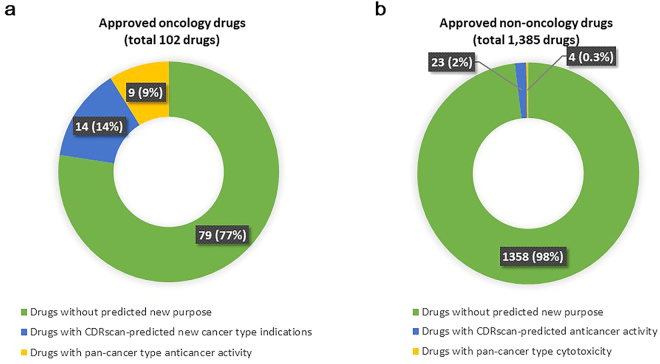
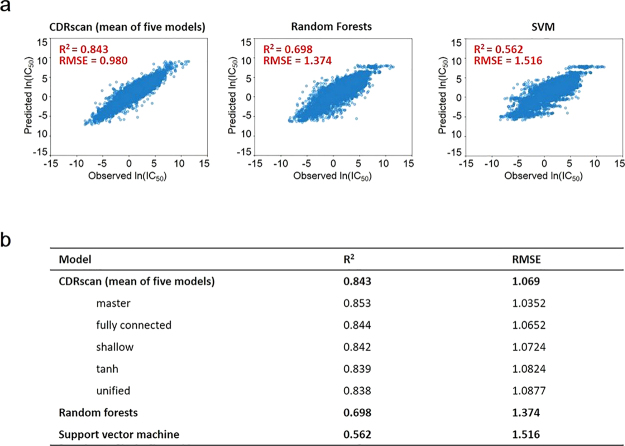
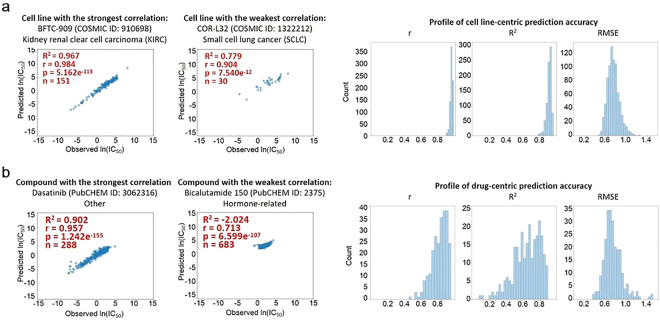
In the era of precision medicine, cancer therapy can be tailored to an individual patient based on the genomic profile of a tumour. Despite the ever-increasing abundance of cancer genomic data, linking mutation profiles to drug efficacy remains a challenge. Herein, we report Cancer Drug Response profile scan (CDRscan) a novel deep learning model that predicts anticancer drug responsiveness based on a large-scale drug screening assay data encompassing genomic profiles of 787 human cancer cell lines and structural profiles of 244 drugs. CDRscan employs a two-step convolution architecture, where the genomic mutational fingerprints of cell lines and the molecular fingerprints of drugs are processed individually, then merged by 'virtual docking', an in silico modelling of drug treatment. Analysis of the goodness-of-fit between observed and predicted drug response revealed a high prediction accuracy of CDRscan (R > 0.84; AUROC > 0.98). We applied CDRscan to 1,487 approved drugs and identified 14 oncology and 23 non-oncology drugs having new potential cancer indications. This, to our knowledge, is the first-time application of a deep learning model in predicting the feasibility of drug repurposing. By further clinical validation, CDRscan is expected to allow selection of the most effective anticancer drugs for the genomic profile of the individual patient.
在精准医学时代,癌症疗法可以根据肿瘤的基因组特征为个体患者量身定制。尽管癌症基因组数据的丰富程度不断增加,但将突变谱与药物疗效联系起来仍然是一个挑战。在此,我们报告了癌症药物反应谱扫描(CDRscan),这是一种新的深度学习模型,它基于涵盖 787 个人类癌细胞系的基因组特征和 244 种药物的结构特征的大规模药物筛选试验数据,预测抗癌药物的反应性。CDRscan 采用两步卷积架构,分别处理细胞系的基因组突变指纹和药物的分子指纹,然后通过“虚拟对接”(药物治疗的一种计算机建模)进行融合。对观察到的和预测的药物反应之间的拟合优度的分析显示,CDRscan 的预测准确性很高(R > 0.84;AUROC > 0.98)。我们将 CDRscan 应用于 1487 种已批准的药物,并鉴定出 14 种肿瘤学和 23 种非肿瘤学药物具有新的潜在癌症适应症。据我们所知,这是首次将深度学习模型应用于预测药物再利用的可行性。通过进一步的临床验证,CDRscan 有望根据个体患者的基因组特征选择最有效的抗癌药物。