a Center on Addiction.
b Department of Psychology , Sam Houston State University.
J Clin Child Adolesc Psychol. 2018 Jul-Aug;47(4):499-526. doi: 10.1080/15374416.2018.1466307. Epub 2018 Jun 12.
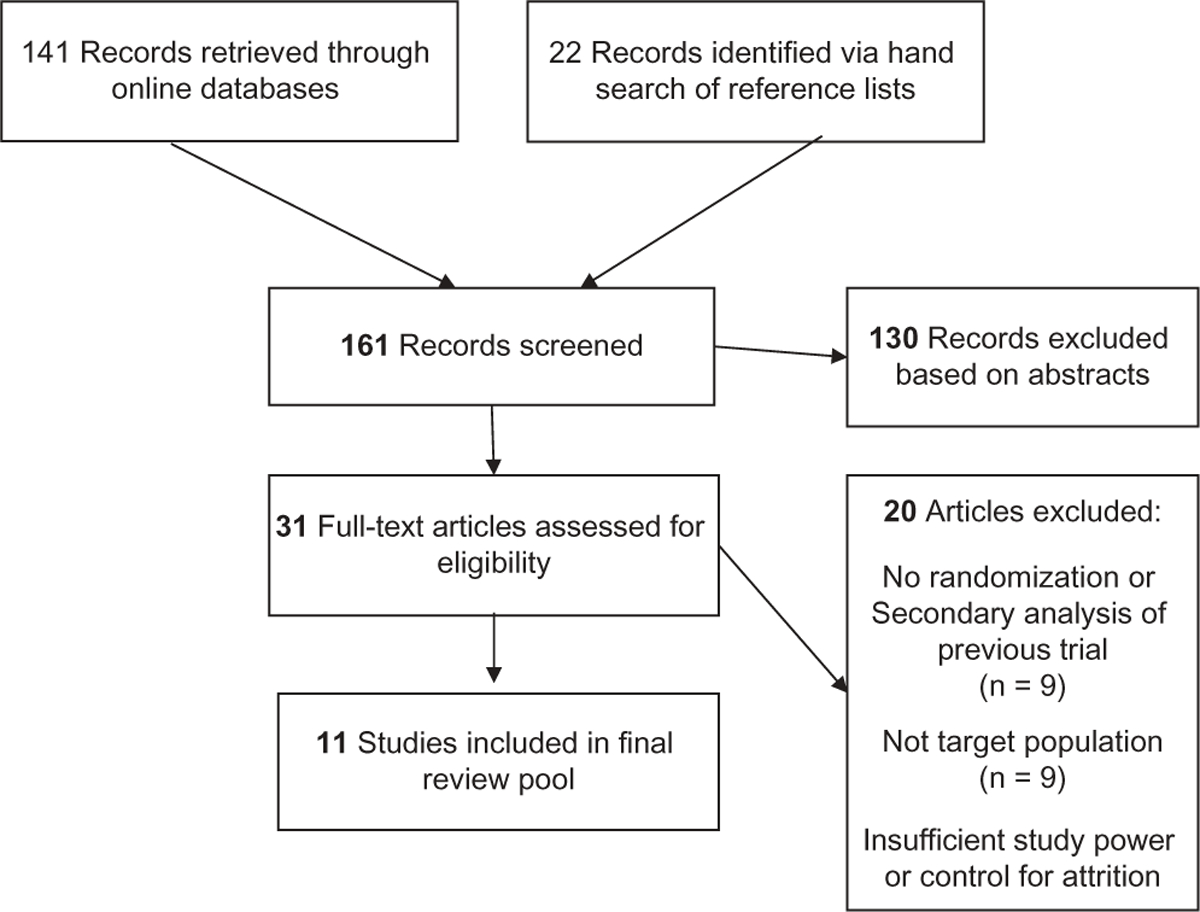
This article updates the evidence base on outpatient behavioral treatments for adolescent substance use (ASU) since publication of the previous review completed for this journal by Hogue, Henderson, Ozechowski, and Robbins (2014). It first summarizes the Hogue et al. findings along with those from recent literature reviews and meta-analytic studies of ASU treatments. It then presents study design and methods criteria used to select 11 comparative studies subjected to Journal of Clinical Child and Adolescent Psychology level of support evaluation. These 11 studies are detailed in terms of their sample characteristics, methodological quality, and substance use outcomes. Cumulative level of support designations are then made for each identified treatment approach. These cumulative designations are virtually identical to those of the previous review: ecological family-based treatment, individual cognitive-behavioral therapy, and group cognitive-behavioral therapy remain well-established; behavioral family-based treatment and motivational interviewing remain probably efficacious; drug counseling remains possibly efficacious; and an updated total of 5 multicomponent treatments combining more than 1 approach (3 of which include contingency management) are deemed well-established or probably efficacious. Treatment delivery issues associated with evidence-based approaches are then reviewed, focusing on client engagement, fidelity and mediator, and predictor and moderator effects. Finally, to help accelerate innovation in ASU treatment science and practice, the article outlines promising horizons in improving youth identification and access, specifying and implementing pragmatic treatment in community settings, and leveraging emerging lessons from implementation science.
本文更新了自 Hogue、Henderson、Ozechowski 和 Robbins(2014 年)为该期刊完成的上一次综述以来,关于青少年物质使用(ASU)门诊行为治疗的证据基础。它首先总结了 Hogue 等人的发现,以及最近关于 ASU 治疗的文献综述和荟萃分析研究的结果。然后介绍了选择 11 项比较研究的研究设计和方法标准,这些研究接受了《临床儿童与青少年心理学杂志》的支持评估水平。这些 11 项研究详细介绍了它们的样本特征、方法质量和物质使用结果。然后为每个确定的治疗方法指定累积支持等级。这些累积指定与上一次综述几乎相同:生态家庭为基础的治疗、个体认知行为疗法和团体认知行为疗法仍然是成熟的;行为家庭为基础的治疗和动机访谈仍然是可能有效的;药物咨询仍然是可能有效的;并且更新的总共 5 种多成分治疗方法结合了超过 1 种方法(其中 3 种方法包括强化管理)被认为是成熟的或可能有效的。然后审查了与循证方法相关的治疗提供问题,重点关注客户参与度、保真度和中介、预测和调节因素的影响。最后,为了帮助加速 ASU 治疗科学和实践的创新,本文概述了在改善青年识别和获得、在社区环境中具体和实施实用治疗以及利用实施科学中的新经验方面的有前途的前景。