Department of Dermatology, School of Medicine, Tokyo Women's Medical University, Shinjuku, Tokyo, 162-8666, Japan.
StaGen Co., Ltd., Taito-ku, Tokyo, 111-0051, Japan.
Sci Rep. 2018 Jun 12;8(1):8974. doi: 10.1038/s41598-018-27145-2.
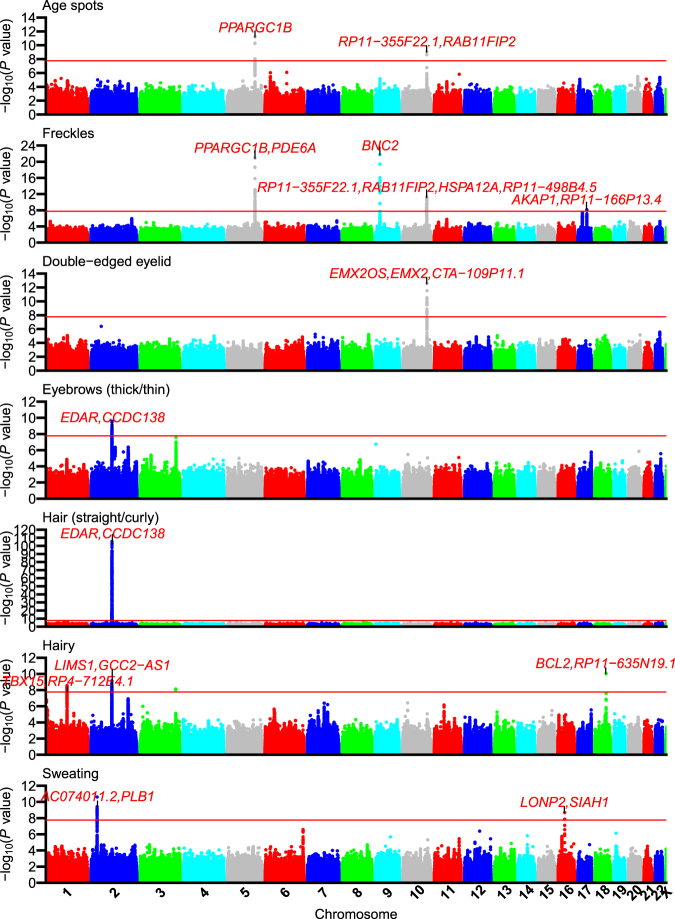
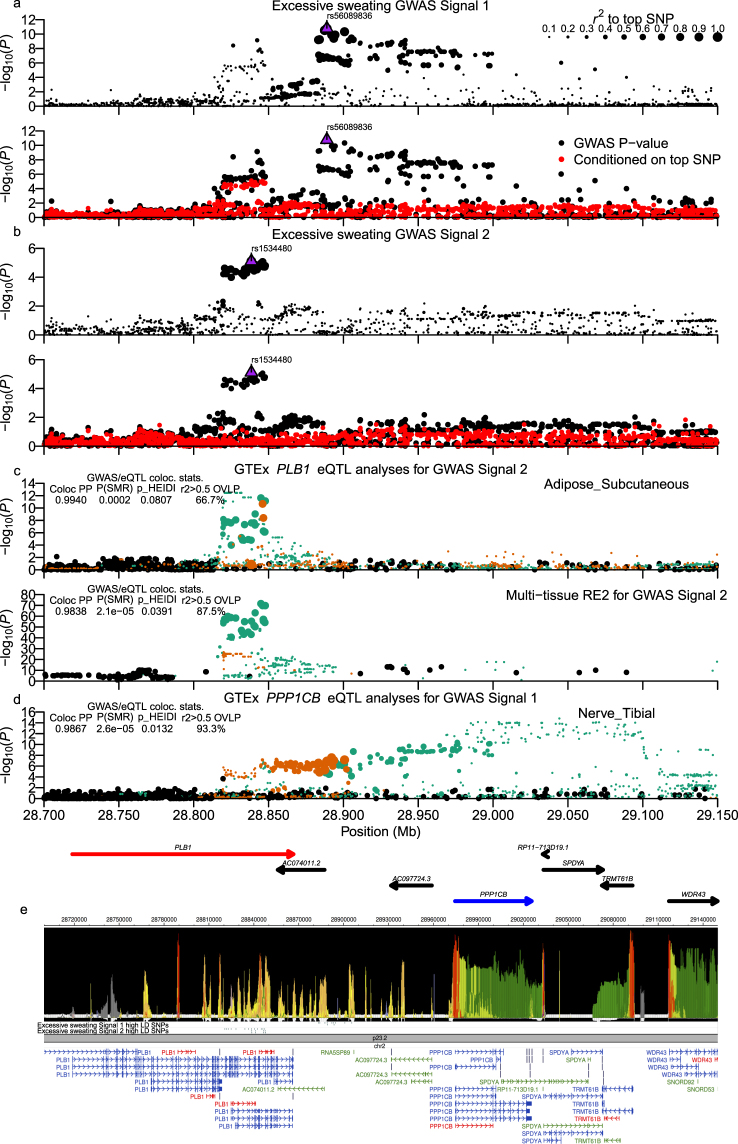
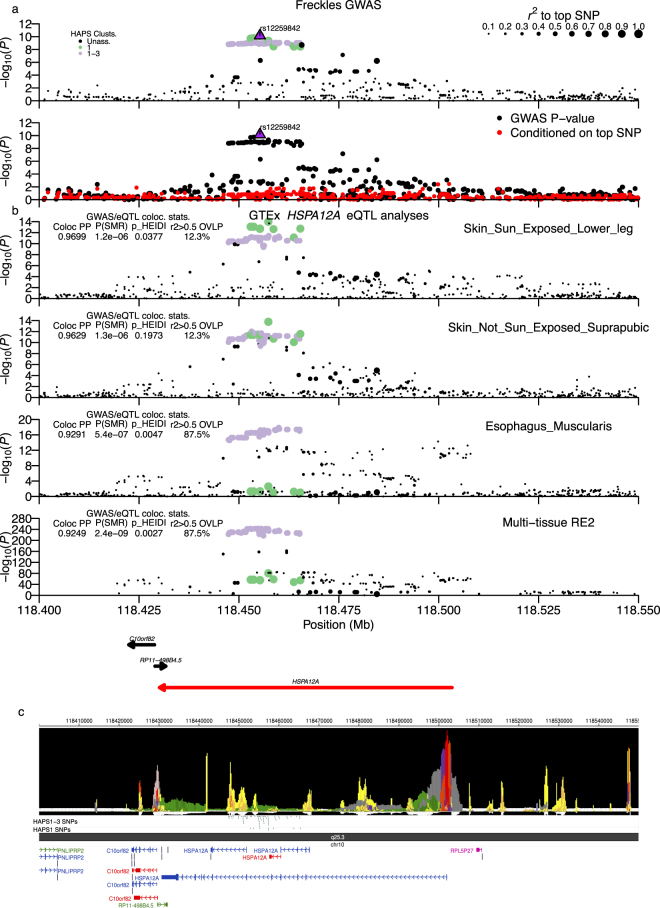
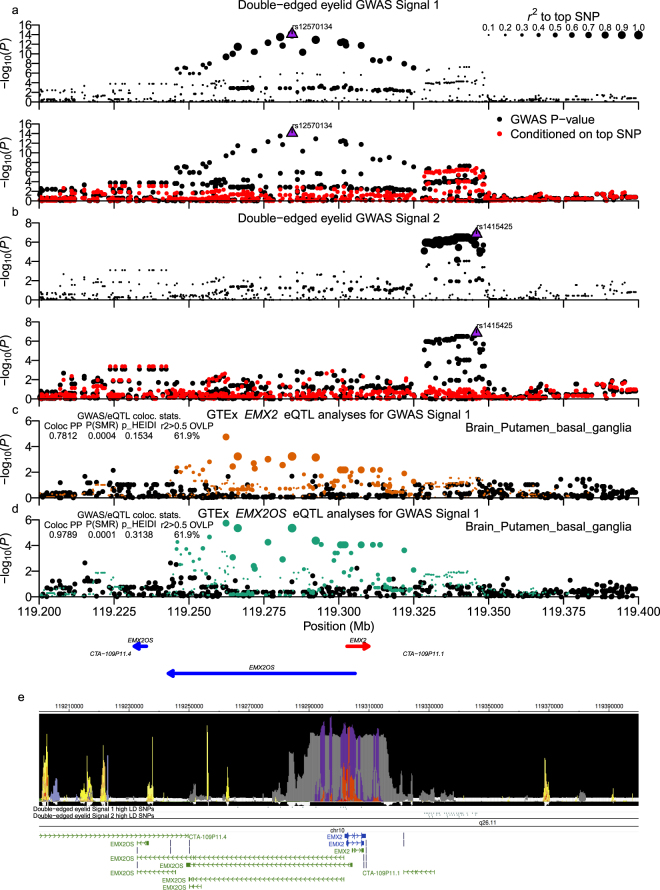
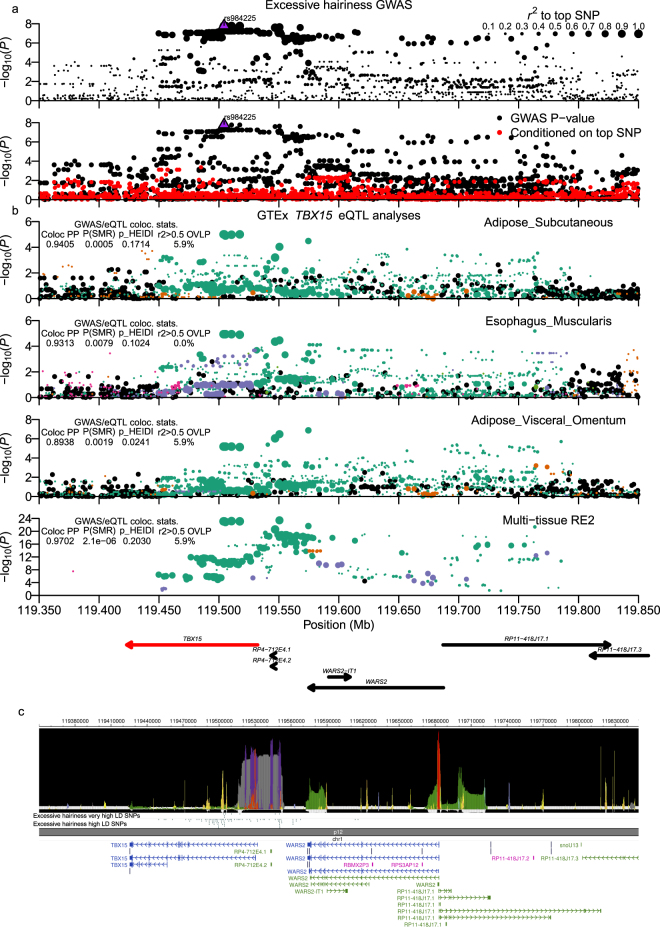
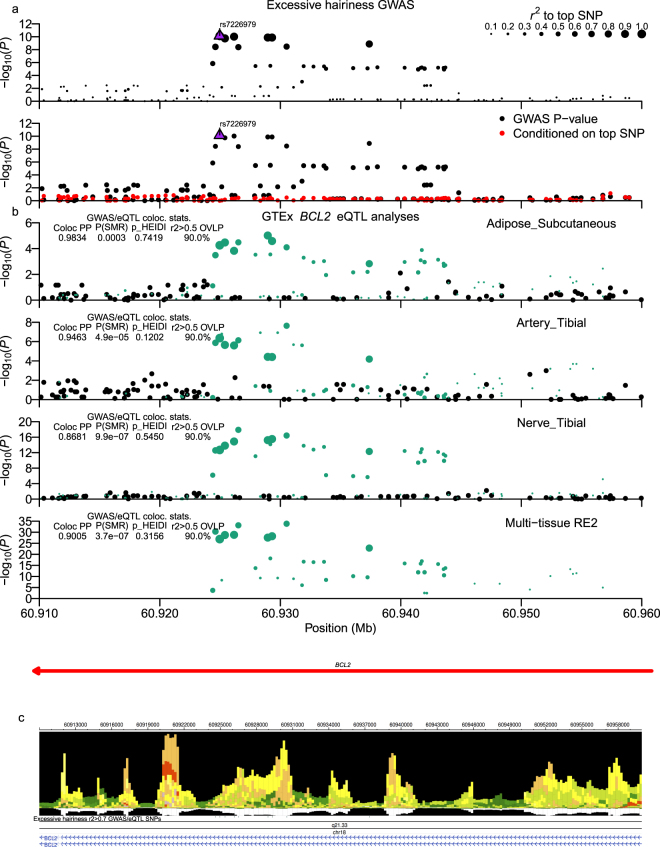
Skin trait variation impacts quality-of-life, especially for females from the viewpoint of beauty. To investigate genetic variation related to these traits, we conducted a GWAS of various skin phenotypes in 11,311 Japanese women and identified associations for age-spots, freckles, double eyelids, straight/curly hair, eyebrow thickness, hairiness, and sweating. In silico annotation with RoadMap Epigenomics epigenetic state maps and colocalization analysis of GWAS and GTEx Project eQTL signals provided information about tissue specificity, candidate causal variants, and functional target genes. Novel signals for skin-spot traits neighboured AKAP1/MSI2 (rs17833789; P = 2.2 × 10), BNC2 (rs10810635; P = 2.1 × 10), HSPA12A (rs12259842; P = 7.1 × 10), PPARGC1B (rs251468; P = 1.3 × 10), and RAB11FIP2 (rs10444039; P = 5.6 × 10). HSPA12A SNPs were the only protein-coding gene eQTLs identified across skin-spot loci. Double edged eyelid analysis identified that a signal around EMX2 (rs12570134; P = 8.2 × 10) was also associated with expression of EMX2 and the antisense-RNA gene EMX2OS in brain putamen basal ganglia tissue. A known hair morphology signal in EDAR was associated with both eyebrow thickness (rs3827760; P = 1.7 × 10) and straight/curly hair (rs260643; P = 1.6 × 10). Excessive hairiness signals' top SNPs were also eQTLs for TBX15 (rs984225; P = 1.6 × 10), BCL2 (rs7226979; P = 7.3 × 10), and GCC2 and LIMS1 (rs6542772; P = 2.2 × 10). For excessive sweating, top variants in two signals in chr2:28.82-29.05 Mb (rs56089836; P = 1.7 × 10) were eQTLs for either PPP1CB or PLB1, while a top chr16:48.26-48.45 Mb locus SNP was a known ABCC11 missense variant (rs6500380; P = 6.8 × 10). In total, we identified twelve loci containing sixteen association signals, of which fifteen were novel. These findings will help dermatologic researchers better understand the genetic underpinnings of skin-related phenotypic variation in human populations.
皮肤特征的变化会影响生活质量,尤其是从美容角度来看对女性的影响。为了研究与这些特征相关的遗传变异,我们对 11311 名日本女性的各种皮肤表型进行了全基因组关联研究,鉴定出了与老年斑、雀斑、双眼皮、直发/卷发、眉毛粗细、多毛和出汗有关的关联。使用 RoadMap Epigenomics 表观遗传状态图谱进行的计算机注释以及全基因组关联研究和 GTEx 项目 eQTL 信号的共定位分析提供了关于组织特异性、候选因果变异和功能靶基因的信息。皮肤斑点性状的新信号与 AKAP1/MSI2(rs17833789;P=2.2×10)、BNC2(rs10810635;P=2.1×10)、HSPA12A(rs12259842;P=7.1×10)、PPARGC1B(rs251468;P=1.3×10)和 RAB11FIP2(rs10444039;P=5.6×10)相邻。HSPA12A 中的 SNP 是在皮肤斑点基因座中唯一鉴定出的蛋白质编码基因 eQTL。双眼皮分析鉴定出,围绕 EMX2(rs12570134;P=8.2×10)的信号也与脑壳核基底神经节组织中 EMX2 和反义 RNA 基因 EMX2OS 的表达相关。在 EDAR 中已知的毛发形态信号与眉毛粗细(rs3827760;P=1.7×10)和直发/卷发(rs260643;P=1.6×10)均相关。过多毛发的信号的最高 SNP 也是 TBX15(rs984225;P=1.6×10)、BCL2(rs7226979;P=7.3×10)和 GCC2 和 LIMS1(rs6542772;P=2.2×10)的 eQTL。对于过度出汗,两个在 chr2:28.82-29.05 Mb 信号中的最高变异(rs56089836;P=1.7×10)是 PPP1CB 或 PLB1 的 eQTL,而 chr16:48.26-48.45 Mb 位置 SNP 是已知的 ABCC11 错义变异(rs6500380;P=6.8×10)。总的来说,我们确定了包含 16 个关联信号的 12 个基因座,其中 15 个是新的。这些发现将帮助皮肤科研究人员更好地理解人类群体中与皮肤相关的表型变异的遗传基础。