Beall Clifford J, Campbell Alisha G, Griffen Ann L, Podar Mircea, Leys Eugene J
Division of Biosciences, College of Dentistry, The Ohio State University, Columbus, Ohio, USA.
Biosciences Division, Oak Ridge National Laboratory, Oak Ridge, Tennessee, USA.
mSystems. 2018 Jun 5;3(3). doi: 10.1128/mSystems.00018-18. eCollection 2018 May-Jun.
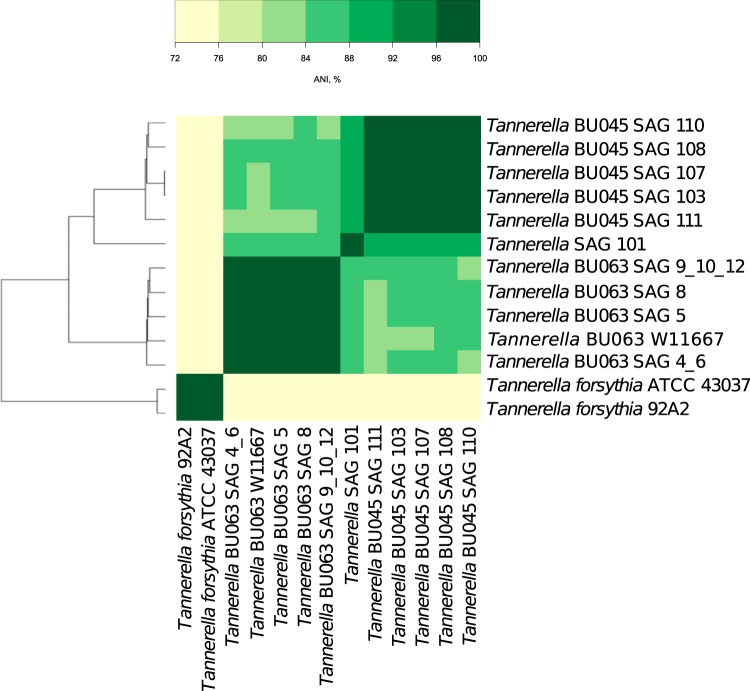
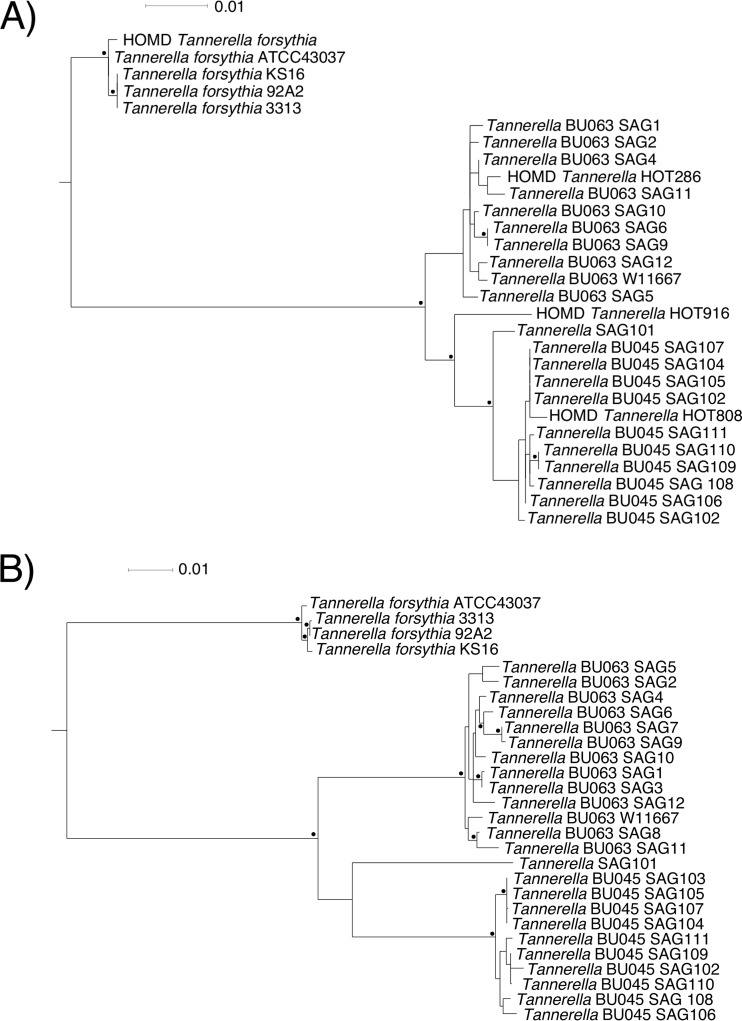
Despite decades of research into the human oral microbiome, many species remain uncultivated. The technique of single-cell whole-genome amplification and sequencing provides a means of deriving genome sequences for species that can be informative on biological function and suggest pathways to cultivation. Tannerella forsythia has long been known to be highly associated with chronic periodontitis and to cause periodontitis-like symptoms in experimental animals, and sp. BU045 (human oral taxon 808) is an uncultivated relative of this organism. In this work, we extend our previous sequencing of the sp. BU063 (human oral taxon 286) genome by sequencing amplified genomes from 11 cells of sp. BU045, including 3 genomes that are at least 90% complete. sp. BU045 is more closely related to sp. BU063 than to T. forsythia by gene content and average nucleotide identity. However, two independent data sets of association with periodontitis, one based on 16S rRNA gene abundance and the other based on gene expression in a metatranscriptomic data set, show that sp. BU045 is more highly associated with disease than sp. BU063. Comparative genomics shows genes and functions that are shared or unique to the different species, which may direct further research of the pathogenesis of chronic periodontitis. Periodontitis (gum disease) affects 47% of adults over 30 in the United States (P. I. Eke, B. A. Dye, L. Wei, G. O. Thornton-Evans, R. J. Genco, et al., J Dent Res 91:914-920, 2012), and it cost between $39 and $396 billion worldwide in 2015 (A. J. Righolt, M. Jevdjevic, W. Marcenes, and S. Listl, J Dent Res, 17 January 2018, https://doi.org/10.1177/0022034517750572). Many bacteria associated with the disease are known only by the DNA sequence of their 16S rRNA gene. In this publication, amplification and sequencing of DNA from single bacterial cells are used to obtain nearly complete genomes of sp. BU045, a species of bacteria that is more prevalent in patients with periodontitis than in healthy patients. Comparing the complete genome of this bacterium to genomes of related bacterial species will help to better understand periodontitis and may help to grow this organism in pure culture, which would allow a better understanding of its role in the mouth.
尽管对人类口腔微生物群进行了数十年的研究,但仍有许多物种未被培养出来。单细胞全基因组扩增和测序技术为获取物种的基因组序列提供了一种方法,这些序列有助于了解生物学功能并提示培养途径。长期以来,人们一直认为福赛坦纳菌与慢性牙周炎高度相关,并能在实验动物中引发类似牙周炎的症状,而口腔菌属BU045(人类口腔分类群808)是该菌的一个未被培养的亲缘种。在这项研究中,我们通过对11个口腔菌属BU045细胞的扩增基因组进行测序,扩展了我们之前对口腔菌属BU063(人类口腔分类群286)基因组的测序工作,其中包括3个至少90%完整的基因组。通过基因含量和平均核苷酸同一性分析,口腔菌属BU045与口腔菌属BU063的亲缘关系比与福赛坦纳菌更近。然而,两个独立的与牙周炎关联的数据集,一个基于16S rRNA基因丰度,另一个基于宏转录组数据集中的基因表达,结果显示口腔菌属BU045比口腔菌属BU063与疾病的关联度更高。比较基因组学揭示了不同物种共有的或独特的基因和功能,这可能为慢性牙周炎发病机制的进一步研究指明方向。在美国,牙周炎(牙龈疾病)影响着47%的30岁以上成年人(P. I. Eke、B. A. Dye、L. Wei、G. O. Thornton-Evans、R. J. Genco等人,《牙科研究杂志》91:914 - 920,2012年),2015年其在全球造成的经济损失在390亿至3960亿美元之间(A. J. Righolt、M. Jevdjevic、W. Marcenes和S. Listl,《牙科研究杂志》,2018年1月17日,https://doi.org/10.1177/0022034517750572)。许多与该疾病相关的细菌仅通过其16S rRNA基因的DNA序列为人所知。在本出版物中,通过对单个细菌细胞的DNA进行扩增和测序,获得了口腔菌属BU045的近乎完整的基因组,该细菌物种在牙周炎患者中比在健康患者中更为普遍。将这种细菌的完整基因组与相关细菌物种的基因组进行比较,将有助于更好地理解牙周炎,并可能有助于在纯培养中培养这种生物体,从而更好地了解其在口腔中的作用。