Szafrański Szymon P, Deng Zhi-Luo, Tomasch Jürgen, Jarek Michael, Bhuju Sabin, Meisinger Christa, Kühnisch Jan, Sztajer Helena, Wagner-Döbler Irene
Research Group Microbial Communication, Department of Molecular Infection Biology, Helmholtz Centre for Infection Research (HZI), Braunschweig, Germany.
Genome Analytics, Helmholtz Centre for Infection Research, Braunschweig, Germany.
NPJ Biofilms Microbiomes. 2015 Sep 23;1:15017. doi: 10.1038/npjbiofilms.2015.17. eCollection 2015.
BACKGROUND/OBJECTIVES: Periodontitis is the most prevalent inflammatory disease worldwide and is caused by a dysbiotic subgingival biofilm. Here we used metatranscriptomics to determine the functional shift from health to periodontitis, the response of individual species to dysbiosis and to discover biomarkers.
Sixteen individuals were studied, from which six were diagnosed with chronic periodontitis. Illumina sequencing of the total messenger RNA (mRNA) yielded ~42 million reads per sample. A total of 324 human oral taxon phylotypes and 366,055 open reading frames from the HOMD database reference genomes were detected.
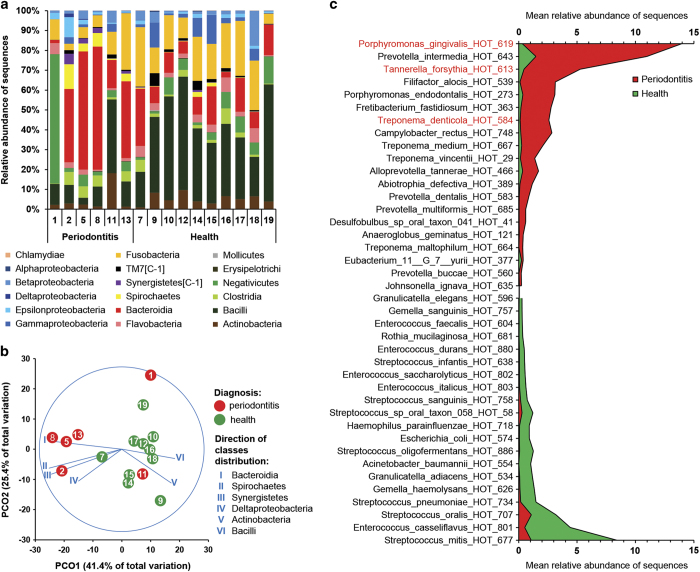
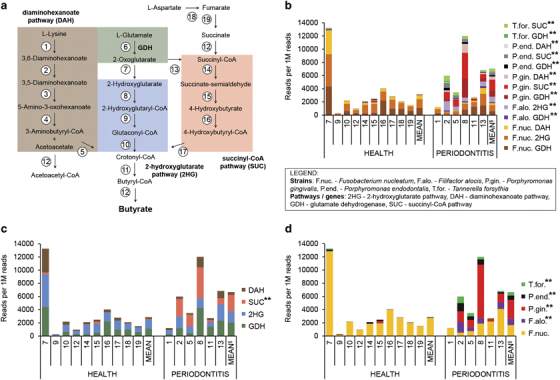
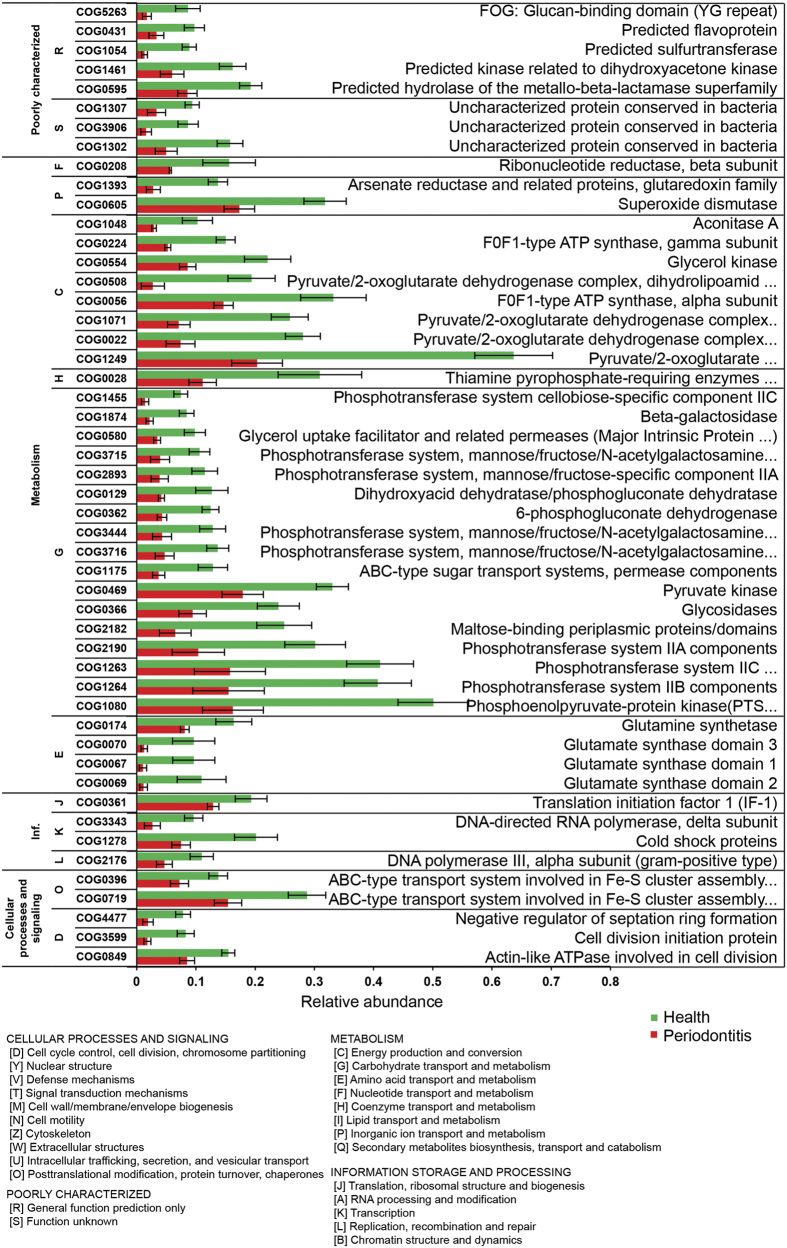
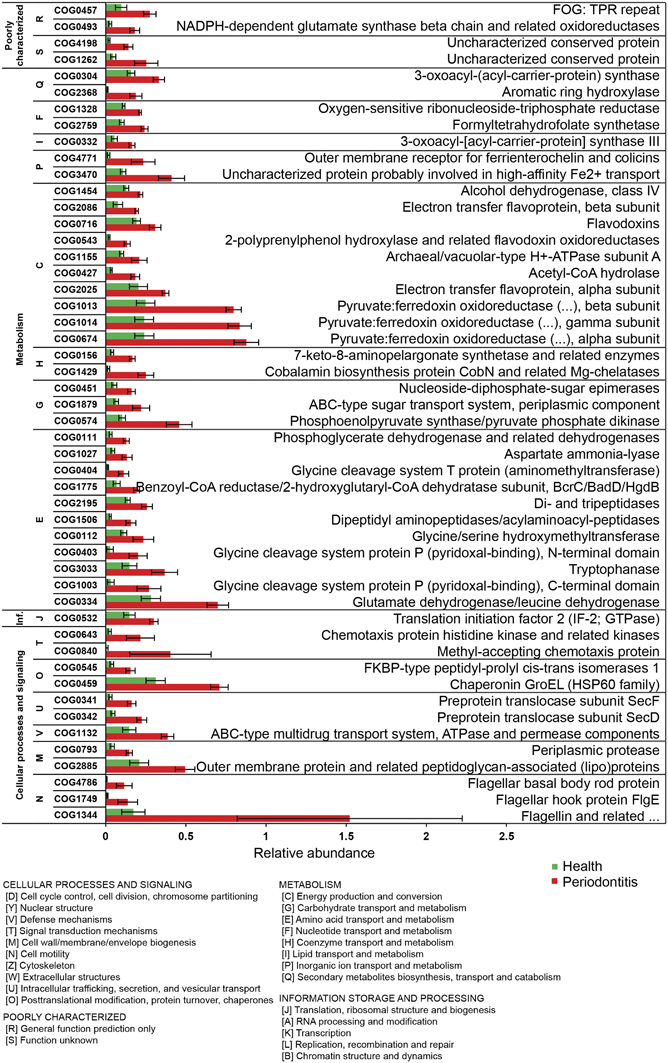
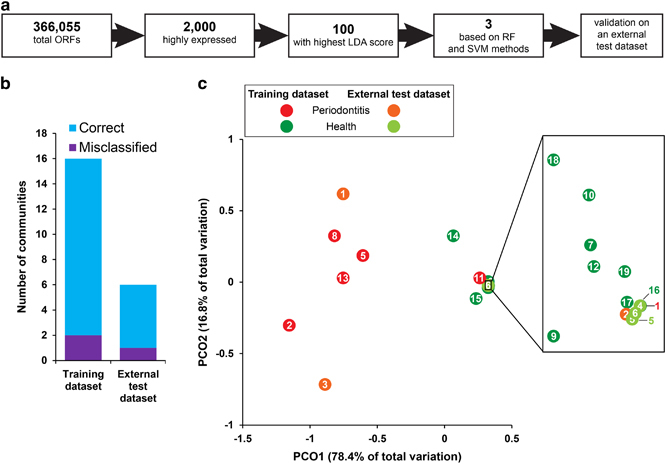
The transcriptionally active community shifted from Bacilli and Actinobacteria in health to Bacteroidia, Deltaproteobacteria, Spirochaetes and Synergistetes in periodontitis. Clusters of orthologous groups (COGs) related to carbohydrate transport and catabolism dominated in health, whereas protein degradation and amino acid catabolism dominated in disease. The LEfSe, random forest and support vector machine methods were applied to the 2,000 most highly expressed genes and discovered the three best functional biomarkers, namely haem binding protein HmuY from , flagellar filament core protein FlaB3 from , and repeat protein of unknown function from They predicted the diagnosis correctly for 14 from 16 individuals, and when applied to an independent study misclassified one out of six subjects only. shifted from commensalism to virulence by upregulating the expression of metalloproteases and the haem transporter. Expression of genes for the synthesis of the cytotoxic short-chain fatty acid butyrate was observed by under all conditions. Four additional species contributed to butyrate synthesis in periodontitis and they used an additional pathway.
Gene biomarkers of periodontitis are highly predictive. The pro-inflammatory role of is not related to butyrate synthesis.
背景/目的:牙周炎是全球最普遍的炎症性疾病,由龈下生物膜生态失调引起。在此,我们使用宏转录组学来确定从健康到牙周炎的功能转变、个体物种对生态失调的反应并发现生物标志物。
对16名个体进行研究,其中6人被诊断为慢性牙周炎。对总信使核糖核酸(mRNA)进行Illumina测序,每个样本产生约4200万条读数。共检测到324种人类口腔分类单元系统发育型和来自HOMD数据库参考基因组的366,055个开放阅读框。
转录活跃群落从健康状态下的芽孢杆菌和放线菌转变为牙周炎状态下的拟杆菌、δ-变形菌、螺旋体和互养菌。与碳水化合物转运和分解代谢相关的直系同源基因簇(COG)在健康状态下占主导,而蛋白质降解和氨基酸分解代谢在疾病状态下占主导。将线性判别分析效应大小(LEfSe)、随机森林和支持向量机方法应用于2000个表达最高的基因,发现了三个最佳功能生物标志物,即来自[具体物种1]的血红素结合蛋白HmuY、来自[具体物种2]的鞭毛丝核心蛋白FlaB3以及来自[具体物种3]的功能未知的重复蛋白。它们对16名个体中的14名做出了正确诊断,应用于独立研究时,仅将6名受试者中的1名误诊。[具体物种4]通过上调金属蛋白酶和血红素转运蛋白的表达从共生转变为致病。在所有条件下均观察到[具体物种5]合成细胞毒性短链脂肪酸丁酸的基因表达。另外四个物种在牙周炎中促进丁酸合成,且它们使用了另一条途径。
牙周炎的基因生物标志物具有高度预测性。[具体物种4]的促炎作用与丁酸合成无关。