Köklü Yusuf, Alemdaroğlu Utku
Faculty of Sport Sciences, Pamukkale University, Denizli 20160, Turkey.
Sports (Basel). 2016 Sep 29;4(4):48. doi: 10.3390/sports4040048.
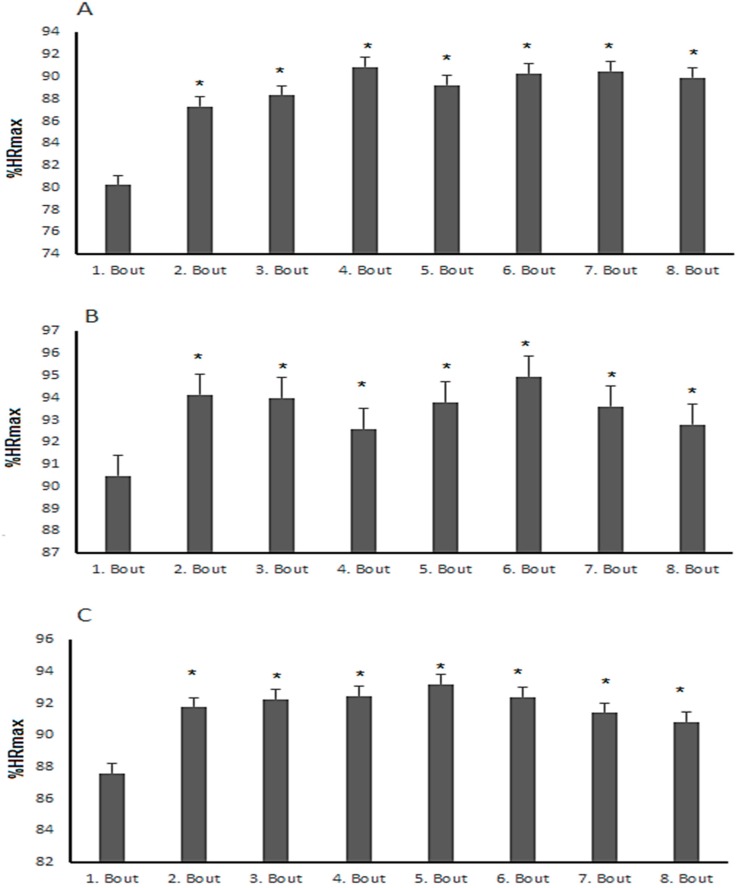
The purpose of this study was to compare the percentage of maximum heart rate (%HRmax), blood lactate (La), and rating of perceived exertion (RPE, CR-10) responses across different formats of small-sided games (SSG) in elite young soccer players. Fourteen players (average age 16.7 ± 0.6 years; height 177.6 ± 4.1 cm; body mass 66.3 ± 4.7 kg; average training age 6.7 ± 1.6 years; percentage of body fat 8.4 ± 2.6%) volunteered to perform the YoYo intermittent recovery test (level 1) and eight bouts of soccer drills including 2-a-side, 3-a-side, and 4-a-side games without goalkeepers in random order at two-day intervals. Heart rates were monitored throughout the SSGs, whereas the RPE and venous blood lactate were determined at the end of the last bout of each SSG. The differences in La, %HRmax, and RPE either across the different SSGs or between the bouts were identified using 3 × 8 (games × exercise bouts) two-way analysis of variance with repeated measures. Significant differences were found in terms of La, RPE, and %HRmax among the different types of SSG ( ≤ 0.05). 3-a-side and 4-a-side games elicited significantly higher responses than 2-a-side games in terms of %HRmax ( ≤ 0.05), whereas 4-a-side games resulted in significantly lower La and RPE responses compared to 2-a-side and 3-a-side games. The results of this study show that physiological responses differ according to the numbers of players involved in small-sided games. Therefore, it can be concluded that 3-a-side and 4-a-side games could be more effective in improving high intensity aerobic performance than 2-a-side games, which in turn are more appropriate for developing anaerobic performance.
本研究旨在比较精英青年足球运动员在不同形式的小型比赛(SSG)中,最大心率百分比(%HRmax)、血乳酸(La)和主观用力程度分级(RPE,CR-10)的反应情况。14名运动员(平均年龄16.7±0.6岁;身高177.6±4.1厘米;体重66.3±4.7千克;平均训练年限6.7±1.6年;体脂百分比8.4±2.6%)自愿参加了YoYo间歇恢复测试(1级),并以随机顺序,每隔两天进行八组足球训练,包括无守门员的2对2、3对3和4对4比赛。在整个小型比赛过程中监测心率,而在每个小型比赛最后一组结束时测定主观用力程度分级和静脉血乳酸。使用3×8(比赛×训练组)重复测量双向方差分析,确定不同小型比赛之间或各训练组之间血乳酸、最大心率百分比和主观用力程度分级的差异。在不同类型的小型比赛中,血乳酸、主观用力程度分级和最大心率百分比方面存在显著差异(≤0.05)。就最大心率百分比而言,3对3和4对4比赛引起的反应显著高于2对2比赛(≤0.05),而与2对2和3对3比赛相比,4对4比赛导致的血乳酸和主观用力程度分级反应显著更低。本研究结果表明,生理反应因参与小型比赛的球员数量而异。因此,可以得出结论,3对3和4对4比赛在提高高强度有氧能力方面可能比2对2比赛更有效,而2对2比赛则更适合发展无氧能力。