Department of Sports Science and Exercise, Strasbourg University, France ; Tunisian Research Laboratory "Sport Performance Optimisation" - Nat. Centre of Med. and Sci. in Sport -El Menzah, Tunisia. ; Olympique Lyonnais FC (soccer), Lyon, France.
J Hum Kinet. 2011 Jun;28:107-14. doi: 10.2478/v10078-011-0027-8. Epub 2011 Jul 4.
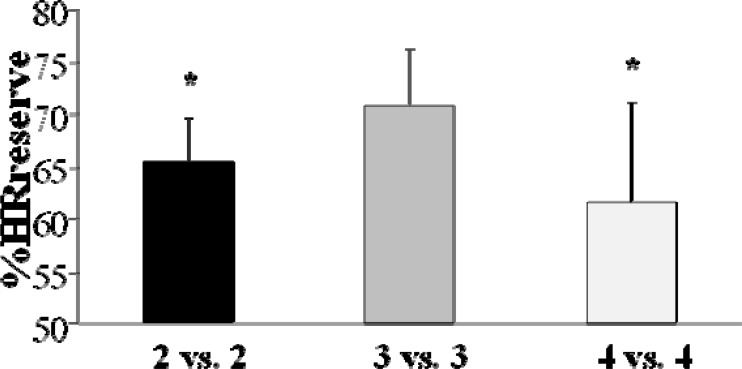
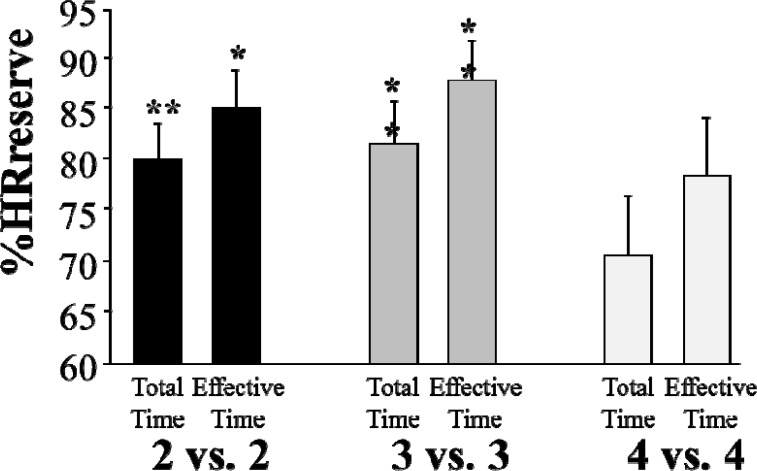
The purpose of this study was to compare heart rate (HR) responses within and between small-sided games (SSG) training methods in elite young soccer players. Twenty-seven youth soccer players (age: 16.5 ± 0.5 years, height: 174.5 ± 5.5 cm, weight: 62.9 ± 8.3, velocity at maximal aerobic speed (MAS): 15.9 ± 0.9 km.h(-1)) performed 3 different SSG (2 vs. 2, 3 vs. 3, 4 vs. 4 without goalkeeper). In each SSG, HR was continuously measured and expressed as a mean percentage of HR reserve (%HRreserve). The mean %HRreserve calculated during the SSG was significantly lower during 4 vs. 4 (70.6 ± 5.9 %) compared to 2 vs. 2 (80.1 ± 3.6 %, p<0.001) and 3 vs. 3 (81.5 ± 4.3 %, p<0.001) SSG. Regardless of the time spent above 60, 65, 70, 75, 80, 85 and 90 % of HRreserve, 4 vs. 4 solicited lower percentage of time than 3 vs. 3 and 2 vs. 2. Intersubject coefficients of variation were significantly higher during 4 vs. 4 compared to 2 vs.2 and 3 vs. 3. The %HRreserve after 30s of recovery was significantly higher for 3 vs. 3 (70.6 ± 5.3 %) compared to 2 vs. 2 (65.2 ± 4.8 %, p<0.05) and 4 vs. 4 (61.6 ± 9.3 %, p<0.05). In conclusion, this study demonstrates that the physiological demands is higher during 2 vs. 2 and 3 vs. 3 compared to 4 vs. 4 in youth soccer players. This difference could be due to that young soccer players do not have the same technical ability and experience as adult players and thus, their activity during the 2 vs. 2 and 3 vs. 3 induces a greater physical demand due to their lack of experience. The age of the players could be linked with the physical demands within small-sided games.
本研究旨在比较青少年精英足球运动员在小场地比赛(SSG)训练方法中的心率(HR)反应。27 名青年足球运动员(年龄:16.5 ± 0.5 岁,身高:174.5 ± 5.5cm,体重:62.9 ± 8.3kg,最大有氧速度(MAS)速度:15.9 ± 0.9km.h(-1))进行了 3 种不同的 SSG(2v2、3v3、4v4 无守门员)。在每个 SSG 中,连续测量 HR 并表示为 HR 储备百分比(%HRreserve)的平均值。4v4 时的平均 %HRreserve 显著低于 2v2(80.1 ± 3.6%,p<0.001)和 3v3(81.5 ± 4.3%,p<0.001)SSG。无论在 60、65、70、75、80、85 和 90%的 HRreserve 以上的时间花费如何,4v4 都比 3v3 和 2v2 花费的时间百分比更低。与 2v2 和 3v3 相比,4v4 的个体间变异系数明显更高。30s 恢复后的 %HRreserve 3v3(70.6 ± 5.3%)显著高于 2v2(65.2 ± 4.8%,p<0.05)和 4v4(61.6 ± 9.3%,p<0.05)。总之,本研究表明,青少年足球运动员在 2v2 和 3v3 时的生理需求高于 4v4。这种差异可能是由于年轻足球运动员没有像成年运动员那样的相同技术能力和经验,因此,由于缺乏经验,他们在 2v2 和 3v3 中的活动会导致更大的身体需求。球员的年龄可能与小场地比赛中的身体需求有关。