Painter Keith B, Haff G Gregory, Triplett N Travis, Stuart Charles, Hornsby Guy, Ramsey Mike W, Bazyler Caleb D, Stone Michael H
Center of Excellence for Sport Science and Coach Education, Sport, Exercise, Recreation and Kinesiology, East Tennessee State University, Johnson City, TN 37614, USA.
Centre for Exercise, and Sport Sciences Research, Edith Cowan University, Joondalup 6027, Australia.
Sports (Basel). 2018 Jan 16;6(1):3. doi: 10.3390/sports6010003.
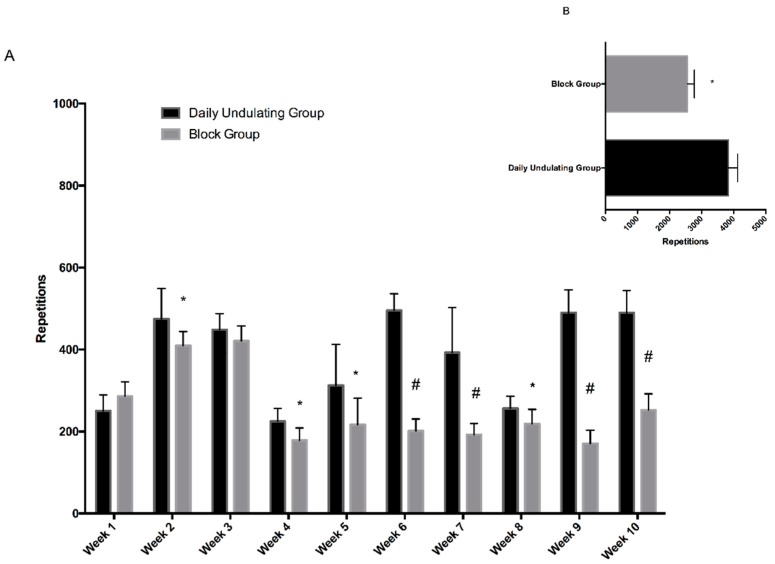
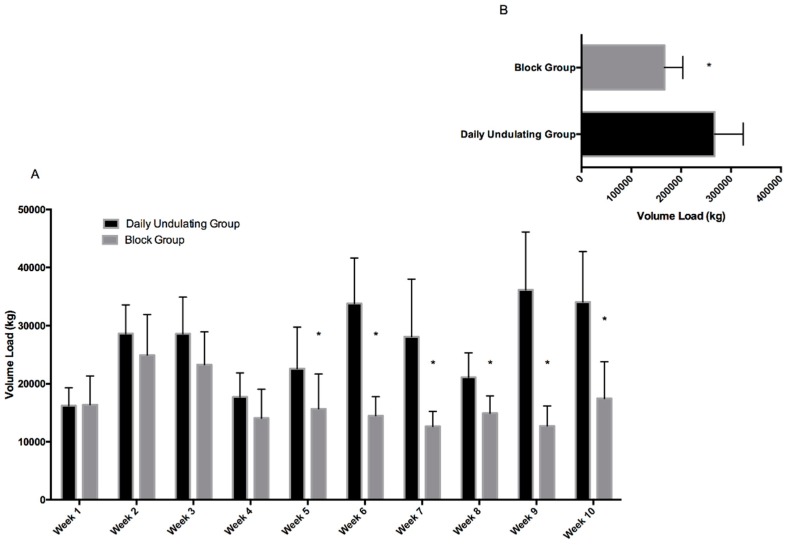
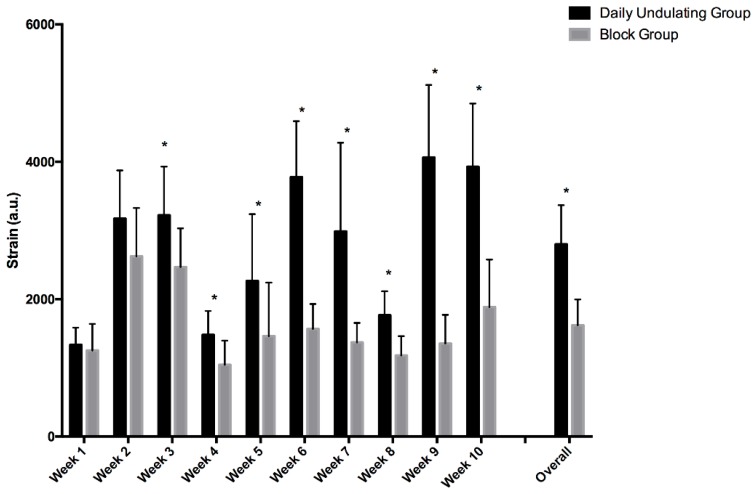
Daily undulating periodization (DUP), using daily alterations in repetitions, has been advocated as a superior method of resistance training, while traditional forms of programming for periodization (Block) have been questioned. Nineteen Division I track and field athletes were assigned to either a 10-week Block or DUP training group. Year and event were controlled. Over the course of the study, there were four testing sessions, which were used to evaluate a variety of strength characteristics, including maximum isometric strength, rate of force development, and one repetition maximum (1RM). Although, performance trends favored the Block group for strength and rate of force development, no statistical differences were found between the two groups. However, different ( ≤ 0.05) estimated volumes of work (VL) and amounts of improvement per VL were found between groups. Based upon calculated training efficiency scores, these data indicate that a Block training model is more efficient in producing strength gains than a DUP model. Additionally, alterations in testosterone (T), cortisol (C) and the T:C ratio were measured. Although there were no statistically ( ≤ 0.05) different hormone alterations between groups, relationships between training variables and hormone concentrations including the T:C ratio, indicate that Block may be more efficacious in terms of fatigue management.
每日波动周期化训练(DUP),即通过每日重复次数的改变进行训练,已被倡导为一种更优的阻力训练方法,而传统的周期化训练模式(块状训练法)则受到了质疑。19名一级田径运动员被分配到为期10周的块状训练组或每日波动周期化训练组。年份和赛事均得到控制。在研究过程中,进行了四次测试,用于评估各种力量特征,包括最大等长力量、力量发展速率和一次重复最大值(1RM)。尽管在力量和力量发展速率方面,表现趋势有利于块状训练组,但两组之间未发现统计学差异。然而,两组之间发现了不同(≤0.05)的估计工作量(VL)以及每单位VL的进步量。根据计算出的训练效率得分,这些数据表明,块状训练模式在增加力量方面比每日波动周期化训练模式更有效。此外,还测量了睾酮(T)、皮质醇(C)以及T:C比值的变化。尽管两组之间在激素变化方面没有统计学(≤0.05)差异,但训练变量与包括T:C比值在内的激素浓度之间的关系表明,块状训练法在疲劳管理方面可能更有效。