Center of Excellence for Sport Science and Coach Education, Department of Sport, Exercise, Recreation and Kinesiology, East Tennessee State University, Johnson City, TN 37614, USA.
Osness Human Performance Laboratories, Department of Health, Sport and Exercise Sciences, University of Kansas, Lawrence, KS 66045, USA.
Int J Environ Res Public Health. 2021 Apr 29;18(9):4735. doi: 10.3390/ijerph18094735.
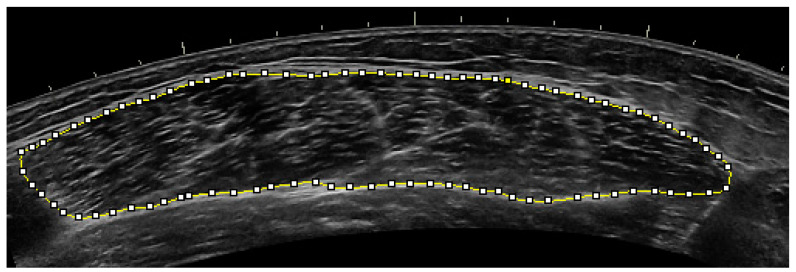
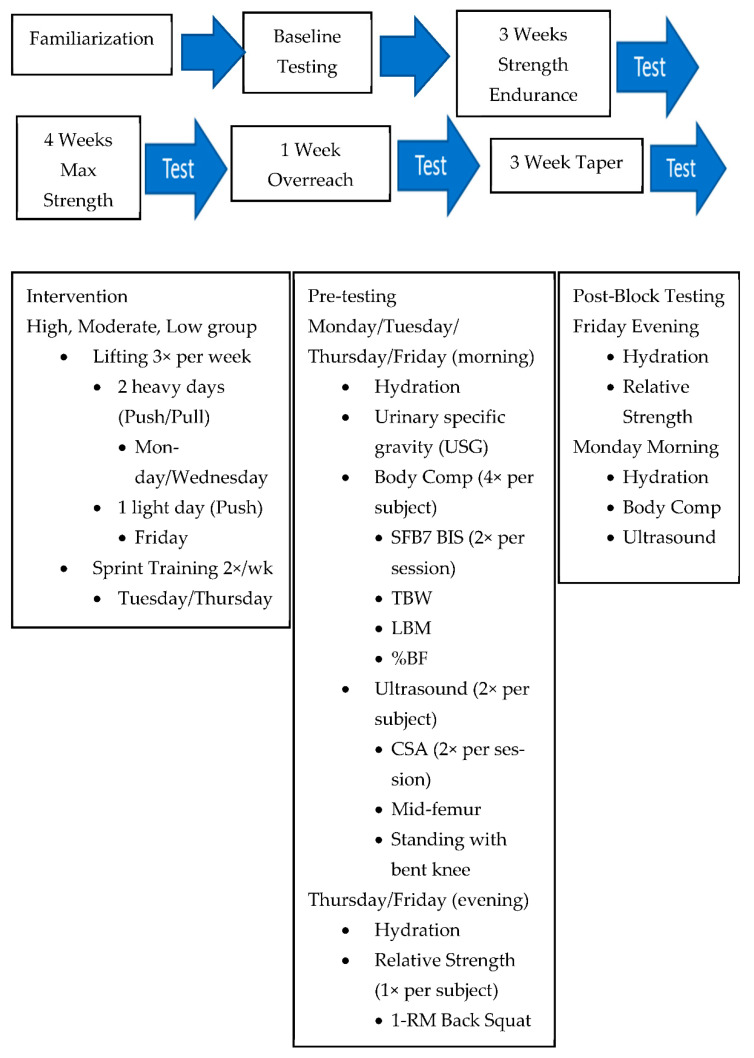
The block periodization training paradigm has been shown to produce enhanced gains in strength and power. The purpose of this study is to assess resistance training induced alterations in lean body mass and cross-sectional area using a block periodization training model among individuals (n = 15) of three differing strength levels (high, moderate and low) based on one repetition maximum back squat relative to body weight. A 3 × 5 mixed-design ANOVA was used to examine within-and between-subject changes in cross-sectional area (CSA), lean body mass (LBM), lean body mass adjusted (LBM) and total body water (TBW) over an 11-week resistance training program. LBM is total body water subtracted from lean body mass. The ANOVA revealed no statistically significant between-group differences in any independent variable ( > 0.05). Within-group effects showed statistically significant increases in cross-sectional area ( < 0.001), lean body mass ( < 0.001), lean body mass adjusted ( ˂ 0.001) and total body water ( < 0.001) from baseline to post intervention: CSA: 32.7 cm ± 8.6; 36.3 cm ± 7.2, LBM: 68.0 kg ± 9.5; 70.6 kg ± 9.4, LBM: 20.4 kg ± 3.1; 21.0 kg ± 3.3 and TBW: 49.8 kg ± 6.9; 51.7 kg ± 6.9. In conclusion, the results of this study suggest subjects experienced an increase in both lean body mass and total body water, regardless of strength level, over the course of the 11-week block periodized program. Gains in lean body mass and cross-sectional area may be due to edema at the early onset of training.
块周期化训练模式已被证明能增强力量和力量的增长。本研究的目的是评估阻力训练诱导的变化,在瘦肉组织质量和横截面积使用块周期化训练模型在个体(n = 15)三个不同的强度水平(高,中,低)基于一重复最大深蹲相对于体重。使用 3 × 5 混合设计方差分析来检验横断面面积(CSA),瘦肉组织质量(LBM),瘦体重调整(LBM)和全身水(TBW)在 11 周的阻力训练计划中的个体内和个体间的变化。LBM 是全身水从瘦体重中减去。方差分析显示,任何独立变量之间均无统计学显著差异(> 0.05)。组内效应显示,横断面面积(<0.001)、瘦体重(<0.001)、瘦体重调整(<0.001)和全身水(<0.001)从基线到干预后均有统计学显著增加:CSA:32.7 cm ± 8.6;36.3 cm ± 7.2,LBM:68.0 kg ± 9.5;70.6 kg ± 9.4,LBM:20.4 kg ± 3.1;21.0 kg ± 3.3和 TBW:49.8 kg ± 6.9;51.7 kg ± 6.9。总之,本研究的结果表明,无论强度水平如何,在 11 周的块周期化训练计划中,受试者的瘦体重和全身水都有所增加。瘦体重和横截面积的增加可能是由于训练早期的水肿。