• 文献检索
  • 文档翻译
  • 深度研究
  • 学术资讯
  • Suppr Zotero 插件Zotero 插件
  • 邀请有礼
  • 套餐&价格
  • 历史记录
应用&插件
Suppr Zotero 插件Zotero 插件浏览器插件Mac 客户端Windows 客户端微信小程序
定价
高级版会员购买积分包购买API积分包
服务
文献检索文档翻译深度研究API 文档MCP 服务
关于我们
关于 Suppr公司介绍联系我们用户协议隐私条款
关注我们

Suppr 超能文献

核心技术专利:CN118964589B侵权必究
粤ICP备2023148730 号-1Suppr @ 2026

文献检索

告别复杂PubMed语法,用中文像聊天一样搜索,搜遍4000万医学文献。AI智能推荐,让科研检索更轻松。

立即免费搜索

文件翻译

保留排版,准确专业,支持PDF/Word/PPT等文件格式,支持 12+语言互译。

免费翻译文档

深度研究

AI帮你快速写综述,25分钟生成高质量综述,智能提取关键信息,辅助科研写作。

立即免费体验

超级马拉松运动中的生理学与病理生理学

Physiology and Pathophysiology in Ultra-Marathon Running.

作者信息

Knechtle Beat, Nikolaidis Pantelis T

机构信息

Institute of Primary Care, University of Zurich, Zurich, Switzerland.

Exercise Physiology Laboratory, Nikaia, Greece.

出版信息

Front Physiol. 2018 Jun 1;9:634. doi: 10.3389/fphys.2018.00634. eCollection 2018.

DOI:10.3389/fphys.2018.00634
PMID:29910741
原文链接:https://pmc.ncbi.nlm.nih.gov/articles/PMC5992463/
Abstract

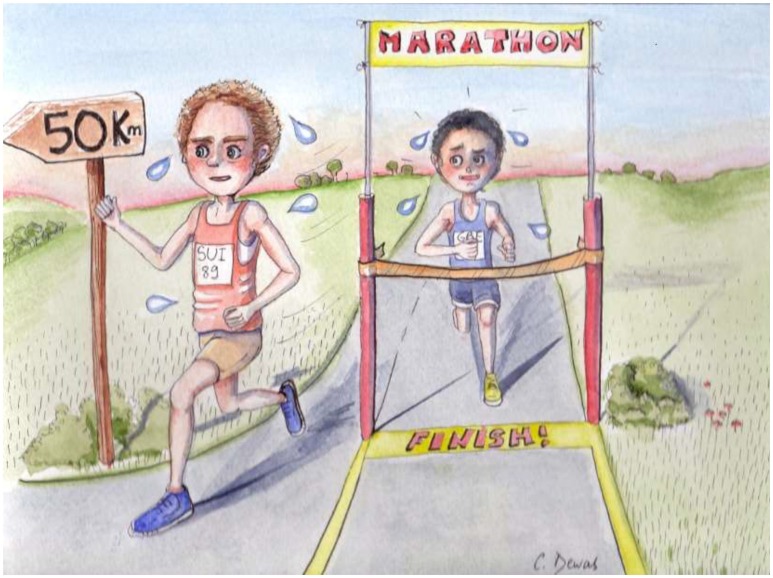
In this overview, we summarize the findings of the literature with regards to physiology and pathophysiology of ultra-marathon running. The number of ultra-marathon races and the number of official finishers considerably increased in the last decades especially due to the increased number of female and age-group runners. A typical ultra-marathoner is male, married, well-educated, and ~45 years old. Female ultra-marathoners account for ~20% of the total number of finishers. Ultra-marathoners are older and have a larger weekly training volume, but run more slowly during training compared to marathoners. Previous experience (e.g., number of finishes in ultra-marathon races and personal best marathon time) is the most important predictor variable for a successful ultra-marathon performance followed by specific anthropometric (e.g., low body mass index, BMI, and low body fat) and training (e.g., high volume and running speed during training) characteristics. Women are slower than men, but the sex difference in performance decreased in recent years to ~10-20% depending upon the length of the ultra-marathon. The fastest ultra-marathon race times are generally achieved at the age of 35-45 years or older for both women and men, and the age of peak performance increases with increasing race distance or duration. An ultra-marathon leads to an energy deficit resulting in a reduction of both body fat and skeletal muscle mass. An ultra-marathon in combination with other risk factors, such as extreme weather conditions (either heat or cold) or the country where the race is held, can lead to exercise-associated hyponatremia. An ultra-marathon can also lead to changes in biomarkers indicating a pathological process in specific organs or organ systems such as skeletal muscles, heart, liver, kidney, immune and endocrine system. These changes are usually temporary, depending on intensity and duration of the performance, and usually normalize after the race. In longer ultra-marathons, ~50-60% of the participants experience musculoskeletal problems. The most common injuries in ultra-marathoners involve the lower limb, such as the ankle and the knee. An ultra-marathon can lead to an increase in creatine-kinase to values of 100,000-200,000 U/l depending upon the fitness level of the athlete and the length of the race. Furthermore, an ultra-marathon can lead to changes in the heart as shown by changes in cardiac biomarkers, electro- and echocardiography. Ultra-marathoners often suffer from digestive problems and gastrointestinal bleeding after an ultra-marathon is not uncommon. Liver enzymes can also considerably increase during an ultra-marathon. An ultra-marathon often leads to a temporary reduction in renal function. Ultra-marathoners often suffer from upper respiratory infections after an ultra-marathon. Considering the increased number of participants in ultra-marathons, the findings of the present review would have practical applications for a large number of sports scientists and sports medicine practitioners working in this field.
https://cdn.ncbi.nlm.nih.gov/pmc/blobs/3d3f/5992463/4c7c7c806eb1/fphys-09-00634-g0005.jpg
https://cdn.ncbi.nlm.nih.gov/pmc/blobs/3d3f/5992463/c40338421178/fphys-09-00634-g0001.jpg
https://cdn.ncbi.nlm.nih.gov/pmc/blobs/3d3f/5992463/504bf3f22160/fphys-09-00634-g0002.jpg
https://cdn.ncbi.nlm.nih.gov/pmc/blobs/3d3f/5992463/ae72498787dc/fphys-09-00634-g0003.jpg
https://cdn.ncbi.nlm.nih.gov/pmc/blobs/3d3f/5992463/eb2add15df95/fphys-09-00634-g0004.jpg
https://cdn.ncbi.nlm.nih.gov/pmc/blobs/3d3f/5992463/4c7c7c806eb1/fphys-09-00634-g0005.jpg
https://cdn.ncbi.nlm.nih.gov/pmc/blobs/3d3f/5992463/c40338421178/fphys-09-00634-g0001.jpg
https://cdn.ncbi.nlm.nih.gov/pmc/blobs/3d3f/5992463/504bf3f22160/fphys-09-00634-g0002.jpg
https://cdn.ncbi.nlm.nih.gov/pmc/blobs/3d3f/5992463/ae72498787dc/fphys-09-00634-g0003.jpg
https://cdn.ncbi.nlm.nih.gov/pmc/blobs/3d3f/5992463/eb2add15df95/fphys-09-00634-g0004.jpg
https://cdn.ncbi.nlm.nih.gov/pmc/blobs/3d3f/5992463/4c7c7c806eb1/fphys-09-00634-g0005.jpg
摘要

在本综述中,我们总结了关于超级马拉松跑的生理学和病理生理学的文献研究结果。在过去几十年里,超级马拉松比赛的数量和官方完赛者的数量大幅增加,这尤其归因于女性和年龄组跑者数量的增加。典型的超级马拉松跑者为男性,已婚,受过良好教育,年龄约45岁。女性超级马拉松跑者占完赛者总数的约20%。超级马拉松跑者年龄更大,每周训练量更大,但与马拉松跑者相比,他们在训练时跑得更慢。以往经验(如超级马拉松比赛的完赛次数和个人最佳马拉松成绩)是超级马拉松成功表现的最重要预测变量,其次是特定的人体测量学特征(如低体重指数、BMI和低体脂)和训练特征(如训练量和训练时的跑步速度)。女性比男性跑得慢,但近年来成绩的性别差异降至约10 - 20%,具体取决于超级马拉松的长度。对于男性和女性来说,最快的超级马拉松比赛成绩通常在35 - 45岁或更年长时取得,并且最佳成绩年龄会随着比赛距离或时长的增加而提高。一场超级马拉松会导致能量亏空,从而使体脂和骨骼肌质量都减少。超级马拉松与其他风险因素(如极端天气条件(炎热或寒冷)或比赛举办国家)相结合,可能会导致运动相关性低钠血症。超级马拉松还可能导致生物标志物发生变化,表明特定器官或器官系统(如骨骼肌、心脏、肝脏、肾脏、免疫和内分泌系统)存在病理过程。这些变化通常是暂时的,取决于表现的强度和持续时间,通常在比赛后会恢复正常。在较长距离的超级马拉松中,约50 - 60%的参与者会出现肌肉骨骼问题。超级马拉松跑者最常见的损伤涉及下肢,如脚踝和膝盖。一场超级马拉松可能会使肌酸激酶升高至100,000 - 200,000 U/l,具体取决于运动员的体能水平和比赛长度。此外,超级马拉松还可能导致心脏变化,如心脏生物标志物、心电图和超声心动图的变化所示。超级马拉松跑者在赛后经常出现消化问题,胃肠道出血也并不罕见。在超级马拉松期间,肝酶也可能会大幅升高。超级马拉松通常会导致肾功能暂时下降。超级马拉松跑者在赛后经常患上呼吸道感染。鉴于超级马拉松参与者数量的增加,本综述的研究结果将对该领域的大量体育科学家和运动医学从业者具有实际应用价值。

相似文献

1
Physiology and Pathophysiology in Ultra-Marathon Running.超级马拉松运动中的生理学与病理生理学
Front Physiol. 2018 Jun 1;9:634. doi: 10.3389/fphys.2018.00634. eCollection 2018.
2
Does Muscle Mass Affect Running Times in Male Long-distance Master Runners?肌肉量会影响男性长跑成年运动员的跑步时间吗?
Asian J Sports Med. 2012 Dec;3(4):247-56. doi: 10.5812/asjsm.34547.
3
What is the age for the fastest ultra-marathon performance in time-limited races from 6 h to 10 days?在限时6小时至10天的超长距离马拉松比赛中,达到最快成绩的年龄是多少?
Age (Dordr). 2014;36(5):9715. doi: 10.1007/s11357-014-9715-3. Epub 2014 Oct 4.
4
Motivation in ultra-marathon runners.超级马拉松运动员的动机。
Psychol Res Behav Manag. 2018 Dec 27;12:31-37. doi: 10.2147/PRBM.S189061. eCollection 2019.
5
Elderly female ultra-marathoners reduced the gap to male ultra-marathoners in Swiss running races.老年女性超级马拉松运动员在瑞士赛跑比赛中缩小了与男性超级马拉松运动员的差距。
Sci Rep. 2023 Aug 2;13(1):12521. doi: 10.1038/s41598-023-39690-6.
6
Will the age of peak ultra-marathon performance increase with increasing race duration?超级马拉松最佳成绩的年龄会随着比赛时长的增加而提高吗?
BMC Sports Sci Med Rehabil. 2014 Sep 27;6:36. doi: 10.1186/2052-1847-6-36. eCollection 2014.
7
Age and ultra-marathon performance - 50 to 1,000 km distances from 1969 - 2012.年龄与超级马拉松成绩——1969年至2012年50至1000公里赛程
Springerplus. 2014 Nov 25;3:693. doi: 10.1186/2193-1801-3-693. eCollection 2014.
8
The Sex Difference in 6-h Ultra-Marathon Running-The Worldwide Trends from 1982 to 2020.6 小时超长马拉松跑的性别差异——1982 年至 2020 年的全球趋势。
Medicina (Kaunas). 2022 Jan 25;58(2):179. doi: 10.3390/medicina58020179.
9
Similarities and differences in anthropometry and training between recreational male 100-km ultra-marathoners and marathoners.业余男性 100 公里超级马拉松选手和马拉松选手在人体测量学和训练方面的异同。
J Sports Sci. 2012;30(12):1249-57. doi: 10.1080/02640414.2012.697182. Epub 2012 Jun 25.
10
Analysis of over 1 million race records shows runners from East African countries as the fastest in 50-km ultra-marathons.对超过 100 万份比赛记录的分析显示,来自东非国家的跑步者是 50 公里超级马拉松比赛中速度最快的。
Sci Rep. 2024 Apr 5;14(1):8006. doi: 10.1038/s41598-024-58571-0.

引用本文的文献

1
Exertional Rhabdomyolysis and Ultra-Trail Races: A Systematic Review Highlighting the Significant Impact of Eccentric Load.运动性横纹肌溶解症与超长距离越野赛:一项强调离心负荷重大影响的系统评价
Muscles. 2024 Aug 13;3(3):242-258. doi: 10.3390/muscles3030022.
2
Influence of long-distance trail running on blood hemostasis at the World Mountain Trail Running Championship 2023-a pilot study.2023年世界山地越野跑锦标赛中长距离越野跑对血液止血的影响——一项试点研究
Res Pract Thromb Haemost. 2025 Jun 30;9(5):102958. doi: 10.1016/j.rpth.2025.102958. eCollection 2025 Jul.
3
Longitudinal NMR-based Metabolomics Analysis of Male Mountain Ultramarathon Runners: New Perspectives for Athletes Monitoring and Injury Prevention.

本文引用的文献

1
Performance in 100-km Ultramarathoners-At Which Age, It Reaches Its Peak?100 公里超级马拉松运动员的表现——在哪个年龄段达到顶峰?
J Strength Cond Res. 2020 May;34(5):1409-1415. doi: 10.1519/JSC.0000000000002539.
2
Age of peak performance in 50-km ultramarathoners - is it older than in marathoners?50公里超级马拉松运动员的最佳成绩年龄——是否比马拉松运动员的年龄更大?
Open Access J Sports Med. 2018 Mar 1;9:37-45. doi: 10.2147/OAJSM.S154816. eCollection 2018.
3
A randomized controlled trial of manual therapy and pneumatic compression for recovery from prolonged running - an extended study.
基于纵向核磁共振的男性山地超级马拉松运动员代谢组学分析:运动员监测与损伤预防的新视角
Sports Med Open. 2025 Jun 24;11(1):79. doi: 10.1186/s40798-025-00879-w.
4
Pacing and placing in 161-km ultramarathons: Effects of sex and age.161公里超级马拉松中的配速与名次:性别和年龄的影响
PLoS One. 2025 May 12;20(5):e0322883. doi: 10.1371/journal.pone.0322883. eCollection 2025.
5
The Sleep-Wake Cycle Pattern of a Blind Trail Ultramarathon Runner and His Guide: The World's First Case.一名盲人超马拉松运动员及其向导的睡眠-觉醒周期模式:世界首例。
Clocks Sleep. 2025 Apr 15;7(2):20. doi: 10.3390/clockssleep7020020.
6
Analysis of the 50-mile ultramarathon distance using a predictive XGBoost model.使用预测性XGBoost模型对50英里超级马拉松距离进行分析。
Sci Rep. 2025 Mar 15;15(1):9016. doi: 10.1038/s41598-025-92581-w.
7
Acid-Base and Electrolyte Balance Responses in the Performance of Female Ultramarathon Runners in a 45 km Mountain Race.45公里山地赛中女子超级马拉松运动员表现中的酸碱及电解质平衡反应
Nutrients. 2025 Feb 20;17(5):751. doi: 10.3390/nu17050751.
8
The Diet Quality of Ultramarathon Runners Taking Part in an Australian Event: A Cross-Sectional Explorative Study.参加澳大利亚一项赛事的超级马拉松运动员的饮食质量:一项横断面探索性研究。
Nutrients. 2025 Jan 29;17(3):485. doi: 10.3390/nu17030485.
9
Physiology and Pathophysiology of Marathon Running: A narrative Review.马拉松跑的生理学与病理生理学:一篇叙述性综述
Sports Med Open. 2025 Jan 27;11(1):10. doi: 10.1186/s40798-025-00810-3.
10
Running trends in Switzerland from 1999 to 2019: An exploratory observational study.1999年至2019年瑞士的跑步趋势:一项探索性观察研究。
PLoS One. 2025 Jan 16;20(1):e0311268. doi: 10.1371/journal.pone.0311268. eCollection 2025.
一项针对长时间跑步后恢复的手法治疗和气动压迫的随机对照试验——一项扩展研究。
Res Sports Med. 2018 Jul-Sep;26(3):354-364. doi: 10.1080/15438627.2018.1447469. Epub 2018 Mar 7.
4
Ultra-obligatory running among ultramarathon runners.超级马拉松运动员中的超强制跑步现象。
Res Sports Med. 2018 Apr-Jun;26(2):211-221. doi: 10.1080/15438627.2018.1431533. Epub 2018 Jan 29.
5
Right Ventricular Structure and Function in the Veteran Ultramarathon Runner: Is There Evidence for Chronic Maladaptation?老兵超级马拉松运动员的右心室结构和功能:是否存在慢性适应不良的证据?
J Am Soc Echocardiogr. 2018 May;31(5):598-605.e1. doi: 10.1016/j.echo.2017.11.021. Epub 2018 Jan 3.
6
The development of skeletal muscle hypertrophy through resistance training: the role of muscle damage and muscle protein synthesis.抗阻训练诱导骨骼肌肥大的机制:肌肉损伤及肌肉蛋白质合成的作用。
Eur J Appl Physiol. 2018 Mar;118(3):485-500. doi: 10.1007/s00421-017-3792-9. Epub 2017 Dec 27.
7
Physiological and Training Profiles of Ultramarathoners.超级马拉松运动员的生理和训练概况
Phys Sportsmed. 1982 May;10(5):61-65. doi: 10.1080/00913847.1982.11947223.
8
Transient cardiac dysfunction but elevated cardiac and kidney biomarkers 24 h following an ultra-distance running event in Mexican Tarahumara.在墨西哥塔拉乌马拉人进行超长跑比赛24小时后出现短暂性心脏功能障碍,但心脏和肾脏生物标志物升高。
Extrem Physiol Med. 2017 Dec 11;6:3. doi: 10.1186/s13728-017-0057-5. eCollection 2017.
9
Foot-strike haemolysis in an ultramarathon runner.一名超级马拉松运动员的足着地性溶血
BMJ Case Rep. 2017 Dec 13;2017:bcr-2017-220661. doi: 10.1136/bcr-2017-220661.
10
The changes of red blood cell viscoelasticity and sports anemia in male 24-hr ultra-marathoners.男性 24 小时超马运动员红细胞流变性和运动性贫血的变化。
J Chin Med Assoc. 2018 May;81(5):475-481. doi: 10.1016/j.jcma.2017.09.011. Epub 2017 Nov 10.