Laboratoire MITOVASC, UMR CNRS 6015 - INSERM 1083, Université d'Angers, Angers, France.
Laboratoire de Génétique, Immunologie et Pathologies Humaines, Faculté des Sciences de Tunis, Université de Tunis El Manar, Tunis, Tunisie.
PLoS Comput Biol. 2018 Jun 18;14(6):e1006209. doi: 10.1371/journal.pcbi.1006209. eCollection 2018 Jun.
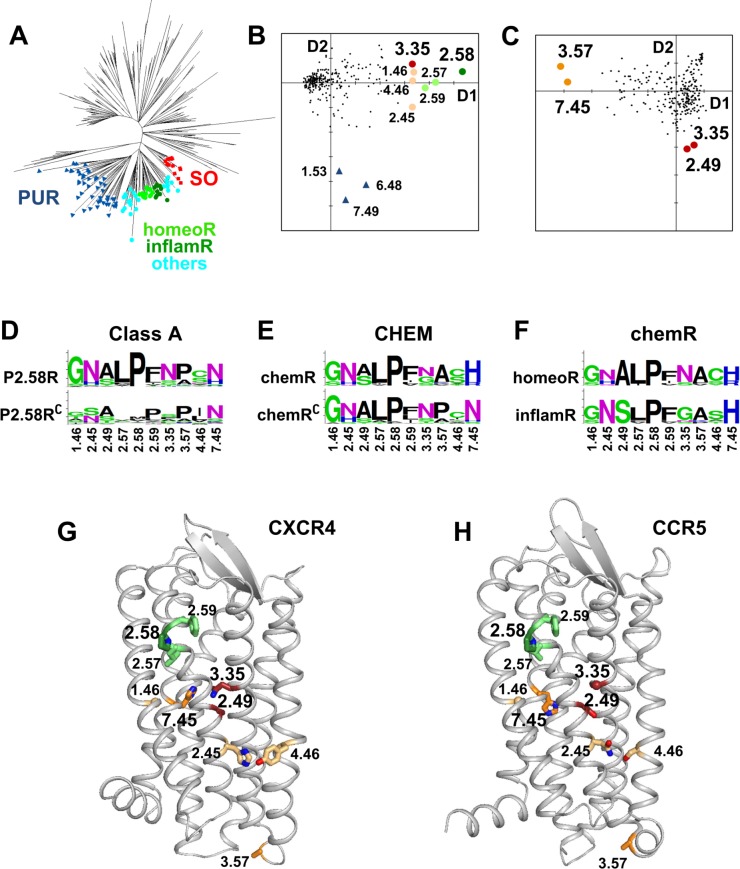
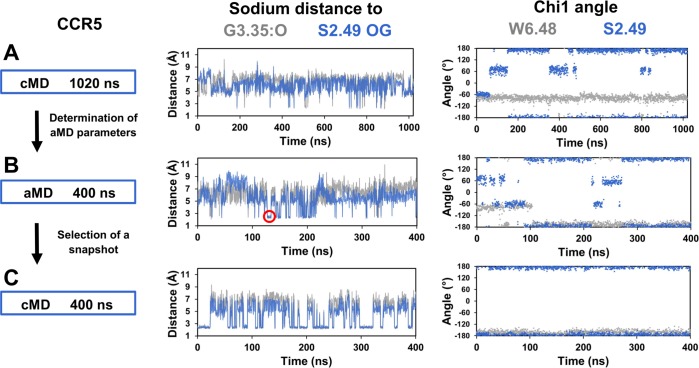
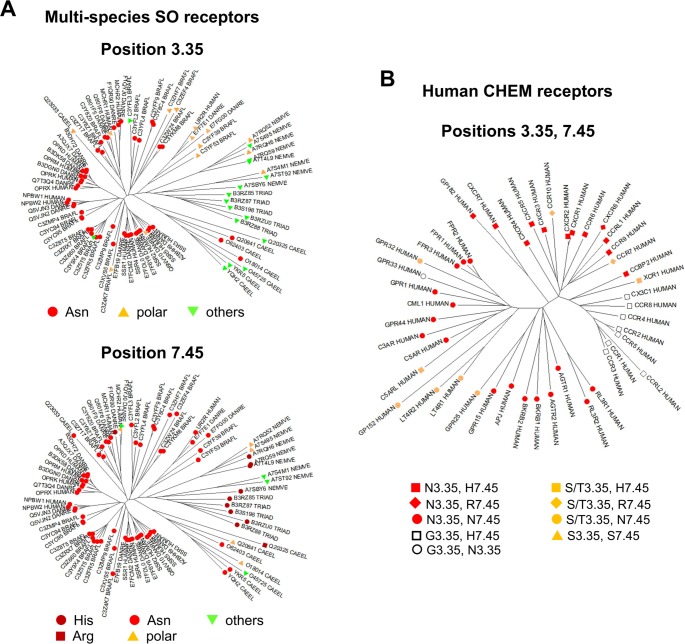
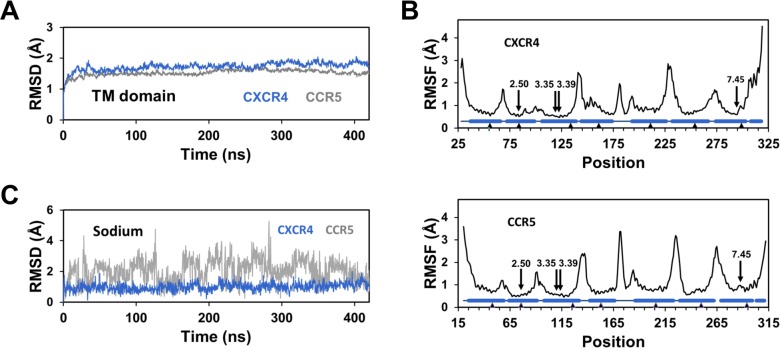
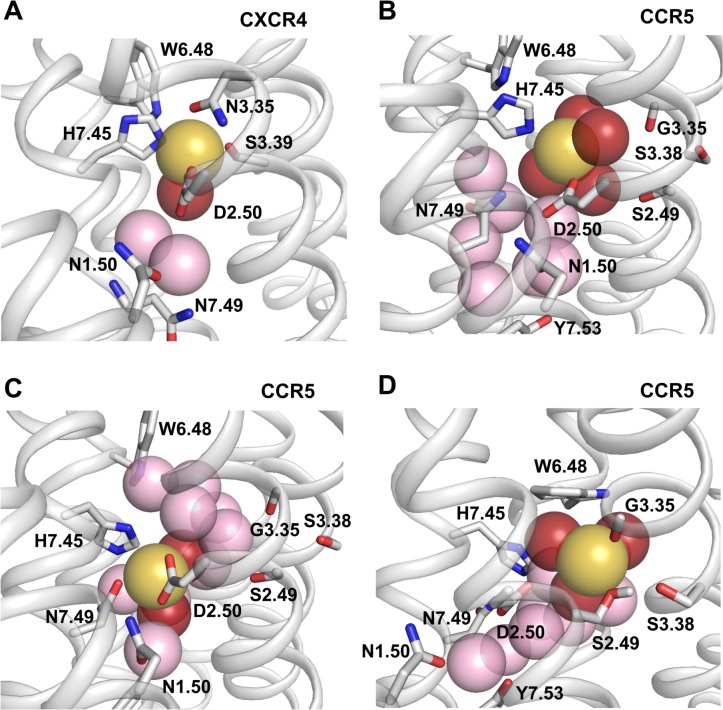
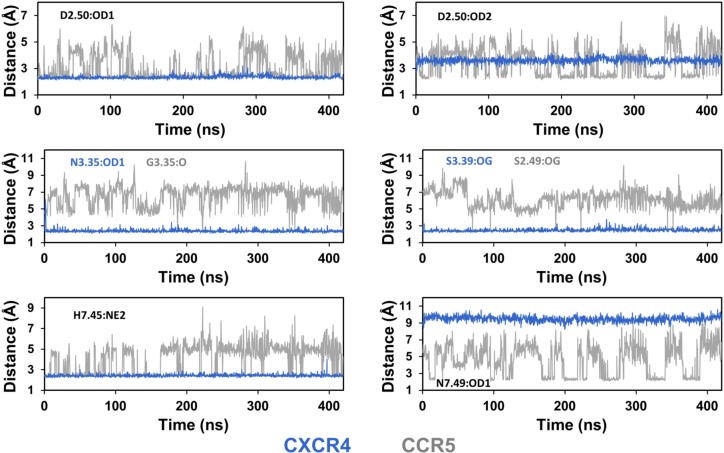
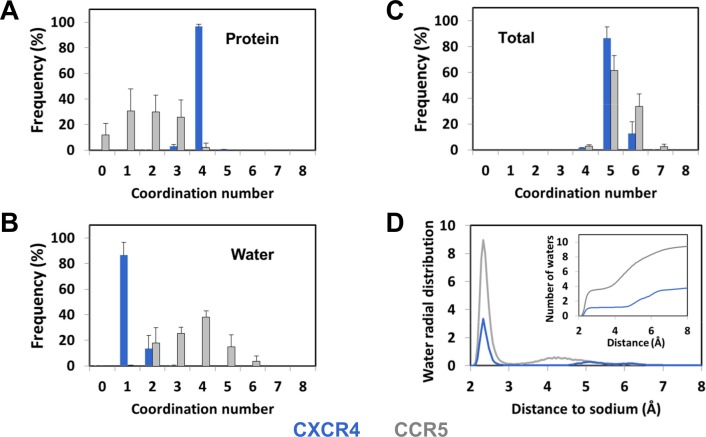
Chemokines and their receptors (members of the GPCR super-family) are involved in a wide variety of physiological processes and diseases; thus, understanding the specificity of the chemokine receptor family could help develop new receptor specific drugs. Here, we explore the evolutionary mechanisms that led to the emergence of the chemokine receptors. Based on GPCR hierarchical classification, we analyzed nested GPCR sets with an eigen decomposition approach of the sequence covariation matrix and determined three key residues whose mutation was crucial for the emergence of the chemokine receptors and their subsequent divergence into homeostatic and inflammatory receptors. These residues are part of the allosteric sodium binding site. Their structural and functional roles were investigated by molecular dynamics simulations of CXCR4 and CCR5 as prototypes of homeostatic and inflammatory chemokine receptors, respectively. This study indicates that the three mutations crucial for the evolution of the chemokine receptors dramatically altered the sodium binding mode. In CXCR4, the sodium ion is tightly bound by four protein atoms and one water molecule. In CCR5, the sodium ion is mobile within the binding pocket and moves between different sites involving from one to three protein atoms and two to five water molecules. Analysis of chemokine receptor evolution reveals that a highly constrained sodium binding site characterized most ancient receptors, and that the constraints were subsequently loosened during the divergence of this receptor family. We discuss the implications of these findings for the evolution of the chemokine receptor functions and mechanisms of action.
趋化因子及其受体(G 蛋白偶联受体超家族的成员)参与多种生理过程和疾病;因此,了解趋化因子受体家族的特异性有助于开发新的受体特异性药物。在这里,我们探讨了导致趋化因子受体出现的进化机制。基于 GPCR 分层分类,我们使用序列协方差矩阵的本征分解方法分析了嵌套的 GPCR 集,并确定了三个关键残基,其突变对于趋化因子受体的出现及其随后向稳态和炎症受体的分化至关重要。这些残基是变构钠离子结合位点的一部分。通过对 CXCR4 和 CCR5 的分子动力学模拟分别作为稳态和炎症趋化因子受体的原型,研究了它们的结构和功能作用。这项研究表明,对于趋化因子受体进化至关重要的三个突变极大地改变了钠离子的结合模式。在 CXCR4 中,钠离子由四个蛋白质原子和一个水分子紧密结合。在 CCR5 中,钠离子在结合口袋内是可移动的,在涉及一个到三个蛋白质原子和两个到五个水分子的不同位置之间移动。对趋化因子受体进化的分析表明,最古老的受体具有高度约束的钠离子结合位点,并且在这个受体家族的分化过程中,这种约束随后被放松。我们讨论了这些发现对趋化因子受体功能和作用机制进化的意义。