Centre of Research in Childhood Health, Institute for Sport Science and Clinical Biomechanics, University of Southern Denmark, Odense, Denmark.
Department of Physiotherapy and Occupational Therapy, University College Copenhagen, Copenhagen, Denmark.
PLoS One. 2018 Jun 18;13(6):e0199281. doi: 10.1371/journal.pone.0199281. eCollection 2018.
The main objective of this study was to investigate the associations between waist circumference, metabolic risk factors, and executive function in adolescents.
The study was cross-sectional and included 558 adolescents (mean age 14.2 years). Anthropometrics and systolic blood pressure (sysBP) were measured and fasting blood samples were analyzed for metabolic risk factors. A metabolic risk factor cluster score (MetS-cluster score) was computed from the sum of standardized sysBP, triglycerides (TG), inverse high-density lipid cholesterol (HDLc) and insulin resistance (homeostasis model assessment). Cognitive control was measured with a modified flanker task.
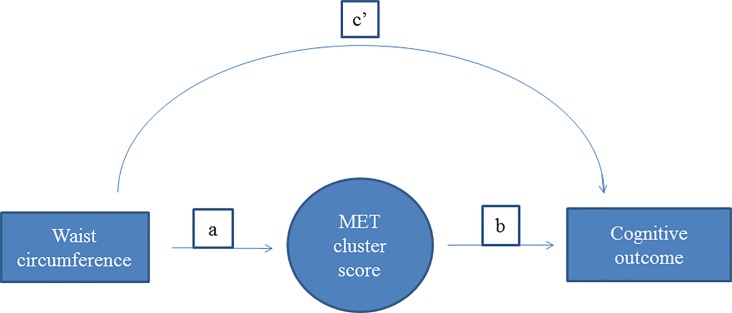
Regression analyses indicated that after controlling for demographic variables, HDLc exhibited a negative and TG a positive association with flanker reaction time (RT). Waist circumference did not demonstrate a statistically significant total association with the cognitive outcomes. In structural equation modeling, waist circumference displayed an indirect positive association with incongruent RT through a higher MetS-cluster score and through lower HDLc. The only statistically significant direct association between waist circumference and the cognitive outcomes was for incongruent RT in the model including HDLc as mediator.
These findings are consonant with the previous literature reporting an adverse association between certain metabolic risk factors and cognitive control. Accordingly, these results suggest specificity between metabolic risk factors and cognitive control outcomes. Further, results of the present study, although cross-sectional, provide new evidence that specific metabolic risk factors may mediate an indirect association between adiposity and cognitive control in adolescents, even though a direct association between these variables was not observed. However, taking the cross-sectional study design into consideration, these results should be interpreted with caution and future longitudinal or experimental studies should verify the findings of this study.
本研究的主要目的是探讨青少年腰围、代谢风险因素与执行功能之间的关系。
本研究为横断面研究,共纳入 558 名青少年(平均年龄 14.2 岁)。测量人体测量学和收缩压(sysBP),并分析空腹血样以评估代谢风险因素。通过标准化 sysBP、甘油三酯(TG)、逆高密度脂蛋白胆固醇(HDLc)和胰岛素抵抗(稳态模型评估)的总和计算代谢风险因素簇评分(MetS 簇评分)。使用改良的侧抑制任务来测量认知控制。
回归分析表明,在校正人口统计学变量后,HDLc 与侧抑制反应时间(RT)呈负相关,TG 呈正相关。腰围与认知结果之间无统计学显著的总关联。在结构方程模型中,腰围通过更高的 MetS 簇评分和更低的 HDLc 与不一致 RT 呈间接正相关。腰围与认知结果之间唯一具有统计学显著直接关联的是在包含 HDLc 作为中介的模型中不一致 RT。
这些发现与先前报告某些代谢风险因素与认知控制之间存在不良关联的文献一致。因此,这些结果表明代谢风险因素与认知控制结果之间存在特异性。此外,尽管本研究为横断面研究,但结果提供了新的证据,表明特定的代谢风险因素可能在青少年肥胖与认知控制之间存在间接关联,尽管这些变量之间没有观察到直接关联。然而,考虑到横断面研究设计,应谨慎解释这些结果,未来的纵向或实验研究应验证本研究的结果。