Department of Biogeography, University of Bayreuth, 95447 Bayreuth, Germany.
Robert Koch Institute, 13353 Berlin, Germany.
Int J Environ Res Public Health. 2018 Jun 15;15(6):1270. doi: 10.3390/ijerph15061270.
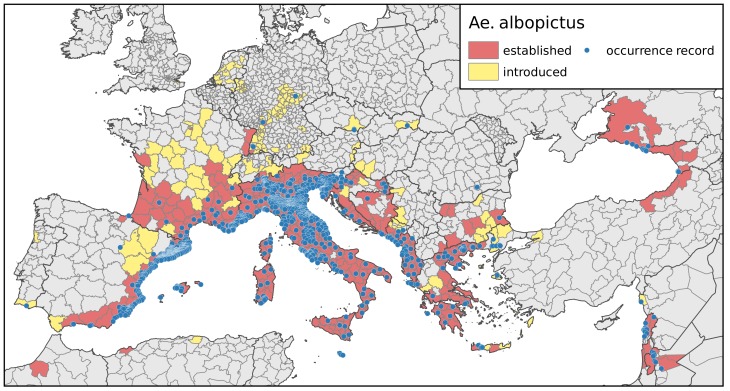
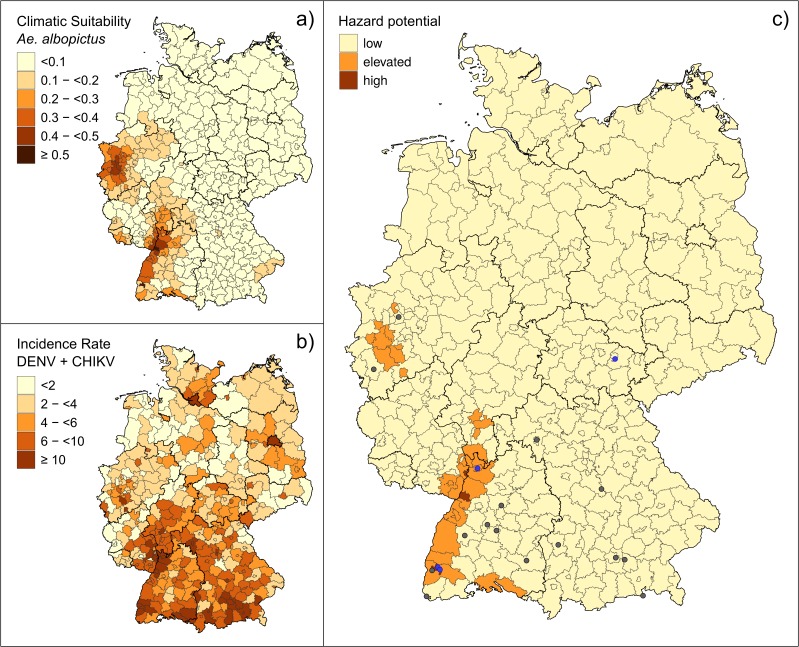
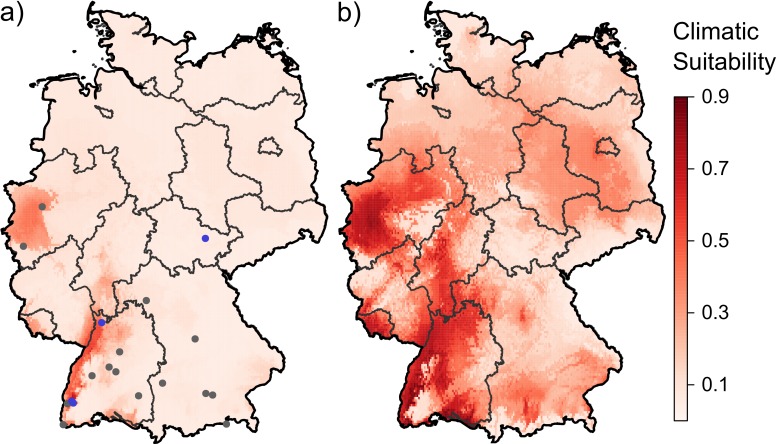
The intensity and extent of transmission of arboviruses such as dengue, chikungunya, and Zika virus have increased markedly over the last decades. Autochthonous transmission of dengue and chikungunya by has been recorded in Southern Europe where the invasive mosquito was already established and viraemic travelers had imported the virus. populations are spreading northward into Germany. Here, we model the current and future climatically suitable regions for establishment in Germany, using climate data of spatially high resolution. To highlight areas where vectors and viraemic travellers are most likely to come into contact, reported dengue and chikungunya incidences are integrated at the county level. German cities with the highest likelihood of autochthonous transmission of -borne arboviruses are currently located in the western parts of the country: Freiburg im Breisgau, Speyer, and Karlsruhe, affecting about 0.5 million people. In addition, 8.8 million people live in regions considered to show elevated hazard potential assuming further spread of the mosquito: Baden-Württemberg (Upper Rhine, Lake Constance regions), southern parts of Hesse, and North Rhine-Westphalia (Lower Rhine). Overall, a more targeted and thus cost-efficient implementation of vector control measures and health surveillance will be supported by the detailed maps provided here.
过去几十年来,登革热、基孔肯雅热和寨卡病毒等虫媒病毒的传播强度和范围显著增加。在已经存在入侵蚊子且病毒血症旅行者输入病毒的南欧,已经记录到登革热和基孔肯雅热的本地传播。 种群正在向北传播到德国。在这里,我们使用空间分辨率较高的气候数据,对德国建立的当前和未来气候适宜地区进行建模。为了突出提示媒介和病毒血症旅行者最有可能接触的区域,我们整合了县级报告的登革热和基孔肯雅热发病率。目前,德国最有可能发生本地传播的城市位于该国西部:弗赖堡、施派尔和卡尔斯鲁厄,影响约 50 万人。此外,还有 880 万人居住在被认为存在蚊媒传播风险的地区:巴登-符腾堡州(莱茵河上游、康斯坦茨湖地区)、黑森州南部和北莱茵-威斯特法伦州(下莱茵)。总体而言,这里提供的详细地图将支持更有针对性且因此更具成本效益的病媒控制措施和健康监测的实施。