• 文献检索
  • 文档翻译
  • 深度研究
  • 学术资讯
  • Suppr Zotero 插件Zotero 插件
  • 邀请有礼
  • 套餐&价格
  • 历史记录
应用&插件
Suppr Zotero 插件Zotero 插件浏览器插件Mac 客户端Windows 客户端微信小程序
定价
高级版会员购买积分包购买API积分包
服务
文献检索文档翻译深度研究API 文档MCP 服务
关于我们
关于 Suppr公司介绍联系我们用户协议隐私条款
关注我们

Suppr 超能文献

核心技术专利:CN118964589B侵权必究
粤ICP备2023148730 号-1Suppr @ 2026

文献检索

告别复杂PubMed语法,用中文像聊天一样搜索,搜遍4000万医学文献。AI智能推荐,让科研检索更轻松。

立即免费搜索

文件翻译

保留排版,准确专业,支持PDF/Word/PPT等文件格式,支持 12+语言互译。

免费翻译文档

深度研究

AI帮你快速写综述,25分钟生成高质量综述,智能提取关键信息,辅助科研写作。

立即免费体验

建立模型预测 21 世纪全球气候变化对基孔肯雅热传播的影响。

Modelling the effects of global climate change on Chikungunya transmission in the 21 century.

机构信息

Department of Biogeography, University of Bayreuth, Bayreuth, Germany.

European Centre for Disease Prevention and Control (ECDC), Stockholm, Sweden.

出版信息

Sci Rep. 2017 Jun 19;7(1):3813. doi: 10.1038/s41598-017-03566-3.

DOI:10.1038/s41598-017-03566-3
PMID:28630444
原文链接:https://pmc.ncbi.nlm.nih.gov/articles/PMC5476675/
Abstract

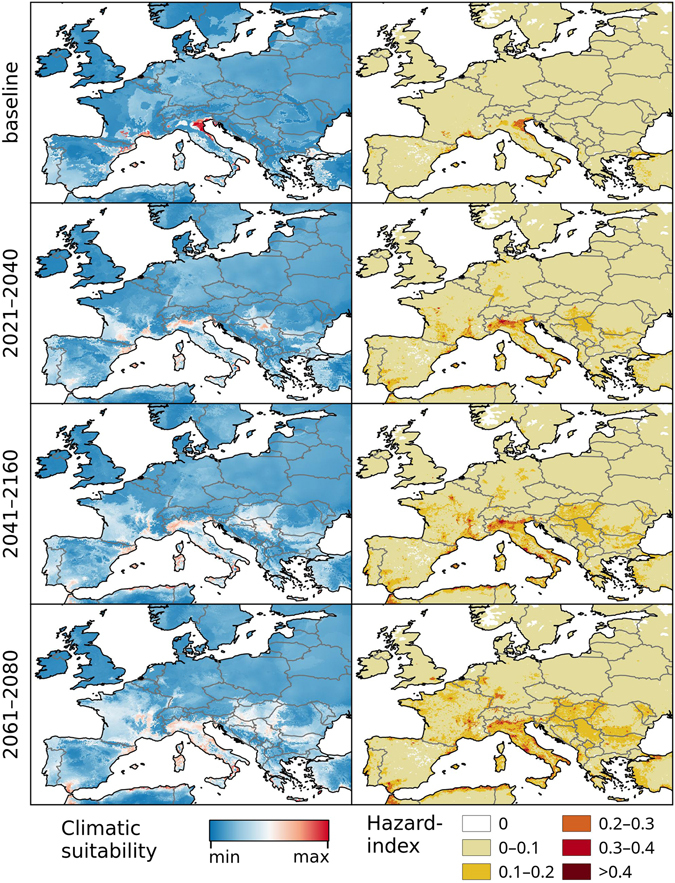
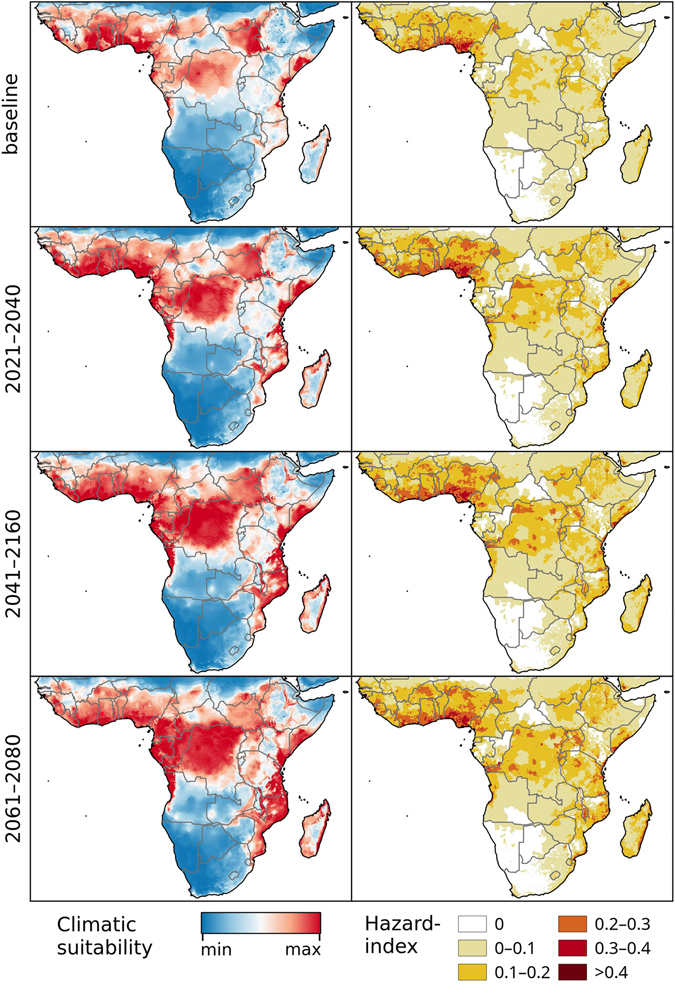
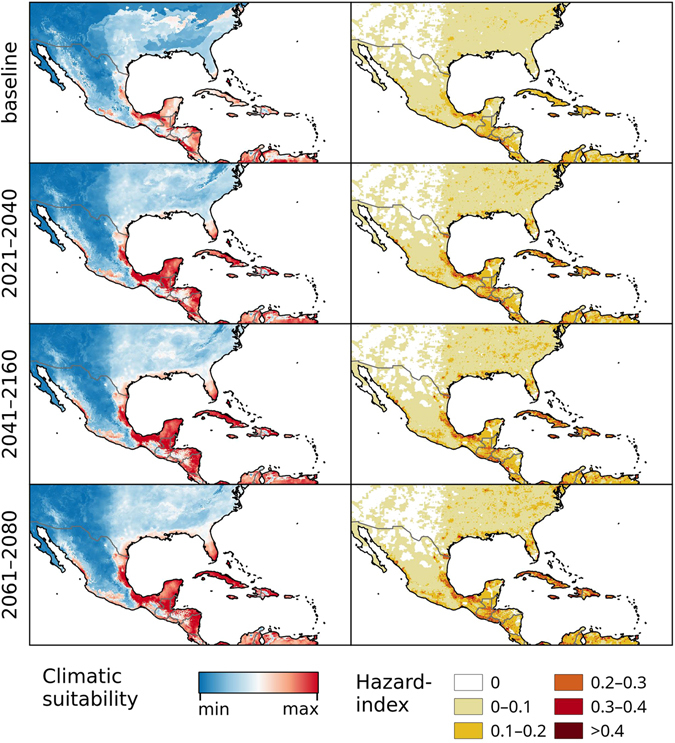
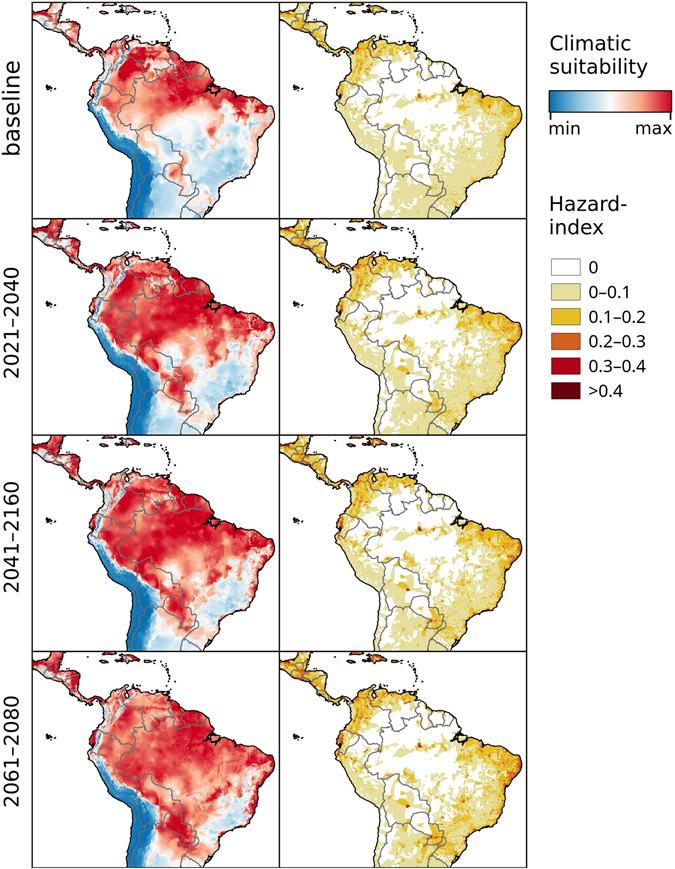
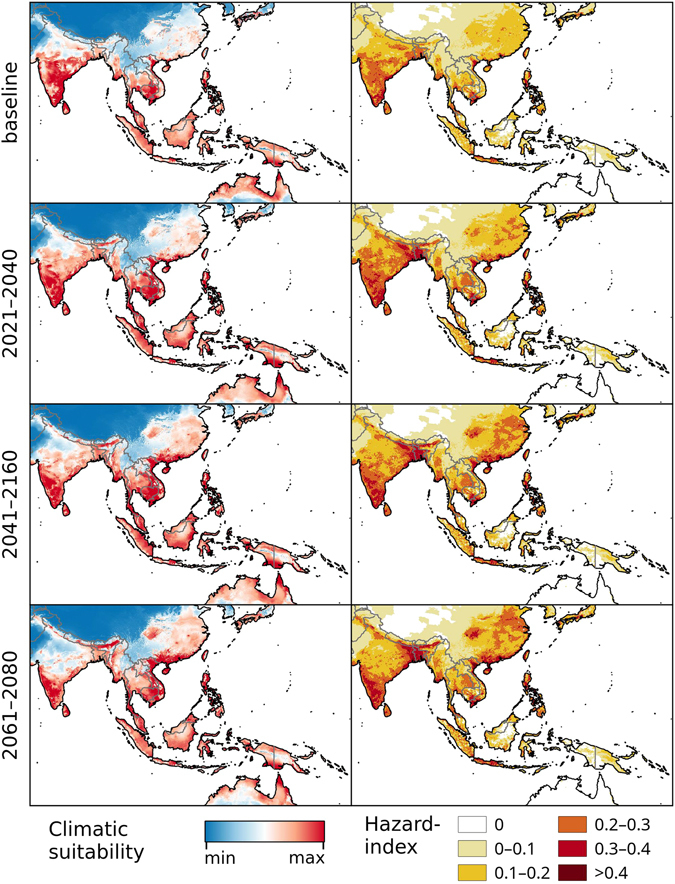
The arrival and rapid spread of the mosquito-borne viral disease Chikungunya across the Americas is one of the most significant public health developments of recent years, preceding and mirroring the subsequent spread of Zika. Globalization in trade and travel can lead to the importation of these viruses, but climatic conditions strongly affect the efficiency of transmission in local settings. In order to direct preparedness for future outbreaks, it is necessary to anticipate global regions that could become suitable for Chikungunya transmission. Here, we present global correlative niche models for autochthonous Chikungunya transmission. These models were used as the basis for projections under the representative concentration pathway (RCP) 4.5 and 8.5 climate change scenarios. In a further step, hazard maps, which account for population densities, were produced. The baseline models successfully delineate current areas of active Chikungunya transmission. Projections under the RCP 4.5 and 8.5 scenarios suggest the likelihood of expansion of transmission-suitable areas in many parts of the world, including China, sub-Saharan Africa, South America, the United States and continental Europe. The models presented here can be used to inform public health preparedness planning in a highly interconnected world.

摘要

基孔肯雅热是一种由蚊子传播的病毒性疾病,近年来在美洲的迅速传播是最重要的公共卫生事件之一,它先于寨卡病毒的传播,并与之相呼应。贸易和旅行的全球化可能导致这些病毒的输入,但气候条件强烈影响当地传播的效率。为了指导未来疫情的防范工作,有必要预测可能适合基孔肯雅热传播的全球区域。在这里,我们提出了基孔肯雅热本地传播的全球关联生态位模型。这些模型被用作代表浓度途径(RCP)4.5 和 8.5 气候变化情景下的预测基础。在进一步的步骤中,制作了考虑人口密度的危险图。基线模型成功划定了当前基孔肯雅热传播的活跃地区。RCP 4.5 和 8.5 情景下的预测表明,包括中国、撒哈拉以南非洲、南美洲、美国和欧洲大陆在内的世界许多地区传播适宜地区扩大的可能性。这里提出的模型可用于在高度互联的世界中为公共卫生防范规划提供信息。
https://cdn.ncbi.nlm.nih.gov/pmc/blobs/1582/5476675/ee0896beaac2/41598_2017_3566_Fig5_HTML.jpg
https://cdn.ncbi.nlm.nih.gov/pmc/blobs/1582/5476675/6dda8a46f4d2/41598_2017_3566_Fig1_HTML.jpg
https://cdn.ncbi.nlm.nih.gov/pmc/blobs/1582/5476675/4f0247731c61/41598_2017_3566_Fig2_HTML.jpg
https://cdn.ncbi.nlm.nih.gov/pmc/blobs/1582/5476675/b3460e813324/41598_2017_3566_Fig3_HTML.jpg
https://cdn.ncbi.nlm.nih.gov/pmc/blobs/1582/5476675/27256c551f50/41598_2017_3566_Fig4_HTML.jpg
https://cdn.ncbi.nlm.nih.gov/pmc/blobs/1582/5476675/ee0896beaac2/41598_2017_3566_Fig5_HTML.jpg
https://cdn.ncbi.nlm.nih.gov/pmc/blobs/1582/5476675/6dda8a46f4d2/41598_2017_3566_Fig1_HTML.jpg
https://cdn.ncbi.nlm.nih.gov/pmc/blobs/1582/5476675/4f0247731c61/41598_2017_3566_Fig2_HTML.jpg
https://cdn.ncbi.nlm.nih.gov/pmc/blobs/1582/5476675/b3460e813324/41598_2017_3566_Fig3_HTML.jpg
https://cdn.ncbi.nlm.nih.gov/pmc/blobs/1582/5476675/27256c551f50/41598_2017_3566_Fig4_HTML.jpg
https://cdn.ncbi.nlm.nih.gov/pmc/blobs/1582/5476675/ee0896beaac2/41598_2017_3566_Fig5_HTML.jpg

相似文献

1
Modelling the effects of global climate change on Chikungunya transmission in the 21 century.建立模型预测 21 世纪全球气候变化对基孔肯雅热传播的影响。
Sci Rep. 2017 Jun 19;7(1):3813. doi: 10.1038/s41598-017-03566-3.
2
Climate change effects on Chikungunya transmission in Europe: geospatial analysis of vector's climatic suitability and virus' temperature requirements.气候变化对欧洲基孔肯雅热传播的影响:病媒气候适宜性和病毒温度要求的地理空间分析。
Int J Health Geogr. 2013 Nov 12;12:51. doi: 10.1186/1476-072X-12-51.
3
Zika and Chikungunya in Europe 2100 - A GIS based model for risk estimation.2100 年欧洲的 Zika 和基孔肯雅热——基于 GIS 的风险估计模型。
Travel Med Infect Dis. 2024 Jul-Aug;60:102737. doi: 10.1016/j.tmaid.2024.102737. Epub 2024 Jul 10.
4
Chikungunya, climate change, and human rights.基孔肯雅热、气候变化与人权
Health Hum Rights. 2014 Jun 14;16(1):105-12.
5
Dengue and chikungunya: long-distance spread and outbreaks in naïve areas.登革热和基孔肯雅热:在未受感染地区的远距离传播和暴发
Pathog Glob Health. 2014 Dec;108(8):349-55. doi: 10.1179/2047773214Y.0000000163. Epub 2014 Dec 9.
6
Challenges with Mosquito-borne Viral Diseases: Outbreak of the Monsters.蚊媒病毒病的挑战:“怪物”的爆发
Curr Top Med Chem. 2017;17(19):2199-2214. doi: 10.2174/1568026617666170130122921.
7
Seasonal temperature variation influences climate suitability for dengue, chikungunya, and Zika transmission.季节性温度变化影响登革热、基孔肯雅热和寨卡病毒传播的气候适宜性。
PLoS Negl Trop Dis. 2018 May 10;12(5):e0006451. doi: 10.1371/journal.pntd.0006451. eCollection 2018 May.
8
Forecasting the Spread of Mosquito-Borne Disease using Publicly Accessible Data: A Case Study in Chikungunya.利用公开数据预测蚊媒疾病的传播:以基孔肯雅热为例的案例研究
AMIA Annu Symp Proc. 2017 Feb 10;2016:431-440. eCollection 2016.
9
Notes from the field: Transmission of chikungunya virus in the continental United States--Florida, 2014.实地记录:2014年基孔肯雅病毒在美国本土佛罗里达州的传播情况
MMWR Morb Mortal Wkly Rep. 2014 Dec 5;63(48):1137.
10
A comparative analysis of Chikungunya and Zika transmission.基孔肯雅热与寨卡病毒传播的比较分析
Epidemics. 2017 Jun;19:43-52. doi: 10.1016/j.epidem.2017.01.001. Epub 2017 Jan 18.

引用本文的文献

1
Chikungunya in a pediatric cohort: Asymptomatic infection, seroconversion, and chronicity rates.儿科队列中的基孔肯雅热:无症状感染、血清转化及慢性化率
PLoS Negl Trop Dis. 2025 Jul 16;19(7):e0013254. doi: 10.1371/journal.pntd.0013254. eCollection 2025 Jul.
2
Assessing chikungunya's economic burden and impact on health-related quality of life: Two systematic literature reviews.评估基孔肯雅热的经济负担及其对健康相关生活质量的影响:两项系统文献综述。
PLoS Negl Trop Dis. 2025 May 5;19(5):e0012990. doi: 10.1371/journal.pntd.0012990. eCollection 2025 May.
3
CHIKV mRNA vaccines encoding conserved structural/envelope proteins confer broad cross-lineage protection against infection.

本文引用的文献

1
[Current and future ecological niche of Leishmaniasis (Kinetoplastida: Trypanosomatidae) in the Neotropical region].[利什曼病(动质体目:锥虫科)在新热带区的当前及未来生态位]
Rev Biol Trop. 2016 Sep;64(3):1237-45.
2
Detecting the impact of temperature on transmission of Zika, dengue, and chikungunya using mechanistic models.使用机理模型检测温度对寨卡病毒、登革热病毒和基孔肯雅病毒传播的影响。
PLoS Negl Trop Dis. 2017 Apr 27;11(4):e0005568. doi: 10.1371/journal.pntd.0005568. eCollection 2017 Apr.
3
Mapping the global geographic potential of Zika virus spread.
编码保守结构/包膜蛋白的基孔肯雅病毒信使核糖核酸疫苗可提供广泛的跨谱系感染防护。
Signal Transduct Target Ther. 2025 Mar 28;10(1):98. doi: 10.1038/s41392-025-02182-2.
4
Chikungunya fever in hospitalized children and adolescents: clinical and epidemiological aspects in a region of northeastern Brazil.巴西东北部某地区住院儿童和青少年的基孔肯雅热:临床和流行病学特征
J Pediatr (Rio J). 2025 May-Jun;101(3):466-472. doi: 10.1016/j.jped.2025.01.010. Epub 2025 Mar 13.
5
Generation of RNA aptamers against chikungunya virus E2 envelope protein.针对基孔肯雅病毒E2包膜蛋白的RNA适配体的生成。
J Virol. 2025 Mar 18;99(3):e0209524. doi: 10.1128/jvi.02095-24. Epub 2025 Feb 10.
6
Introduction of Vector-Borne Infections in Europe: Emerging and Re-Emerging Viral Pathogens with Potential Impact on One Health.欧洲媒介传播感染概述:对“同一健康”具有潜在影响的新出现和再次出现的病毒病原体
Pathogens. 2025 Jan 12;14(1):63. doi: 10.3390/pathogens14010063.
7
Multiorgan proteomic analysis of infected animal models predict potential host factors for chikungunya virus.感染动物模型的多器官蛋白质组学分析预测基孔肯雅病毒的潜在宿主因素。
MedComm (2020). 2025 Jan 3;6(1):e70013. doi: 10.1002/mco2.70013. eCollection 2025 Jan.
8
The global health and economic burden of chikungunya from 2011 to 2020: a model-driven analysis on the impact of an emerging vector-borne disease.2011年至2020年基孔肯雅热的全球健康和经济负担:对一种新兴媒介传播疾病影响的模型驱动分析
BMJ Glob Health. 2024 Dec 3;9(12):e016648. doi: 10.1136/bmjgh-2024-016648.
9
Health Co-Benefits of Environmental Changes in the Context of Carbon Peaking and Carbon Neutrality in China.中国碳达峰碳中和背景下环境变化带来的健康协同效益
Health Data Sci. 2024 Oct 2;4:0188. doi: 10.34133/hds.0188. eCollection 2024.
10
The evolutionary and molecular history of a chikungunya virus outbreak lineage.基孔肯雅热病毒爆发谱系的进化和分子历史。
PLoS Negl Trop Dis. 2024 Jul 26;18(7):e0012349. doi: 10.1371/journal.pntd.0012349. eCollection 2024 Jul.
绘制寨卡病毒传播的全球地理潜在范围。
Mem Inst Oswaldo Cruz. 2016 Sep;111(9):559-60. doi: 10.1590/0074-02760160149.
4
Geographic potential of disease caused by Ebola and Marburg viruses in Africa.埃博拉病毒和马尔堡病毒在非洲引发疾病的地理潜在因素。
Acta Trop. 2016 Oct;162:114-124. doi: 10.1016/j.actatropica.2016.06.012. Epub 2016 Jun 14.
5
Global distribution and environmental suitability for chikungunya virus, 1952 to 2015.1952年至2015年基孔肯雅病毒的全球分布及环境适宜性
Euro Surveill. 2016 May 19;21(20). doi: 10.2807/1560-7917.ES.2016.21.20.30234.
6
Determinants and Drivers of Infectious Disease Threat Events in Europe.欧洲传染病威胁事件的决定因素和驱动因素
Emerg Infect Dis. 2016 Apr;22(4):581-9. doi: 10.3201/eid2204.
7
The global distribution of the arbovirus vectors Aedes aegypti and Ae. albopictus.虫媒病毒载体埃及伊蚊和白纹伊蚊的全球分布。
Elife. 2015 Jun 30;4:e08347. doi: 10.7554/eLife.08347.
8
Autochthonous Chikungunya Transmission and Extreme Climate Events in Southern France.法国南部的本地基孔肯雅热传播与极端气候事件
PLoS Negl Trop Dis. 2015 Jun 16;9(6):e0003854. doi: 10.1371/journal.pntd.0003854. eCollection 2015 Jun.
9
Reappearance of chikungunya, formerly called dengue, in the Americas.基孔肯雅热(曾被称为登革热)在美洲再度出现。
Emerg Infect Dis. 2015 Apr;21(4):557-61. doi: 10.3201/eid2104.141723.
10
Climate change influences on global distributions of dengue and chikungunya virus vectors.气候变化对登革热和基孔肯雅病毒媒介全球分布的影响。
Philos Trans R Soc Lond B Biol Sci. 2015 Apr 5;370(1665). doi: 10.1098/rstb.2014.0135.